Alderney Iron Age Echoes

Download PDF creates a visual, rasterized copy. Use Print for selectable text and better assistive-technology support.

Bericht wird vorbereitet

Verfügbare Informationen und Referenzen werden geladen

Verbindung mit dem archäologischen Quellenbestand...

Alte Quellen werden zusammengestellt

Zum Hauptinhalt springen
Alderney Iron Age Echoes
Zivilisations-Spotlight

Alderney Iron Age Echoes

Two ancient voices from Longis Common illuminate Channel Islands life at the edge of Iron Age Britain

337 CE - 45 BCE
Channel Islands (Alderney), United Kingdom
Scrollen zum Start
Kapitel I

Die Geschichte

Die Alderney Iron Age Echoes-Kultur verstehen

Archaeological finds at Longis Common, Alderney (337–45 BCE) reveal coastal Iron Age lifeways. Two ancient genomes show identical maternal lineages (mtDNA H61), offering a tantalizing, preliminary genetic glimpse that must be read alongside sparse archaeological evidence.

Time Period

337–45 BCE

Region

Channel Islands (Alderney), United Kingdom

Common Y-DNA

Unknown (no Y-DNA reported)

Common mtDNA

H61 (2 samples)

Kapitel II

Zeitleiste

Zentrale Momente in der Geschichte dieser Kultur

200 BCE

Longis Common occupation (radiocarbon window)

Human remains and material culture at Longis Common date to the late Iron Age (c. 337–45 BCE), reflecting coastal settlement and cross‑Channel contacts.

Kapitel III

Origins & Emergence

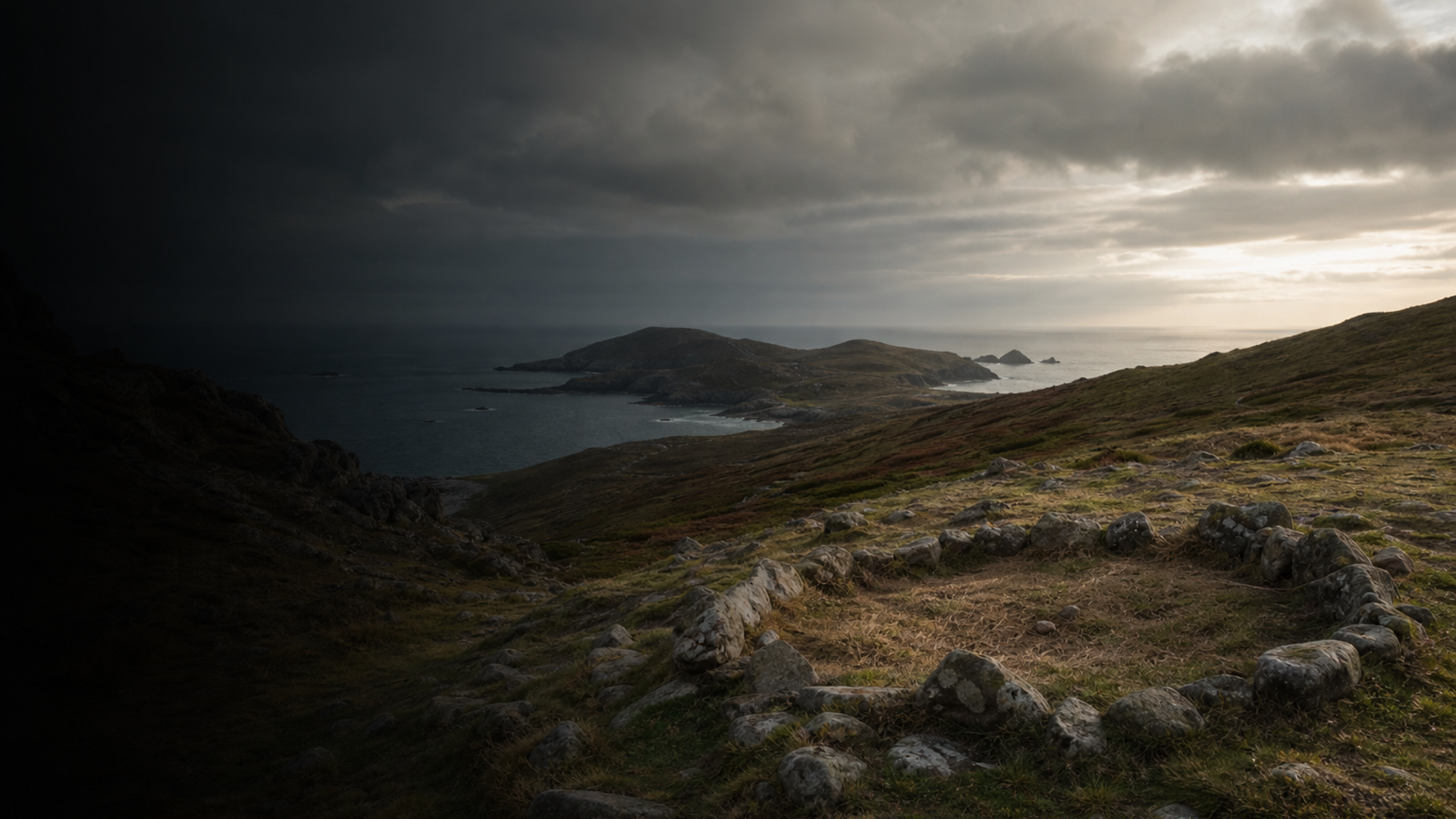
The Longis Common occupation on Alderney sits at a liminal seascape — a small island outpost where maritime routes and Atlantic winds shaped human choice. Archaeological data indicates activity dated between 337 and 45 BCE, placing these finds firmly within the Iron Age Channel Islands horizon. Excavations at Longis Common have recovered structural traces, pottery sherds, and worked bone consistent with coastal Hillfort and promontory traditions found elsewhere in the Channel Islands and Brittany.

Limited evidence suggests the community maintained a mixed economy of fishing, shellfish gathering, and small-scale cultivation adapted to thin soils. The material culture shows affinities with Iron Age southern Britain and northern Gaul, reflecting persistent cross-channel connections before and during the late pre-Roman century. Geologically visible shorelines and tidal causeways would have framed seasonal mobility and maritime exchange.

While the archaeological footprint at Longis Common provides the spatial and material context, the addition of ancient DNA from human remains adds a new dimension to origin stories: it allows us to test hypotheses about local continuity versus mobility, and about the degree to which island communities mirrored mainland genetic patterns. Given the small dataset, any reconstruction of origins remains provisional and invites further fieldwork and sampling.

  • Site: Longis Common, Alderney (Channel Islands)
  • Date range from recovered material: 337–45 BCE
  • Evidence points to coastal Iron Age lifeways with cross‑Channel ties
Kapitel IV

Daily Life & Society

Life on Alderney in the late Iron Age would have been sculpted by the sea: boats, nets and salt were as decisive as plough and herd. Archaeological indicators from Longis Common — hearths, fragmented pottery, and carved bone tools — suggest households organized around combined marine and terrestrial resources. Faunal remains hint at diets rich in fish and shellfish, supplemented by sheep, cattle, and small grain cultivation where soils permitted.

Settlement layout at Longis Common likely balanced defensive needs and access to foraging territories; natural promontories and ridgelines provided vantage points for both watching the horizon and structuring community space. Craft activities, including textile production and bone-working, would have supported both local needs and traded commodities. Material parallels with sites in Guernsey, Jersey, and the nearby Normandy coast point to regular movement of goods, ideas and people across the Channel.

Socially, these island communities were small and tightly connected; kin networks, maritime knowledge, and seasonal rhythms framed social identity. Burial evidence on the islands is patchy, making household and communal practices difficult to reconstruct; archaeologists therefore interpret daily life through artifact assemblages and environmental proxies.

  • Mixed marine and pastoral economy
  • Crafts and small‑scale exchange linked to mainland coasts
Kapitel V

Genetic Profile

Two human samples from Longis Common yield identical mitochondrial haplogroup assignments: H61. Both genomes come from the window 337–45 BCE and provide a very limited but revealing maternal snapshot. mtDNA H subclades are widespread across Europe in the Iron Age and later periods, so the presence of H61 aligns with broad continental patterns rather than proving a unique island origin.

No Y‑chromosome haplogroup is reported for these samples; without paternal markers we lack a full picture of sex‑specific mobility or patrilineal continuity. Importantly, the sample count is only two: this is an extremely small dataset, and conclusions must be framed as provisional. Limited evidence suggests possible maternal continuity with wider Iron Age Britain and continental neighbors, but this could reflect common regional ancestry rather than direct local continuity.

When compared to larger Iron Age datasets from southern Britain and northern Gaul — where R1b is frequently observed on the Y-chromosome and diverse mtDNA lineages occur — the Longis Common mtDNA fits within expected variation but cannot alone resolve questions of migration, exchange, or population structure. Future sampling and genomic sequencing (including autosomal data) are essential to test hypotheses about island endogamy, maritime connectivity, and demographic change during the late pre‑Roman centuries.

  • Both samples: mtDNA H61 (identical maternal signal)
  • No Y-DNA reported; sample size (n=2) makes conclusions preliminary
Kapitel VI

Legacy & Modern Connections

The genetic and archaeological echoes from Longis Common resonate into present-day questions about Channel Islands identity. Maternal lineages like H61 link these ancient islanders to broad patterns of European maternal ancestry, but they do not by themselves demonstrate direct descent to modern Channel Islanders. Archaeological continuity in settlement features and material styles suggests long-term cross‑Channel interaction, and autosomal ancient DNA in broader British and French Iron Age samples indicates substantial regional genetic continuity alongside episodes of mobility.

For communities and museum audiences, the Longis Common finds offer a cinematic image: small island communities shaped by tides and trade, carrying mitochondrial stories that match continental rhythms. Yet scientifically we must be cautious: with only two genomes, any bridge from ancient individuals to modern populations is tentative. The true legacy of ChannelIslands_IA will become clearer as more targeted excavations and genetic sampling fill the archival silence of these windswept shores.

  • mtDNA links mirror broad European maternal ancestry
  • Direct modern continuity remains unproven without larger datasets
KI-gestützt

KI-Assistent

Stellen Sie Fragen zur Alderney Iron Age Echoes-Kultur

KI-Assistent von DNAGENICS

Funktion freischalten
Stellen Sie Fragen zur Kultur Alderney Iron Age Echoes. Unser KI-Assistent kann genetische Befunde, historischen Kontext, archäologische Belege und moderne Verbindungen erläutern.

Beispiel einer KI-Analyse

Die Alderney Iron Age Echoes-Kultur ist ein faszinierendes Kapitel der Menschheitsgeschichte...

Genetische Analysen zeigen Übereinstimmungen mit früheren Populationen und Hinweise auf besondere Anpassungen und kulturelle Innovationen. Alte DNA-Proben liefern Einblicke in Migrationsmuster, soziale Strukturen und genetische Verbindungen zwischen Populationen.

Dies ist eine Vorschau der KI-Analyse. Schalten Sie den vollständigen KI-Assistenten frei, um detaillierte Einblicke zu erkunden:

  • Genetische Zusammensetzung und genetische Ähnlichkeit
  • Migrationsmuster und Ursprünge
  • Alltag und kulturelle Praktiken
  • Genetischer Bezug zu heutigen Populationen

Weitere antike Kulturen erkunden

Geschichten von Zivilisationen aus der antiken Welt entdecken

Use code for 30% off • Expires Nov 08




