Ansarve Megalithic People

Download PDF creates a visual, rasterized copy. Use Print for selectable text and better assistive-technology support.

Bericht wird vorbereitet

Verfügbare Informationen und Referenzen werden geladen

Verbindung mit dem archäologischen Quellenbestand...

Alte Quellen werden zusammengestellt

Zum Hauptinhalt springen
Ansarve Megalithic People
Zivilisations-Spotlight

Ansarve Megalithic People

Stone chambers on Gotland and the fragile genetic traces of a maritime Neolithic world

3525 CE - 2631 BCE
Ansarve, Gotland, Sweden
Scrollen zum Start
Kapitel I

Die Geschichte

Die Ansarve Megalithic People-Kultur verstehen

Archaeological and ancient-DNA evidence from Ansarve (3525–2631 BCE) reveals a small, locally rooted megalithic community on Gotland. Limited samples suggest paternal continuity (haplogroup I) alongside diverse maternal lineages linked to Neolithic networks. Conclusions remain preliminary.

Time Period

3525–2631 BCE

Region

Ansarve, Gotland, Sweden

Common Y-DNA

I (4/6 samples)

Common mtDNA

J (2), HV (1), H7d (1), T (1), K (1)

Kapitel II

Zeitleiste

Zentrale Momente in der Geschichte dieser Kultur

3525 BCE

Earliest dated burial at Ansarve

Radiocarbon dates mark the earliest sampled burial at Ansarve around 3525 BCE, initiating centuries of megalith use.

Kapitel III

Origins & Emergence

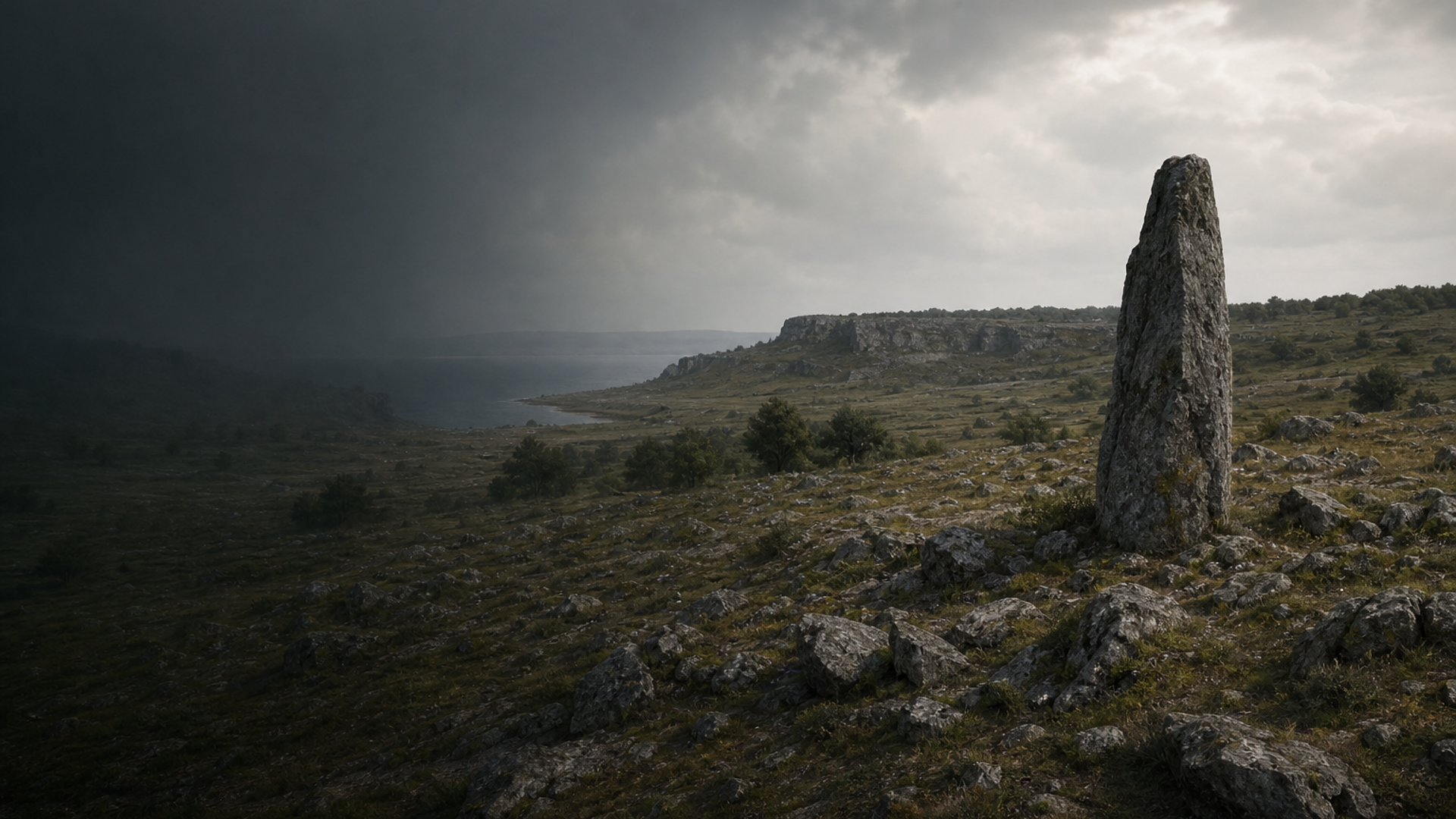
The Ansarve megalithic site, set in the windswept coastlines of Gotland, belongs to a broader north Baltic tradition of stone-built tombs and communal burial architecture. Radiocarbon-calibrated material associated with human remains falls between 3525 and 2631 BCE, placing Ansarve in the late Neolithic, a period of intensified maritime contact and monument building across northern Europe. Archaeological data indicates careful construction of stone chambers and repeated use of burial space, suggesting a community that invested both labor and memory in fixed monuments.

Cinematic images of boats and long-stone shadows meet the archaeological reality: small, mobile farmsteads exploiting sea and land, punctuated by communal rites at megaliths. Material traces at Ansarve — the stones themselves, traces of weathered bone, and scattered artefacts — hint at regional ties to Gotlandic and Baltic networks, but preservation is uneven. Limited evidence suggests cultural continuity with earlier coastal foragers as well as adoption of Neolithic practices. Given the small sample set (six genomes), any reconstruction of population origins must remain cautious: Ansarve appears to be a local expression within a patchwork of Neolithic and Mesolithic traditions rather than the product of a single migrating people.

  • Located at Ansarve on Gotland; dated 3525–2631 BCE
  • Part of Baltic megalithic building traditions and coastal networks
  • Evidence points to long-term local use of stone chamber tombs
Kapitel IV

Daily Life & Society

Life around the Ansarve tomb was shaped by the interplay of sea and field. Archaeological inference from Gotlandic Neolithic contexts suggests mixed economies: small-scale cereal cultivation and animal husbandry combined with fishing, seal hunting, and foraging. The megalith served as a social anchor — a place where burial practices, memory, and social identity were enacted and visible on the landscape.

Social structure at Ansarve was likely kin-centered, with communal burial reflecting lineage or household ties rather than individualized elite display. Craft activities — pottery, flint-knapping, bone working — would have been woven into household life and seasonal mobility. Ritual deposition in the chamber and repeated use over centuries indicate differential treatment of the dead and possibly inherited rights to tomb use. However, direct evidence for diet, house plans, or craft assemblages specific to Ansarve is limited; many reconstructions rely on comparative data from contemporaneous Gotlandic and Baltic sites.

  • Economy likely mixed: small-scale farming plus marine resources
  • Megaliths functioned as communal centers for burial and identity
Kapitel V

Genetic Profile

Six ancient genomes from Ansarve provide a slender but revealing window into population history. Four of the six male individuals carry Y-chromosome haplogroup I, a lineage commonly observed in Mesolithic and later Scandinavian contexts; this pattern is consistent with substantial local male continuity on Gotland during the late Neolithic. Maternal lineages are more diverse: two individuals with mtDNA J, and one each of HV, H7d, T, and K. These mitochondrial haplogroups include lineages that appear in Neolithic farmer-associated contexts (for example haplogroups J and K) as well as broader European distributions.

Taken together, the genetic picture suggests a community shaped by local paternal continuity and more mixed maternal ancestry, consistent with regional admixture between incoming Neolithic farmer-related groups and resident hunter‑gatherers. Important caveats apply: the sample count is small (n=6), so patterns could change with additional data. Archaeogenetic comparisons to other Baltic and Scandinavian datasets hint at connections across maritime networks, but specific admixture proportions and mobility patterns remain unresolved. Consequently, interpretations remain provisional and should be seen as hypotheses to test with further sampling.

  • Y-DNA dominated by haplogroup I (4/6) — suggests local paternal continuity
  • mtDNA shows diverse maternal input (J, HV, H7d, T, K); implies admixture
Kapitel VI

Legacy & Modern Connections

The stone chambers of Ansarve continue to shape how modern inhabitants of Gotland read their past: monuments anchor stories of ancestry and place. Genetically, haplogroup I endures in modern Scandinavia at appreciable frequencies, hinting at threads of continuity over millennia, while mitochondrial diversity reflects long-term interactions between incoming and local groups. Ancient DNA from Ansarve contributes a piece to a larger puzzle: the mosaic of northern European ancestry created by waves of migration, local survival, and maritime exchange.

Because the dataset is small, claims about direct descent to specific modern populations should be cautious. Instead, Ansarve’s greatest contribution is its power to illuminate processes — continuity, contact, and memory — that shaped the Neolithic and left enduring archaeological landscapes across the Baltic.

  • Haplogroup I continuity resonates with later Scandinavian paternal lineages
  • Megalithic monuments remain focal points of cultural memory on Gotland
KI-gestützt

KI-Assistent

Stellen Sie Fragen zur Ansarve Megalithic People-Kultur

KI-Assistent von DNAGENICS

Funktion freischalten
Stellen Sie Fragen zur Kultur Ansarve Megalithic People. Unser KI-Assistent kann genetische Befunde, historischen Kontext, archäologische Belege und moderne Verbindungen erläutern.
Beispiel einer KI-Analyse

Die Ansarve Megalithic People-Kultur ist ein faszinierendes Kapitel der Menschheitsgeschichte...

Genetische Analysen zeigen Übereinstimmungen mit früheren Populationen und Hinweise auf besondere Anpassungen und kulturelle Innovationen. Alte DNA-Proben liefern Einblicke in Migrationsmuster, soziale Strukturen und genetische Verbindungen zwischen Populationen.

Dies ist eine Vorschau der KI-Analyse. Schalten Sie den vollständigen KI-Assistenten frei, um detaillierte Einblicke zu erkunden:
  • Genetische Zusammensetzung und genetische Ähnlichkeit
  • Migrationsmuster und Ursprünge
  • Alltag und kulturelle Praktiken
  • Genetischer Bezug zu heutigen Populationen

Weitere antike Kulturen erkunden

Geschichten von Zivilisationen aus der antiken Welt entdecken

Use code for 30% off • Expires Nov 08





