Banda Cave, Guangxi — Northern & Southern

Download PDF creates a visual, rasterized copy. Use Print for selectable text and better assistive-technology support.

Bericht wird vorbereitet

Verfügbare Informationen und Referenzen werden geladen

Verbindung mit dem archäologischen Quellenbestand...

Alte Quellen werden zusammengestellt

Zum Hauptinhalt springen
Banda Cave, Guangxi — Northern & Southern
Zivilisations-Spotlight

Banda Cave, Guangxi — Northern & Southern

Two early medieval burials (433–644 CE) from Dahua Yao County reveal southern Chinese lifeways and maternal lineages.

433 CE - 644 CE
Guangxi (Hechi), China
Scrollen zum Start
Kapitel I

Die Geschichte

Die Banda Cave, Guangxi — Northern & Southern-Kultur verstehen

Banda Cave (Hechi, Guangxi) preserves two human burials dated 433–644 CE (Northern & Southern Dynasties through early Tang). Limited ancient DNA from two individuals shows mtDNA lineages F2d and A. Small sample size makes conclusions preliminary, but findings hint at deep southern East Asian maternal continuity.

Time Period

433–644 CE

Region

Guangxi (Hechi), China

Common Y-DNA

Not reported / not available

Common mtDNA

F2d (1), A (1)

Kapitel II

Zeitleiste

Zentrale Momente in der Geschichte dieser Kultur

433 CE

Earliest dated burial from Banda Cave

A human burial from Banda Cave dates to 433 CE, within the Northern & Southern Dynasties period.

644 CE

Latest dated burial in the series

A second burial or context from Banda Cave dates to 644 CE, into the early Tang period.

Kapitel III

Origins & Emergence

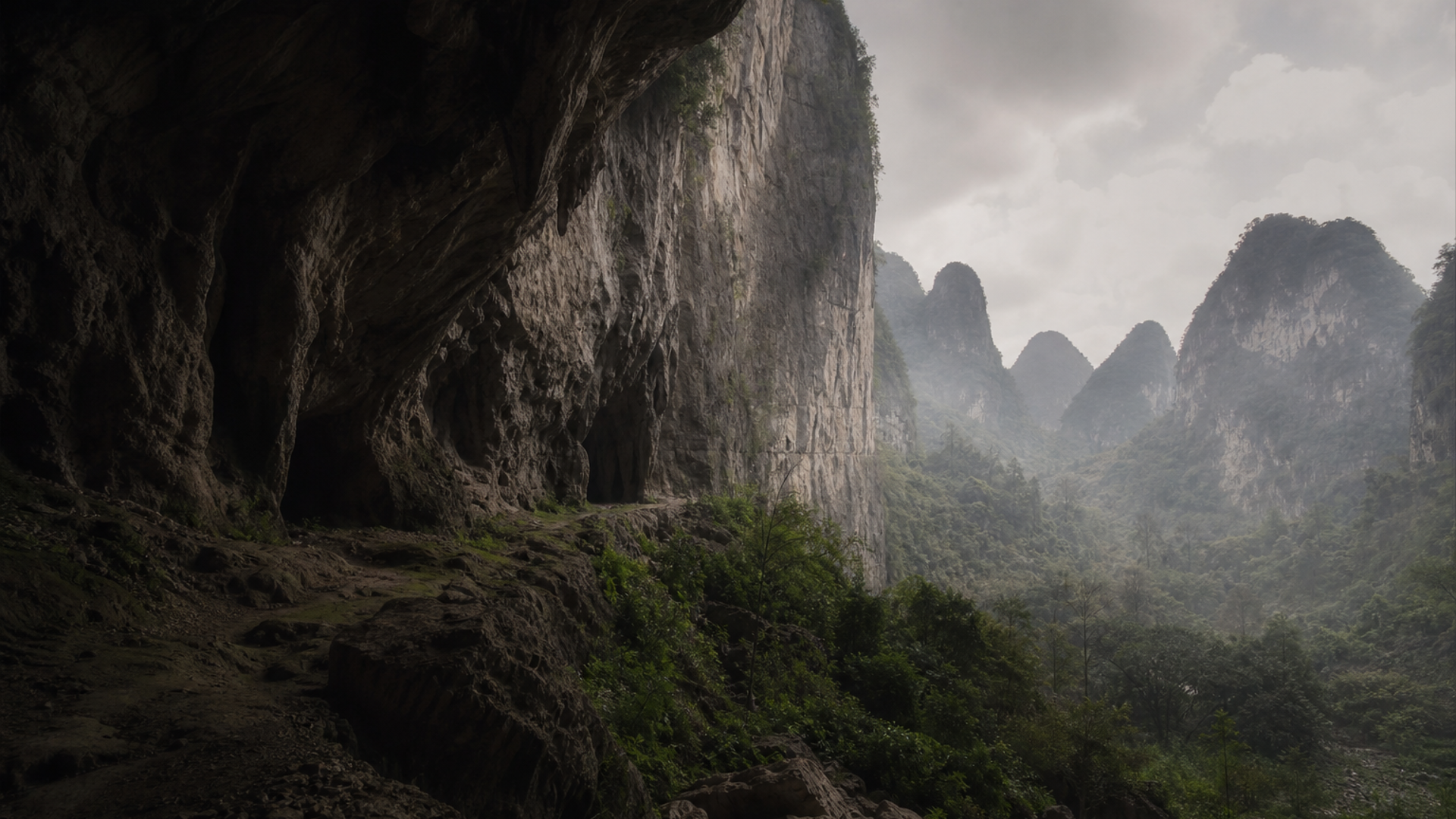
Banda Cave sits in the karst-draped hills of Dahua Yao Autonomous County (Hechi City, Guangxi). The human remains recovered there fall into a period of profound transformation in southern China: the waning centuries of the Northern & Southern Dynasties and the consolidation of Sui–Tang rule (mid 5th to mid 7th centuries CE). Archaeological data indicates cave use for burial during the local Banda phase, but excavation records and material inventories remain limited.

The landscape evokes a cinematic mix of limestone ridges, river valleys, and terraces where small, mobile communities practiced mixed subsistence strategies. Regionally, this era saw intensified contact between lowland agriculturalists and upland foragers, and increasing flows of people, goods, and ideas along river corridors.

Limited evidence suggests that Banda Cave individuals were part of long-standing southern East Asian population networks rather than recent large-scale northern migrations. However, with only two sampled individuals, any statement about population dynamics must be cautious: these remains offer a narrow window into a complex human story that archaeological and genetic sampling can only gradually clarify.

  • Site: Banda Cave, Dahua Yao Autonomous County, Hechi City, Guangxi, China
  • Date range for remains: 433–644 CE (Northern & Southern Dynasties to early Tang)
  • Evidence is limited; interpretations are preliminary
Kapitel IV

Daily Life & Society

Archaeological inference, regional ethnography, and landscape archaeology combine to suggest how people who used Banda Cave may have lived. Across Guangxi in the early medieval period, settlements commonly exploited wet-rice terraces in valleys, supplemented by upland horticulture, hunting, fishing, and the gathering of forest resources. Social life was likely organized at the village and kin-group scale, with seasonal movements between riverine fields and wooded slopes.

Cave interment can reflect practical choices—rock shelter, protection from floodplain disturbance—or social signaling, but the Banda Cave assemblage lacks a large published grave inventory to say whether burials were everyday community graves or reserved for particular lineages or statuses. Material culture from contemporary Guangxi sites often shows interaction with broader southern Chinese networks: trade items, shared ceramic forms, and stylistic echoes of lowland cultures.

Archaeobotanical and zooarchaeological datasets from the wider region document rice cultivation and riverine resource use, but whether the Banda individuals practiced identical economies is not yet proven. The portrait that emerges is of resilient communities negotiating a rich, mobile hinterland beneath the growing reach of Sui–Tang polities.

  • Likely mixed subsistence: wet-rice agriculture in valleys, upland foraging and fishing
  • Cave burial may reflect local funerary practice; specific status unknown
Kapitel V

Genetic Profile

Two individuals sampled from Banda Cave yielded mitochondrial haplogroups F2d and A — maternal lineages that are part of the deep genetic tapestry of East and Southeast Asia. Haplogroup A is widespread across East Asia and into northeast Eurasia, while sublineages of F (including F2 variants) are common in southern China and Southeast Asia. These mitochondrial signals point to local maternal ancestry consistent with long-term southern East Asian population structure.

No Y‑chromosome haplogroups are reported for these two samples, and genome-wide autosomal data are not available in the dataset provided here. Because the sample count is extremely small (n = 2), any broader inference—such as continuity with present-day Guangxi groups (Zhuang, Yao, other Tai-Kadai or Hmong-Mien‑speaking populations)—must be tentative. Limited evidence suggests affinities with indigenous southern lineages rather than wholesale replacement by northern-derived groups during the 5th–7th centuries CE.

In future, additional genome-wide sampling, combined with radiocarbon dating and comparative data from neighboring sites, could reveal admixture proportions, sex-biased migration, and the degree of continuity between Banda Cave people and later populations in southern China.

  • mtDNA: F2d and A detected — indicative of southern/ East Asian maternal ancestry
  • Sample size (n=2) is too small for population-level claims; conclusions are preliminary
Kapitel VI

Legacy & Modern Connections

The Banda Cave burials are a fragile bridge across fifteen centuries to the modern inhabitants of Guangxi. While mtDNA lineages such as F2 and A persist in many living East and Southeast Asian communities, direct lines of descent cannot be asserted from two samples alone. Archaeogenetics offers the promise of tracing threads of continuity — maternal lineages, regional mobility, and demographic shifts — but requires broader sampling to avoid overinterpretation.

Culturally, the Banda individuals inhabited a world becoming increasingly linked to imperial structures to the north while remaining rooted in southern ecological and social niches. For local communities today, such discoveries can illuminate deep time in the landscape and provide context for cultural identities that are themselves the product of long, layered histories. Continued collaborative excavation, respectful curation, and expanded aDNA work will be needed to turn these preliminary glimpses into robust narratives.

  • Ancient mtDNA lines seen at Banda Cave are present in modern East/Southeast Asian populations, suggesting long-term maternal continuity
  • Broader genomic sampling and community-engaged research are needed to clarify connections
KI-gestützt

KI-Assistent

Stellen Sie Fragen zur Banda Cave, Guangxi — Northern & Southern-Kultur

KI-Assistent von DNAGENICS

Funktion freischalten
Stellen Sie Fragen zur Kultur Banda Cave, Guangxi — Northern & Southern. Unser KI-Assistent kann genetische Befunde, historischen Kontext, archäologische Belege und moderne Verbindungen erläutern.

Beispiel einer KI-Analyse

Die Banda Cave, Guangxi — Northern & Southern-Kultur ist ein faszinierendes Kapitel der Menschheitsgeschichte...

Genetische Analysen zeigen Übereinstimmungen mit früheren Populationen und Hinweise auf besondere Anpassungen und kulturelle Innovationen. Alte DNA-Proben liefern Einblicke in Migrationsmuster, soziale Strukturen und genetische Verbindungen zwischen Populationen.

Dies ist eine Vorschau der KI-Analyse. Schalten Sie den vollständigen KI-Assistenten frei, um detaillierte Einblicke zu erkunden:

  • Genetische Zusammensetzung und genetische Ähnlichkeit
  • Migrationsmuster und Ursprünge
  • Alltag und kulturelle Praktiken
  • Genetischer Bezug zu heutigen Populationen

Weitere antike Kulturen erkunden

Geschichten von Zivilisationen aus der antiken Welt entdecken

Use code for 30% off • Expires Nov 08