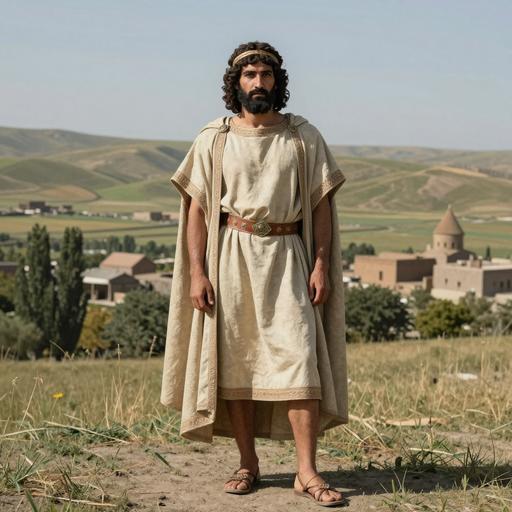
Beniamin of Shirak — Achaemenid Armenia

Download PDF creates a visual, rasterized copy. Use Print for selectable text and better assistive-technology support.

Bericht wird vorbereitet

Verfügbare Informationen und Referenzen werden geladen

Verbindung mit dem archäologischen Quellenbestand...

Alte Quellen werden zusammengestellt

Zum Hauptinhalt springen
Beniamin of Shirak — Achaemenid Armenia
Zivilisations-Spotlight

Beniamin of Shirak — Achaemenid Armenia

Seven individuals from Beniamin (450 BCE–550 CE) linking archaeology and ancient DNA

450 BCE - 550 CE
Shirak Province, Armenia
7 antike Proben
Scrollen zum Start
Kapitel I

Die Geschichte

Die Beniamin of Shirak — Achaemenid Armenia-Kultur verstehen

Archaeological and aDNA samples from Beniamin, Shirak Province (450 BCE–550 CE) offer a tentative window into life in Achaemenid-era and late-antique Armenia. Limited samples mean conclusions are provisional; data hint at local continuity and regional connections across the Armenian Highlands.

Time Period

450 BCE – 550 CE

Region

Shirak Province, Armenia

Common Y-DNA

Not reported / low sample count

Common mtDNA

Not reported / low sample count

Kapitel II

Zeitleiste

Zentrale Momente in der Geschichte dieser Kultur

550 BCE

Achaemenid expansion into the Armenian Highlands

The mid-6th century BCE Achaemenid expansion brought parts of the Armenian Highlands into imperial networks, influencing administration and exchange—context for the earliest Beniamin samples.

Kapitel III

Origins & Emergence

Perched on the high plateau of the Armenian Highlands, the village of Beniamin in Shirak Province yields a slender but evocative archaeological record spanning from the mid-first millennium BCE into late antiquity. Radiocarbon-calibrated samples tied to burial contexts and settlement traces place human activity here between 450 BCE and 550 CE — a period when the Achaemenid imperial system reached into the Armenian marches and later when local polities negotiated Roman, Parthian, and Sasanian pressures.

Archaeological data indicates continuity of occupation rather than abrupt replacement: ceramics, architectural fragments, and mortuary traces (where excavation was possible) suggest a community rooted in highland agricultural and pastoral lifeways while participating in wider economic and cultural networks. Limited evidence suggests some material culture reflects Achaemenid administrative and artistic influences, although local forms persist.

Because the Beniamin dataset is small and sampling is uneven, interpretations about initial settlement or direct political ties must remain cautious. What emerges clearly is a location at the crossroads: topographically conservative yet open to exchange, where local identity was formed in conversation with imperial and regional forces. This interplay between local tradition and external influence frames the archaeological story of Beniamin.

  • Occupation evidence dated 450 BCE–550 CE in Beniamin, Shirak Province
  • Material culture shows local traditions with some Achaemenid-era influence
  • Site sits at a crossroads of imperial and regional connections
Kapitel IV

Daily Life & Society

Armenian highland life at Beniamin would have been shaped by altitude, seasonality, and long-standing mountain pastoralism. Archaeological indicators and regional comparisons suggest a mixed economy of barley and wheat cultivation, sheep and goat herding, and seasonal transhumance across upland pastures. Households likely combined stored grain, dairy production, and craft activities that accommodated a rhythm of planting, harvest, and winter stabling.

Socially, small village communities in Shirak tended to be organized around kin groups and cooperative resource management. Mortuary practices visible at Beniamin — limited though the sample is — suggest locally specific rites with occasional elements shared across the Armenian Highlands. Trade and exchange threads connected Beniamin to nearby valleys and to caravan routes that linked to Anatolia, the Iranian plateau, and the Black Sea littoral; such connections brought goods, ideas, and people across political boundaries.

Archaeological data indicates resilience: households adapted to imperial administrations (Achaemenid and later powers) while maintaining local lifeways. Yet the detail of everyday belief, household hierarchy, and gendered labor remains largely inferential until larger excavations and more systematic sampling are completed.

  • Mixed agro-pastoral economy adapted to highland climate
  • Local mortuary practices with regional parallels
  • Connected to broader exchange networks despite mountainous terrain
Kapitel V

Genetic Profile

Seven ancient DNA samples from Beniamin offer a rare genetic glimpse into a community spanning the late Achaemenid era through late antiquity. Because n = 7 is small, genetic conclusions must be explicitly tentative: statistical power is limited, and allele frequency estimates are sensitive to sampling bias and preservation conditions.

Comparative ancient DNA work across the South Caucasus and Armenian Highlands often detects a strong substratum related to local Chalcolithic and Bronze Age populations, with variable later inputs from neighboring regions (Anatolia, the Iranian plateau, and steppe zones). The Beniamin individuals may reflect this pattern of long-term regional continuity combined with episodic gene flow, but current samples do not permit robust quantification of ancestry proportions.

No common Y-DNA or mtDNA haplogroups are reported for the Beniamin set in the provided metadata; absence of reported haplogroups should not be read as absence in the past. Future sampling, deeper genome coverage, and comparison to larger regional datasets will clarify kinship patterns, patrilineal or matrilineal continuity, and potential mobility signals (e.g., non-local ancestry in particular graves).

Limited evidence suggests local continuity tempered by regional connection; however, with fewer than ten genomes the most responsible framing is provisional hypothesis rather than firm conclusion.

  • Dataset = 7 ancient genomes — conclusions are preliminary
  • Suggests regional continuity with possible episodic external inputs
Kapitel VI

Legacy & Modern Connections

The people of Beniamin lived at the interface of continuity and change; their material and genetic traces contribute to the longer story of Armenian population history. Archaeological signals and comparative aDNA studies across the Highlands often point to substantial continuity from Bronze Age and Iron Age ancestors into the medieval period, though admixture events layered additional diversity over time.

For modern Armenians, sites like Beniamin offer a tangible connection to ancestral landscapes and lifeways. Yet it is important to stress uncertainty: small sample sizes and gaps in the archaeological record mean that direct one-to-one links between any ancient individuals and specific modern lineages remain probabilistic. Ongoing ancient DNA sampling, combined with careful archaeological context from Shirak and neighboring regions, will progressively refine how local communities like Beniamin contributed to the genetic tapestry of the Armenian Highlands.

  • Contributes to evidence for regional continuity in the Armenian Highlands
  • Small sample sizes mean modern connections are suggestive, not definitive
Kapitel VII

Probenkatalog

7 alte DNA-Proben, die mit der Beniamin of Shirak — Achaemenid Armenia-Kultur in Verbindung stehen und genetische Einordnungen zu den Menschen dieses Zeitraums liefern.

7 / 7 Proben
Porträt Probe Land Epoche Datum Kultur Geschlecht Y-DNA mtDNA
Künstlerische Rekonstruktion von Beniamin Antiquity individual, Armenia
Beniamin Antiquity individual, Armenia
Armenia Armenia_Beniamin_Achaemenid 450 BCE - 550 CE Persian Civilization M J-Y3476 -
Künstlerische Rekonstruktion von Beniamin Antiquity individual, Armenia
Beniamin Antiquity individual, Armenia
Armenia Armenia_Beniamin_Achaemenid 450 BCE - 550 CE Persian Civilization F - -
Künstlerische Rekonstruktion von Beniamin Antiquity individual, Armenia
Beniamin Antiquity individual, Armenia
Armenia Armenia_Beniamin_Achaemenid 405-380 calBCE (2315±15 BP, UCIAMS-237550) Persian Civilization F - -
Künstlerische Rekonstruktion von Beniamin Antiquity individual, Armenia
Beniamin Antiquity individual, Armenia
Armenia Armenia_Beniamin_Achaemenid 450 BCE - 550 CE Persian Civilization M L-Y261585 -
Künstlerische Rekonstruktion von Beniamin Antiquity individual, Armenia
Beniamin Antiquity individual, Armenia
Armenia Armenia_Beniamin_Achaemenid 450 BCE - 550 CE Persian Civilization F - -
Künstlerische Rekonstruktion von Beniamin Antiquity individual, Armenia
Beniamin Antiquity individual, Armenia
Armenia Armenia_Beniamin_Achaemenid 450 BCE - 550 CE Persian Civilization F - -
Künstlerische Rekonstruktion von Beniamin Antiquity individual, Armenia
Beniamin Antiquity individual, Armenia
Armenia Armenia_Beniamin_Achaemenid 450 BCE - 550 CE Persian Civilization M J-Y15913 -
KI-gestützt

KI-Assistent

Stellen Sie Fragen zur Beniamin of Shirak — Achaemenid Armenia-Kultur

KI-Assistent von DNAGENICS

Funktion freischalten
Stellen Sie Fragen zur Kultur Beniamin of Shirak — Achaemenid Armenia. Unser KI-Assistent kann genetische Befunde, historischen Kontext, archäologische Belege und moderne Verbindungen erläutern.

Beispiel einer KI-Analyse

Die Beniamin of Shirak — Achaemenid Armenia-Kultur ist ein faszinierendes Kapitel der Menschheitsgeschichte...

Genetische Analysen zeigen Übereinstimmungen mit früheren Populationen und Hinweise auf besondere Anpassungen und kulturelle Innovationen. Alte DNA-Proben liefern Einblicke in Migrationsmuster, soziale Strukturen und genetische Verbindungen zwischen Populationen.

Dies ist eine Vorschau der KI-Analyse. Schalten Sie den vollständigen KI-Assistenten frei, um detaillierte Einblicke zu erkunden:

  • Genetische Zusammensetzung und genetische Ähnlichkeit
  • Migrationsmuster und Ursprünge
  • Alltag und kulturelle Praktiken
  • Genetischer Bezug zu heutigen Populationen

Weitere antike Kulturen erkunden

Geschichten von Zivilisationen aus der antiken Welt entdecken

Use code for 30% off • Expires Nov 08