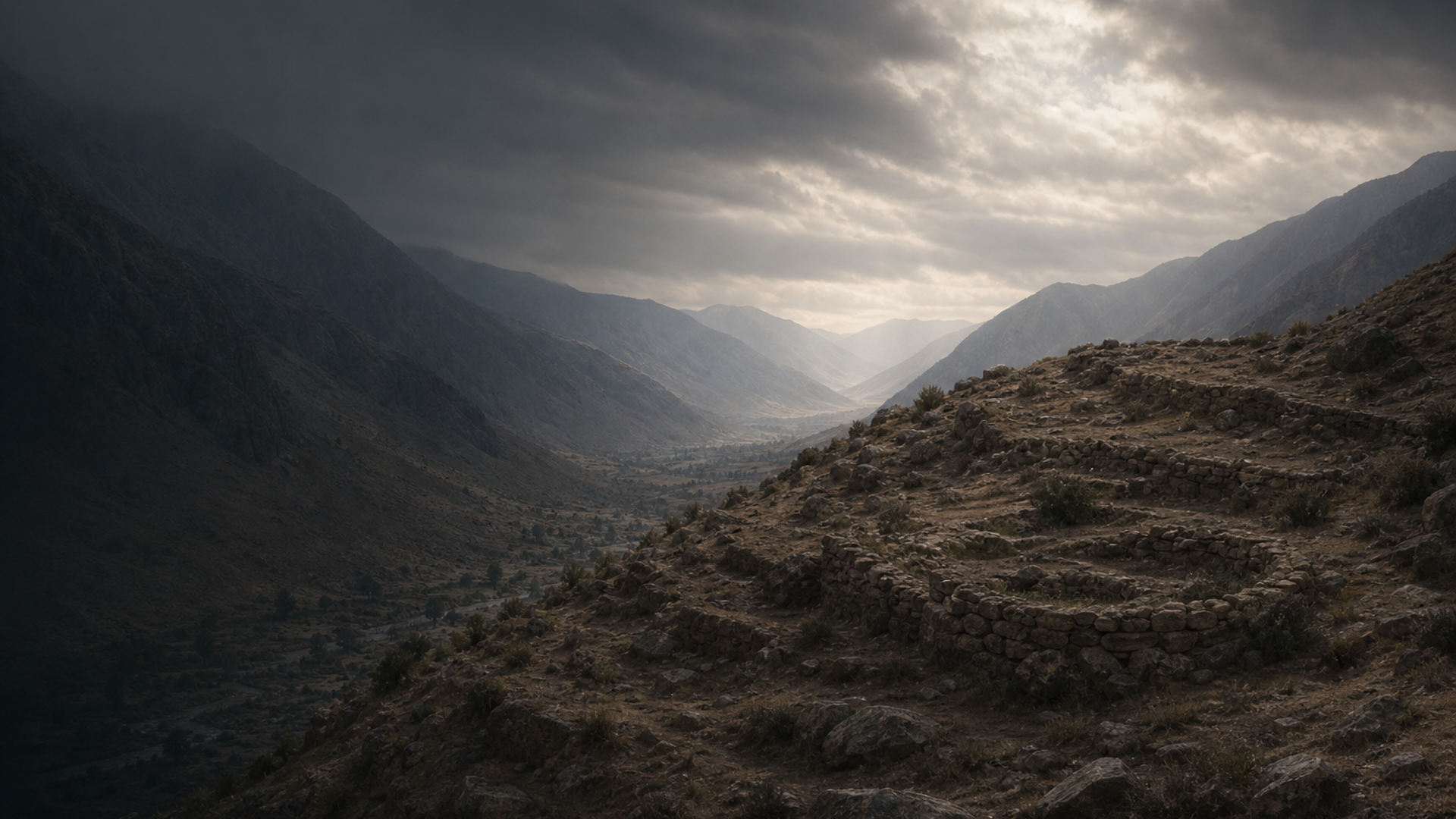
Butkara II — Swat Valley Iron Age

Download PDF creates a visual, rasterized copy. Use Print for selectable text and better assistive-technology support.

Bericht wird vorbereitet

Verfügbare Informationen und Referenzen werden geladen

Verbindung mit dem archäologischen Quellenbestand...

Alte Quellen werden zusammengestellt

Zum Hauptinhalt springen
Butkara II — Swat Valley Iron Age
Zivilisations-Spotlight

Butkara II — Swat Valley Iron Age

A small but evocative genetic window into an Iron Age religious center, 1000–785 BCE

1000 CE - 785 BCE
Swat Valley, Pakistan
Scrollen zum Start
Kapitel I

Die Geschichte

Die Butkara II — Swat Valley Iron Age-Kultur verstehen

Archaeological remains from Butkara II in Swat Valley (1000–785 BCE) paired with five ancient genomes reveal a mixed genetic picture: Y haplogroups dominated by R and presence of J; maternal lineages include U, HV, M, W. Limited samples make conclusions preliminary.

Time Period

1000–785 BCE

Region

Swat Valley, Pakistan

Common Y-DNA

R (predominant), J

Common mtDNA

U, HV, M, W

Kapitel II

Zeitleiste

Zentrale Momente in der Geschichte dieser Kultur

1000 BCE

Butkara II active as Iron Age center

Archaeological evidence indicates ritual and communal occupation at Butkara II around the start of the first millennium BCE.

785 BCE

Latest sampled individuals

The most recent radiocarbon-calibrated genomes from the site date to about 785 BCE, framing the sampled interval.

Kapitel III

Origins & Emergence

Under the long sweep of the Hindu Kush foothills, Butkara II in the Swat Valley emerges in the archaeological record as an Iron Age locus of ritual and communal life between roughly 1000 and 785 BCE. Excavations and survey work in the Butkara area reveal stratified deposits and localized concentrations of ritual architecture that signal an enduring cultural presence. Archaeological data indicates continuity of place: the valley’s deep river slots and fertile terraces supported farming communities while also anchoring pilgrimage and ritual locales.

Genetic data from five sampled individuals provides a tentative glimpse of the people who used these spaces. The predominance of Y-chromosome R lineages among the small set of male individuals is consistent with wider patterns of West Eurasian-associated ancestry in parts of northern South Asia during the first millennium BCE, while the presence of J hints at Near Eastern connections. Maternal lineages are mixed (U, HV alongside M and W), suggesting complex local and regional networks of descent and mobility. Limited evidence suggests these genetic signatures reflect both local continuity and incoming influences; however, with only five genomes the picture remains preliminary and subject to revision as more samples and direct archaeological associations become available.

  • Butkara II occupied as an Iron Age ritual center, 1000–785 BCE
  • Stratified archaeological deposits indicate long-term local use
  • Genetic signals suggest mixed local and West Eurasian influences
Kapitel IV

Daily Life & Society

Archaeological traces from the Swat Valley reveal a landscape of fields, lanes, and ritual precincts where everyday labor met formal performance. At Butkara II, pottery sherds, small stone tools, and fragments of worked metal recovered from surface and stratigraphic contexts point to agriculture, craft production, and exchange. Archaeological data indicates spaces used for communal rites—shrines, curated deposits, and assemblages that would have structured seasonal and life-cycle ceremonies.

The social life of the valley likely blended household production with regional networks of movement. The presence of diverse maternal haplogroups (U, HV, M, W) in the genetic sample aligns with an expectation of incoming and local female lineages, which may reflect exogamous marriage patterns or the mobility of women through trade and pilgrimage routes. Material culture suggests small-scale metallurgy and craft specialization, while landscape evidence implies irrigation and mixed farming. Limited excavation coverage and the small genetic sample size mean these reconstructions are provisional: each artifact, hearth, or burial context still has the power to change our view of daily practice at Butkara II.

  • Evidence for agriculture, craft production, and local metallurgy
  • Material and genetic diversity imply regional mobility and exchange
Kapitel V

Genetic Profile

Five ancient genomes sampled from burials and contexts attributed to Butkara II (Swat Valley, Pakistan) date between 1000 and 785 BCE. Y-chromosome results show three individuals carrying haplogroup R and one carrying J (one male may be undetermined in published calls); mitochondrial haplogroups in the five individuals are U (2), HV (1), M (1), and W (1). These data suggest a mixed ancestry profile blending lineages typically associated with West Eurasian maternal and paternal markers alongside South/Central Asian maternal lineages.

Caution is essential: with fewer than ten genomes the dataset is preliminary. Still, the predominance of Y-R in this small set is consistent with broader patterns in northern South Asia where R-lineages are frequent in late Bronze and Iron Age contexts and often interpreted as signals of West Eurasian-related male-mediated ancestry. The presence of mtDNA M—widespread in South and Central Asia—alongside U and HV points to local maternal continuity or integration of diverse maternal sources. The difference between predominantly R Y-lineages and a mixed set of maternal haplogroups could indicate sex-biased mobility or marriage networks, but archaeological correlation is limited. Further sampling across well-dated contexts at Butkara II and neighboring sites is required to test hypotheses about population movement, social organization, and the relationship between genetic change and cultural transformation.

  • Five genomes: Y haplogroups R (3) and J (1); mtDNA U (2), HV, M, W
  • Patterns suggest mixed West Eurasian and local South/Central Asian ancestry, but sample size is small
Kapitel VI

Legacy & Modern Connections

The genetic and archaeological traces from Butkara II underscore the deep entanglement of local tradition and long-distance connections across the first millennium BCE. Many of the haplogroups observed—R, J, U, HV, M, W—continue to occur across populations of Pakistan and neighboring regions today. This continuity does not imply direct one-to-one ancestry for any single community, but it does signal enduring biological and cultural interactions in the Swat corridor: routes of trade, marriage, and ritual that have shaped human landscapes for millennia.

Because the dataset is small, statements about continuity or replacement must remain tentative. Expanded ancient DNA sampling, coupled with targeted excavation and improved chronological control at Butkara II and nearby sites, will clarify how these early Iron Age communities contributed to the genetic and cultural mosaic of South Asia.

  • Haplogroups seen at Butkara II persist in modern South Asian populations
  • More samples and context needed to trace direct lines of ancestry
KI-gestützt

KI-Assistent

Stellen Sie Fragen zur Butkara II — Swat Valley Iron Age-Kultur

KI-Assistent von DNAGENICS

Funktion freischalten
Stellen Sie Fragen zur Kultur Butkara II — Swat Valley Iron Age. Unser KI-Assistent kann genetische Befunde, historischen Kontext, archäologische Belege und moderne Verbindungen erläutern.
Beispiel einer KI-Analyse

Die Butkara II — Swat Valley Iron Age-Kultur ist ein faszinierendes Kapitel der Menschheitsgeschichte...

Genetische Analysen zeigen Übereinstimmungen mit früheren Populationen und Hinweise auf besondere Anpassungen und kulturelle Innovationen. Alte DNA-Proben liefern Einblicke in Migrationsmuster, soziale Strukturen und genetische Verbindungen zwischen Populationen.

Dies ist eine Vorschau der KI-Analyse. Schalten Sie den vollständigen KI-Assistenten frei, um detaillierte Einblicke zu erkunden:

  • Genetische Zusammensetzung und genetische Ähnlichkeit
  • Migrationsmuster und Ursprünge
  • Alltag und kulturelle Praktiken
  • Genetischer Bezug zu heutigen Populationen

Weitere antike Kulturen erkunden

Geschichten von Zivilisationen aus der antiken Welt entdecken

Use code for 30% off • Expires Nov 08