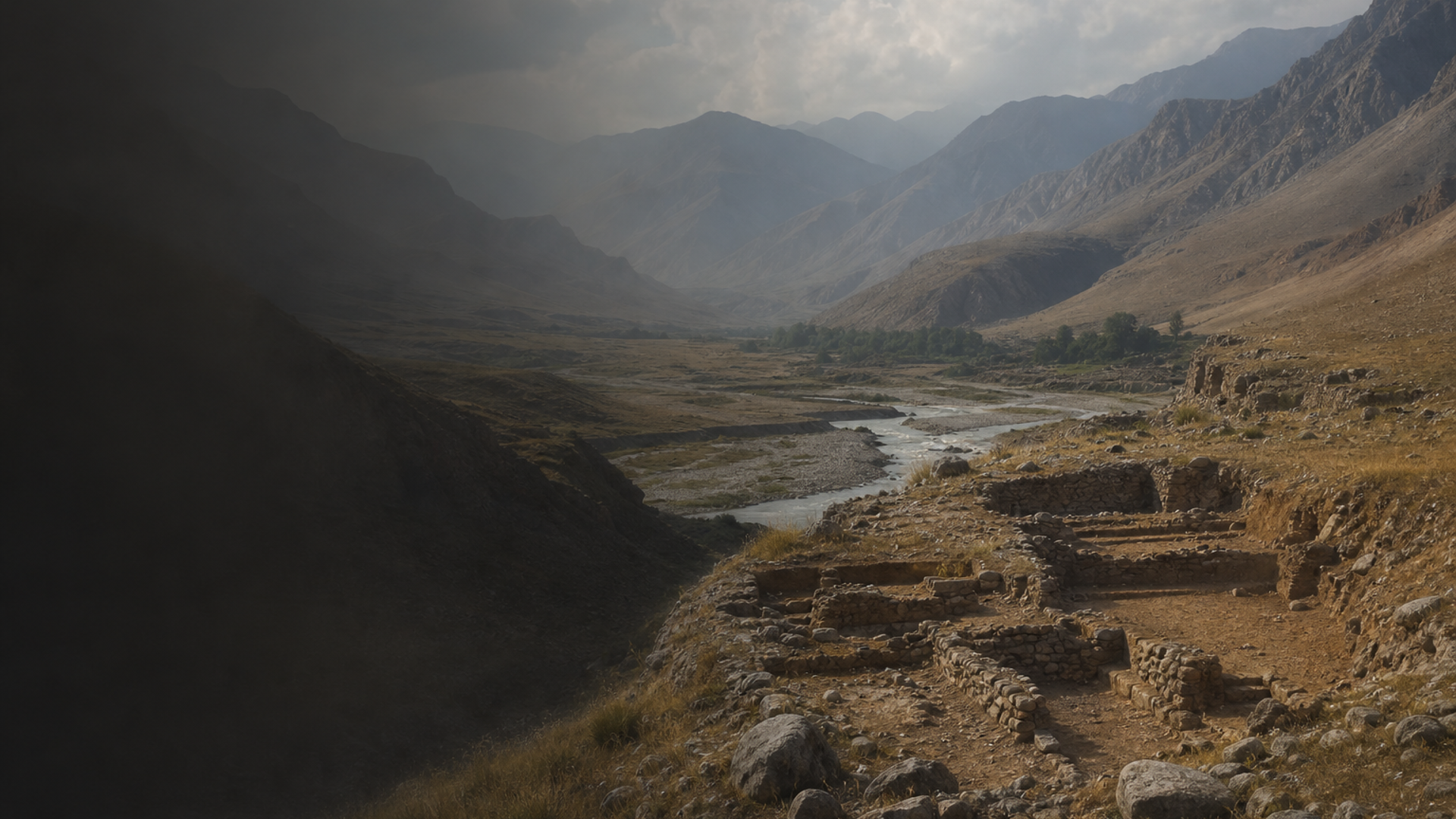
Butkara IV — Voices from Swat Valley

Download PDF creates a visual, rasterized copy. Use Print for selectable text and better assistive-technology support.

Bericht wird vorbereitet

Verfügbare Informationen und Referenzen werden geladen

Verbindung mit dem archäologischen Quellenbestand...

Alte Quellen werden zusammengestellt

Zum Hauptinhalt springen
Butkara IV — Voices from Swat Valley
Zivilisations-Spotlight

Butkara IV — Voices from Swat Valley

Ritual center of the Swat Valley (200 BCE–108 CE) seen through archaeology and DNA

200 BCE - 108 CE
Swat Valley, Pakistan (Butkara IV)
Scrollen zum Start
Kapitel I

Die Geschichte

Die Butkara IV — Voices from Swat Valley-Kultur verstehen

Butkara IV (Swat Valley, Pakistan) — a late Iron Age religious hub dated 200 BCE–108 CE. Four ancient genomes hint at South Asian maternal continuity (M30) and West-Eurasian paternal input (J). Small sample size makes conclusions preliminary.

Time Period

200 BCE–108 CE

Region

Swat Valley, Pakistan (Butkara IV)

Common Y-DNA

J (observed in 2 of 4 samples)

Common mtDNA

M30 (2), U2a (1), HV (1)

Kapitel II

Zeitleiste

Zentrale Momente in der Geschichte dieser Kultur

200 BCE

Butkara IV — active ritual phase (approx.)

Butkara IV functions as a regional religious center in the Swat Valley, with shrine construction and votive activity documented archaeologically.

Kapitel III

Origins & Emergence

Butkara IV rises from the layered soils of the Swat Valley as a place of devotion and exchange. Archaeological data indicates continuous ritual activity at Butkara — a node in the wider Gandharan cultural landscape — between roughly 200 BCE and 108 CE. Excavations at Butkara have revealed stratified deposits of votive offerings, structural remains associated with shrine architecture, and assemblages that reflect long-distance contacts across the Hindu Kush corridor.

The cinematic sweep of the site — terraces cut into mountain slopes, compacted ritual floors, and scattered fragments of offering pottery — points to a community shaped by pilgrimage and metropolitan connections. Limited epigraphic and material evidence suggests local elites sponsored religious monuments while artisans worked in styles that absorb both South Asian and West Eurasian motifs. Together, the material culture and stratigraphy suggest a society negotiating local traditions and external influences during a dynamic phase of the Iron Age in northern South Asia.

Because only four genetic samples are available from this phase at Butkara IV, interpretations of population origins must remain cautious. Archaeology documents the cultural horizon; ancient DNA provides an additional voice, but one that is still faint until larger sample series are studied.

  • Butkara IV active ca. 200 BCE–108 CE in Swat Valley
  • Archaeological evidence shows religious architecture and votive deposits
  • Cultural connections across the Hindu Kush and into Gandhara
Kapitel IV

Daily Life & Society

Life around Butkara IV would have been shaped by ritual calendars, seasonal agriculture, and the movement of people and goods across mountain passes. Archaeological remains from the Swat Valley indicate mixed subsistence — cereal cultivation, pastoral herding, and craft production — supporting communities that hosted pilgrims and itinerant artisans.

Material traces such as pottery shards, metalworking debris, and architectural foundations suggest specialized craft areas and communal ritual spaces. Funerary contexts recovered in the region show variability in burial treatment, implying distinctions of status, community identity, or changing religious practice over time. The visual culture of Gandhara — narrative reliefs and hybrid motifs seen regionally — hints that Butkara’s inhabitants participated in broader networks of belief and artistic exchange.

Daily life would therefore have combined localized agricultural rhythms with the cosmopolitan demands of a religious center: provisioning shrines, supplying craftsmen, and accommodating visitors bound for pilgrimage.

  • Mixed agriculture and pastoralism sustained local communities
  • Crafts, shrine maintenance, and pilgrimage shaped urban rhythms
Kapitel V

Genetic Profile

Four ancient individuals from Butkara IV provide a preliminary genetic snapshot. Uniparental markers show two Y-chromosome haplogroups labeled J and mitochondrial diversity dominated by M30 (2 samples), plus U2a and HV. M30 is a lineage common in South Asia, often associated with long-standing maternal continuity in the subcontinent. U2a also occurs in South and Central Asia and may reflect deep regional ancestry. HV is widespread in West Eurasia and appears at low frequencies across South Asia, indicating past connections beyond the immediate valley.

Y-haplogroup J, observed in two of the four males, has a strong presence in West Asia and is also found in parts of South Asia; its appearance at Butkara IV could reflect male-mediated gene flow from west-to-east at some point in the preceding millennia, or the persistence of lineages introduced earlier. However, with only four samples (n=4), these uniparental signals are suggestive rather than definitive.

Archaeological context combined with these genetic signals points toward a mixed picture: a largely South Asian maternal substrate (M30) punctuated by paternal lineages that suggest contacts across the western corridors. Robust conclusions about admixture proportions, timing, or social patterns (for example, whether incoming males integrated into local communities) require larger autosomal datasets and more samples from contemporaneous sites across Gandhara and the Swat Valley.

  • Two Y-DNA J lineages hint at West-to-South Asian connections
  • mtDNA dominated by M30 supports local South Asian maternal continuity
Kapitel VI

Legacy & Modern Connections

The echoes of Butkara IV persist in both landscape and genes. Maternal lineages such as M30 remain common across South Asian populations, suggesting threads of continuity between ancient valley inhabitants and many modern communities. The presence of U2a and HV, and Y-lineage J, points to the Swat Valley’s role as a crossroads where local and transregional ancestries intersected.

Culturally, Butkara contributed to the long arc of Gandharan religious and artistic traditions that influenced Buddhist visual language across Asia. Genetically, the small Butkara sample hints at the complex tapestry of South Asia: layers of local continuity enriched by episodic gene flow. Future work integrating more genomes, archaeology, and isotope studies will better illuminate how people moved, married, and built communities in this dramatic mountain landscape.

  • Mitochondrial lineages (M30) suggest maternal continuity into modern South Asia
  • Combined archaeological and genetic signals underscore Swat Valley as a contact zone
KI-gestützt

KI-Assistent

Stellen Sie Fragen zur Butkara IV — Voices from Swat Valley-Kultur

KI-Assistent von DNAGENICS

Funktion freischalten
Stellen Sie Fragen zur Kultur Butkara IV — Voices from Swat Valley. Unser KI-Assistent kann genetische Befunde, historischen Kontext, archäologische Belege und moderne Verbindungen erläutern.

Beispiel einer KI-Analyse

Die Butkara IV — Voices from Swat Valley-Kultur ist ein faszinierendes Kapitel der Menschheitsgeschichte...

Genetische Analysen zeigen Übereinstimmungen mit früheren Populationen und Hinweise auf besondere Anpassungen und kulturelle Innovationen. Alte DNA-Proben liefern Einblicke in Migrationsmuster, soziale Strukturen und genetische Verbindungen zwischen Populationen.

Dies ist eine Vorschau der KI-Analyse. Schalten Sie den vollständigen KI-Assistenten frei, um detaillierte Einblicke zu erkunden:

  • Genetische Zusammensetzung und genetische Ähnlichkeit
  • Migrationsmuster und Ursprünge
  • Alltag und kulturelle Praktiken
  • Genetischer Bezug zu heutigen Populationen

Weitere antike Kulturen erkunden

Geschichten von Zivilisationen aus der antiken Welt entdecken

Use code for 30% off • Expires Nov 08