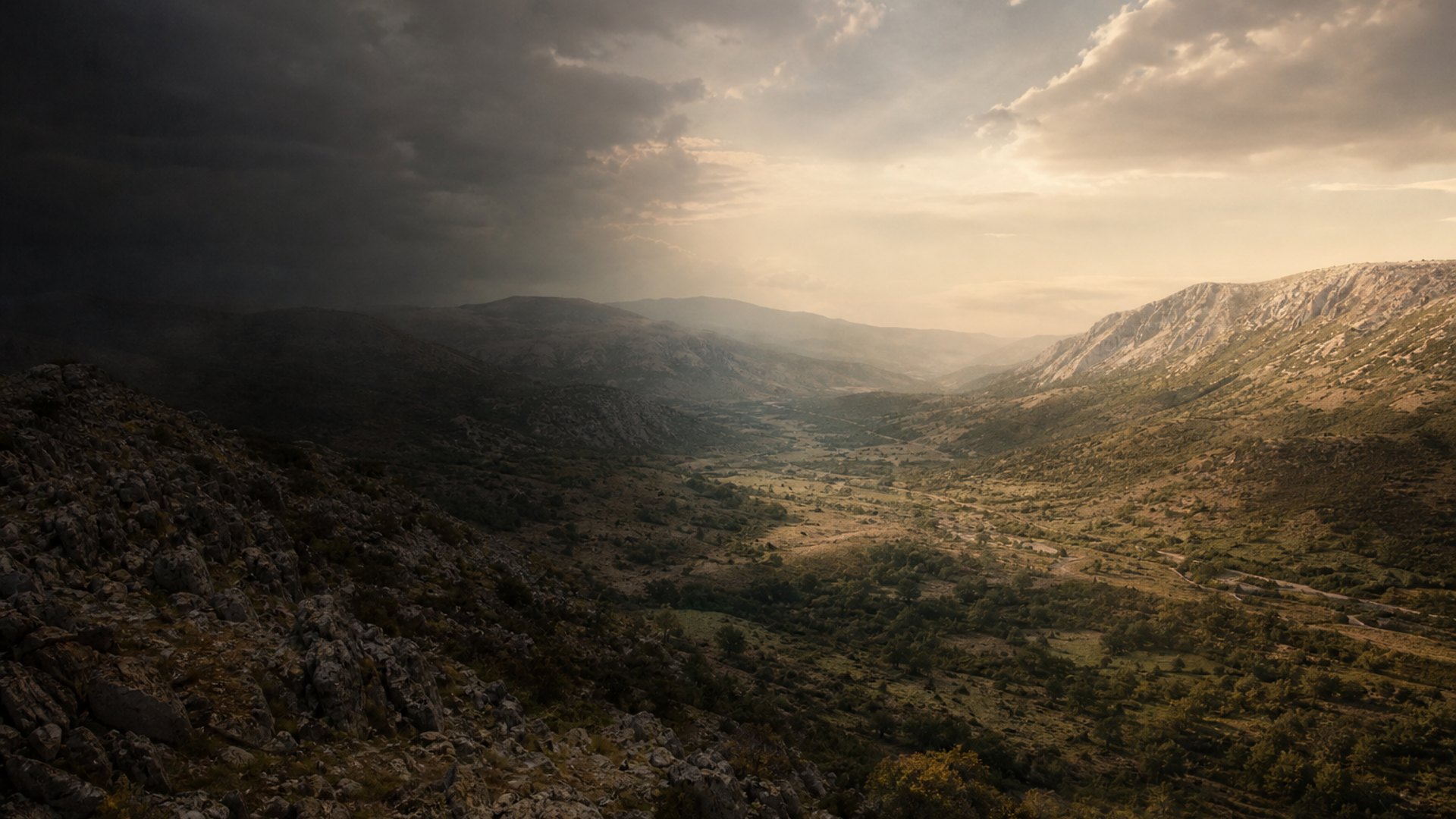
Cetina Valley — Middle Bronze Age

Download PDF creates a visual, rasterized copy. Use Print for selectable text and better assistive-technology support.

Bericht wird vorbereitet

Verfügbare Informationen und Referenzen werden geladen

Verbindung mit dem archäologischen Quellenbestand...

Alte Quellen werden zusammengestellt

Zum Hauptinhalt springen
Cetina Valley — Middle Bronze Age
Zivilisations-Spotlight

Cetina Valley — Middle Bronze Age

Riverine communities in Dalmatia whose maternal lineages illuminate Bronze Age connections

2000 CE - 1600 BCE
Cetina Valley, Croatia (Dalmatia)
Scrollen zum Start
Kapitel I

Die Geschichte

Die Cetina Valley — Middle Bronze Age-Kultur verstehen

Archaeological and mtDNA data from 16 Middle Bronze Age individuals (2000–1600 BCE) in the Cetina Valley, Croatia, reveal dominant H and J maternal lineages. Archaeology indicates a pastoral, river-focused lifeway with regional exchanges across Dalmatia.

Time Period

2000–1600 BCE

Region

Cetina Valley, Croatia (Dalmatia)

Common Y-DNA

Not reported / limited data

Common mtDNA

H (6), J (5), T (1), H5 (1), HV (1) — 16 samples

Kapitel II

Zeitleiste

Zentrale Momente in der Geschichte dieser Kultur

2000 BCE

Regional consolidation in the Cetina Valley

Archaeological evidence marks the consolidation of Middle Bronze Age lifeways along the Cetina river, with distinct material culture and valley cemeteries.

Kapitel III

Origins & Emergence

The Cetina Valley group emerges in the archaeological record of inland Dalmatia around the beginning of the Middle Bronze Age (c. 2000 BCE). Archaeological data indicate communities organized along the river corridor, exploiting upland pastures and fertile terraces. Material culture — pottery styles, metalwork in bronze, and funerary practices recorded in valley cemeteries — suggests local developments built on earlier Neolithic and Early Bronze Age traditions combined with influences from neighboring Adriatic and inland groups.

Limited evidence suggests these communities participated in regional exchange networks that threaded the Dalmatian coast to the interior. The landscape itself — the Cetina river cutting through karst landscapes — shaped movement, resource use, and settlement placement. While settlement patterns and ritual behaviors can be observed in excavations across the valley, many interpretations remain provisional: preservation bias and uneven excavation coverage mean we rely on a patchwork of sites rather than a continuous record.

  • Emergence c. 2000 BCE in the Cetina Valley of Dalmatia
  • Material culture shows continuity with local traditions plus regional influences
  • Archaeological record is regionally uneven; conclusions remain cautious
Kapitel IV

Daily Life & Society

Life in the Cetina Valley during 2000–1600 BCE was tied to the river and its mosaic of arable terraces, pastures, and woodland. Archaeology indicates a mixed economy: husbandry and seasonal grazing likely dominated, supplemented by cultivation of cereals and pulse crops where soils allowed. Riverine resources — fish and freshwater mollusks — would have added dietary variety while river routes facilitated exchange of raw materials and finished bronze goods.

Craftspeople working in bronze, pottery, and bone/antler likely shaped local identity. Funerary assemblages from valley cemeteries hint at differentiation in status and role: some burials contain more elaborate objects, while others are modest. These patterns suggest emerging social complexity but do not allow firm statements about political organization. Women and men likely held complementary economic roles; mortuary evidence paired with isotopic and genetic sampling (where available) is beginning to clarify mobility and residence patterns, though more genome-wide and isotopic data are needed to resolve household and community structure.

  • Mixed economy of pastoralism, farming, and river resource use
  • Evidence of craft specialization and social differentiation in burials
Kapitel V

Genetic Profile

Genome-wide data for this Cetina Valley group are limited in the provided dataset, but mitochondrial DNA (mtDNA) from 16 individuals shows a clear concentration of maternal lineages: haplogroup H (6 individuals) and J (5 individuals) dominate, with single occurrences of T, H5, and HV. Haplogroup H is widespread across Europe from the Neolithic onward and is commonly interpreted as reflecting longstanding maternal continuity in many regions. Haplogroup J likewise appears frequently in Neolithic and Bronze Age contexts and can reflect maternal lineages associated with early farmers and later regional dynamics.

No common Y-DNA pattern is reported for these samples, so paternal lineage structure cannot be assessed here. Without accompanying genome-wide autosomal data for all individuals, interpretations about Steppe-related ancestry, Neolithic farmer continuity, or later admixture remain tentative. The sample size (n=16) is moderate: it is sufficient to identify dominant maternal lineages locally but still limited for making broad demographic claims. Future genome-wide and Y-chromosome sequencing, combined with strontium/isotopic mobility studies, will better resolve questions of migration, sex-biased movement, and population continuity in Middle Bronze Age Dalmatia.

  • mtDNA dominated by H (6) and J (5) among 16 samples
  • Y-chromosome data not reported — paternal structure remains unknown
Kapitel VI

Legacy & Modern Connections

The maternal lineages found in the Cetina Valley samples connect these Bronze Age communities to broader European maternal networks: H and J remain common in modern populations across the Balkans and wider Europe. Archaeological continuity in settlement zones and persistent landscape use suggests aspects of local cultural heritage persisted through later prehistory, though direct cultural continuity should not be assumed from mtDNA alone.

For users of DNA ancestry services, these results illustrate an important point: mtDNA reports a single maternal line among many ancestors and cannot capture the full tapestry of ancestry. The Cetina Valley data offer a vivid window into maternal heritage in Middle Bronze Age Dalmatia and underscore the value of combining archaeology and genetics to reconstruct past lives — while maintaining caution about sample limits and missing paternal or autosomal resolution.

  • Maternal haplogroups H and J link Bronze Age Dalmatia to broader European lineages
  • mtDNA is informative but represents only the maternal line; broader genomic data are needed for full ancestry
KI-gestützt

KI-Assistent

Stellen Sie Fragen zur Cetina Valley — Middle Bronze Age-Kultur

KI-Assistent von DNAGENICS

Funktion freischalten
Stellen Sie Fragen zur Kultur Cetina Valley — Middle Bronze Age. Unser KI-Assistent kann genetische Befunde, historischen Kontext, archäologische Belege und moderne Verbindungen erläutern.
Beispiel einer KI-Analyse

Die Cetina Valley — Middle Bronze Age-Kultur ist ein faszinierendes Kapitel der Menschheitsgeschichte...

Genetische Analysen zeigen Übereinstimmungen mit früheren Populationen und Hinweise auf besondere Anpassungen und kulturelle Innovationen. Alte DNA-Proben liefern Einblicke in Migrationsmuster, soziale Strukturen und genetische Verbindungen zwischen Populationen.

Dies ist eine Vorschau der KI-Analyse. Schalten Sie den vollständigen KI-Assistenten frei, um detaillierte Einblicke zu erkunden:

  • Genetische Zusammensetzung und genetische Ähnlichkeit
  • Migrationsmuster und Ursprünge
  • Alltag und kulturelle Praktiken
  • Genetischer Bezug zu heutigen Populationen

Weitere antike Kulturen erkunden

Geschichten von Zivilisationen aus der antiken Welt entdecken

Use code for 30% off • Expires Nov 08