Chincha Coast Echoes (1250–1613 CE)

Download PDF creates a visual, rasterized copy. Use Print for selectable text and better assistive-technology support.

Bericht wird vorbereitet

Verfügbare Informationen und Referenzen werden geladen

Verbindung mit dem archäologischen Quellenbestand...

Alte Quellen werden zusammengestellt

Zum Hauptinhalt springen
Chincha Coast Echoes (1250–1613 CE)
Zivilisations-Spotlight

Chincha Coast Echoes (1250–1613 CE)

Archaeology and ancient DNA illuminate lives on Peru’s south coast.

1250 CE - 1613 CE
Chincha, South Coast, Peru
Scrollen zum Start
Kapitel I

Die Geschichte

Die Chincha Coast Echoes (1250–1613 CE)-Kultur verstehen

Material culture and genomic data from Chincha (1250–1613 CE) reveal a Late Horizon coastal population with Indigenous Y-DNA Q and diverse maternal lineages (B2b, A, C variants). Archaeological evidence indicates maritime trade, Inca interaction, and continuity into the early colonial era.

Time Period

1250–1613 CE (Late Horizon–early Colonial)

Region

Chincha, South Coast, Peru

Common Y-DNA

Q (observed in 2 of 12 samples)

Common mtDNA

B2b (2), A (1), C, C1b, C1c (each 1)

Kapitel II

Zeitleiste

Zentrale Momente in der Geschichte dieser Kultur

1250 CE

Late Horizon consolidation

Archaeological evidence marks increased integration of coastal Chincha communities into broader Late Horizon exchange and administrative networks.

1532 CE

Spanish contact begins in Peru

Spanish incursions initiate demographic, social, and economic disruptions that affected coastal populations and their genetic landscape.

1613 CE

Latest sampled individuals

The upper bound of the sampled chronology; some individuals postdate initial colonial contact, complicating demographic interpretation.

Kapitel III

Origins & Emergence

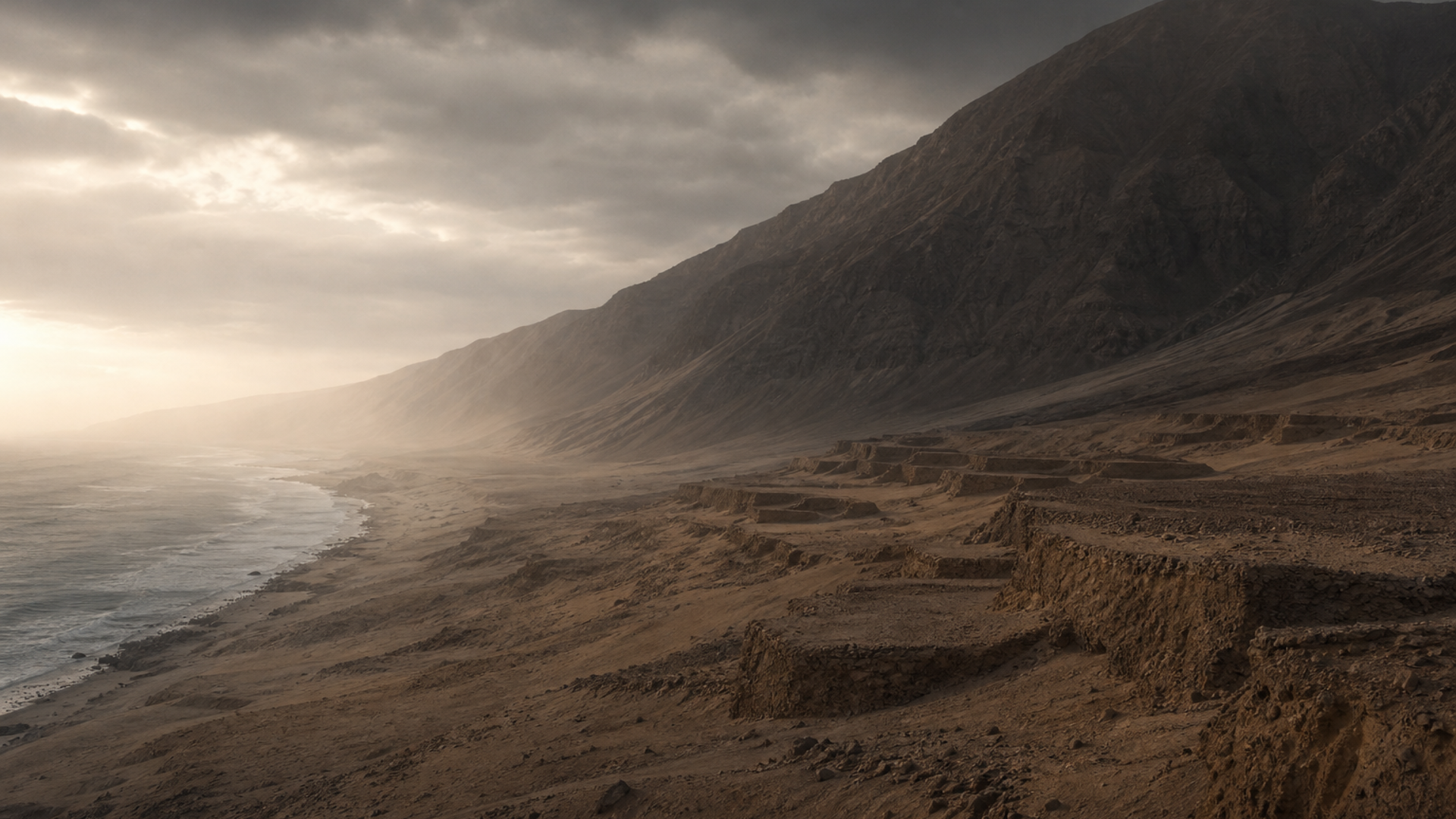
On the arid cliffs and fertile valleys of the Chincha coast, communities folded both sea and soil into their lifeways. Archaeological data indicates occupation during the Late Horizon (c.1250 CE onward), a period when Inca political and economic influence spread along the Peruvian litoral. Ceramic styles, architectural traces, and midden deposits at Chincha sites speak of coastal fishing economies, intensified exchange networks, and local craft traditions.

The cinematic sweep of wind across pebble beaches and the salt-crusted terraces frames how these communities emerged: a coastal population adapting to seasonal upwellings and maritime resources while participating in wider Late Horizon polities. Material culture points to contact and integration with neighboring groups such as Chimú and later Inca administrators, but the archaeological record also preserves local continuities in burial practice and craft that resist simple assimilation narratives.

Limited regional sampling and the modest number of dated contexts mean that models of origin remain provisional. Still, when artifacts are read alongside radiocarbon dates and genomic data, a picture emerges of a resilient coastal society shaped by both local innovation and interregional ties.

  • Occupied during the Late Horizon (c.1250 CE onward) on the Chincha coast
  • Archaeological evidence of fishing, trade, and craft production
  • Signs of contact with Chimú and Inca spheres, alongside local continuity
Kapitel IV

Daily Life & Society

Daily life on the Chincha shore combined maritime expertise with agricultural practice in nearby valleys. Fish and marine mollusks dominate midden assemblages at coastal sites, while terraced fields and irrigated plots inland supported maize, beans, and cotton—an economy that fueled textile and rope industries essential for seafaring and storage.

Settlement architecture includes compact habitations and storage features adapted to coastal climatic conditions. Craft specialization is visible in pottery forms and fiber goods, hinting at household-based workshops and exchange networks. Burials recovered from Chincha contexts show variable mortuary treatment: some individuals are interred with utilitarian goods, others with items indicating social distinctions, suggesting a society with differentiated roles but without starkly hierarchical monumental architecture seen in highland polities.

Ethnographic analogy and zooarchaeological remains suggest seasonal mobility tied to fishing cycles, and archaeological indications of trade imply Chincha acted as a maritime intermediary, connecting southern Andean coasts to inland and northern partners. These patterns form the human backdrop against which ancient DNA contributes biological context.

  • Economy centered on marine resources, irrigated agriculture, and textile production
  • Household craft and variable mortuary practices indicate social differentiation
Kapitel V

Genetic Profile

Twelve sequenced individuals from Chincha (1250–1613 CE) provide a modest but informative genetic window into this coastal population. On the paternal side, Y-DNA haplogroup Q appears in two samples; Q is a hallmark Native American paternal lineage found widely across the Americas. Maternal lineages are diverse: B2b (observed in two individuals) alongside A and multiple C subclades (C, C1b, C1c). These mitochondrial haplogroups are common among Indigenous peoples of western South America and are consistent with deep regional ancestry.

Genomic affinity analyses (when available) typically place Chincha individuals within the broader Andean genetic continuum, reflecting long-term regional continuity. Because the dataset is small (12 samples) and spans both pre- and post-contact centuries, interpretations should be cautious: the period after 1532 CE saw demographic disruption and potential genetic input from introduced populations. In this Chincha assemblage there is no blanket signal of large-scale non-Indigenous ancestry reported here, but low-level admixture in later contexts cannot be excluded without more targeted sampling.

Taken together, the genetic data support archaeological impressions of an Indigenous coastal population with maternal diversity and paternal lineages typical of Native American groups. Larger sample sizes, broader geographic sampling along the south coast, and fine-grained temporal resolution would strengthen inferences about migration, kinship, and post-contact change.

  • Y-DNA Q observed (2/12), consistent with Native American paternal ancestry
  • mtDNA diversity includes B2b, A, and several C subclades reflecting Andean maternal lineages
Kapitel VI

Legacy & Modern Connections

The Chincha shore's cultural rhythms echo into the present through continuity in coastal lifeways, place names, and genetic ancestry among modern coastal communities. Archaeogenetic links tie ancient Chincha individuals to the broader tapestry of Andean peoples, providing a biological thread that complements material culture and oral histories.

Archaeological stewardship and collaboration with descendant communities are essential: genetic findings gain meaning when integrated with local knowledge, descendant claims, and ethical research practices. While the current sample set offers valuable glimpses, ongoing work—combining more archaeological excavation, radiocarbon dating, and expanded ancient DNA sampling—will refine our understanding of how Chincha populations navigated the transformations of the Late Horizon and early colonial centuries.

  • Genetic continuity ties ancient Chincha to modern Andean coastal populations
  • Further sampling and community collaboration will clarify post-contact changes
KI-gestützt

KI-Assistent

Stellen Sie Fragen zur Chincha Coast Echoes (1250–1613 CE)-Kultur

KI-Assistent von DNAGENICS

Funktion freischalten
Stellen Sie Fragen zur Kultur Chincha Coast Echoes (1250–1613 CE). Unser KI-Assistent kann genetische Befunde, historischen Kontext, archäologische Belege und moderne Verbindungen erläutern.
Beispiel einer KI-Analyse

Die Chincha Coast Echoes (1250–1613 CE)-Kultur ist ein faszinierendes Kapitel der Menschheitsgeschichte...

Genetische Analysen zeigen Übereinstimmungen mit früheren Populationen und Hinweise auf besondere Anpassungen und kulturelle Innovationen. Alte DNA-Proben liefern Einblicke in Migrationsmuster, soziale Strukturen und genetische Verbindungen zwischen Populationen.

Dies ist eine Vorschau der KI-Analyse. Schalten Sie den vollständigen KI-Assistenten frei, um detaillierte Einblicke zu erkunden:
  • Genetische Zusammensetzung und genetische Ähnlichkeit
  • Migrationsmuster und Ursprünge
  • Alltag und kulturelle Praktiken
  • Genetischer Bezug zu heutigen Populationen

Weitere antike Kulturen erkunden

Geschichten von Zivilisationen aus der antiken Welt entdecken

Use code for 30% off • Expires Nov 08





