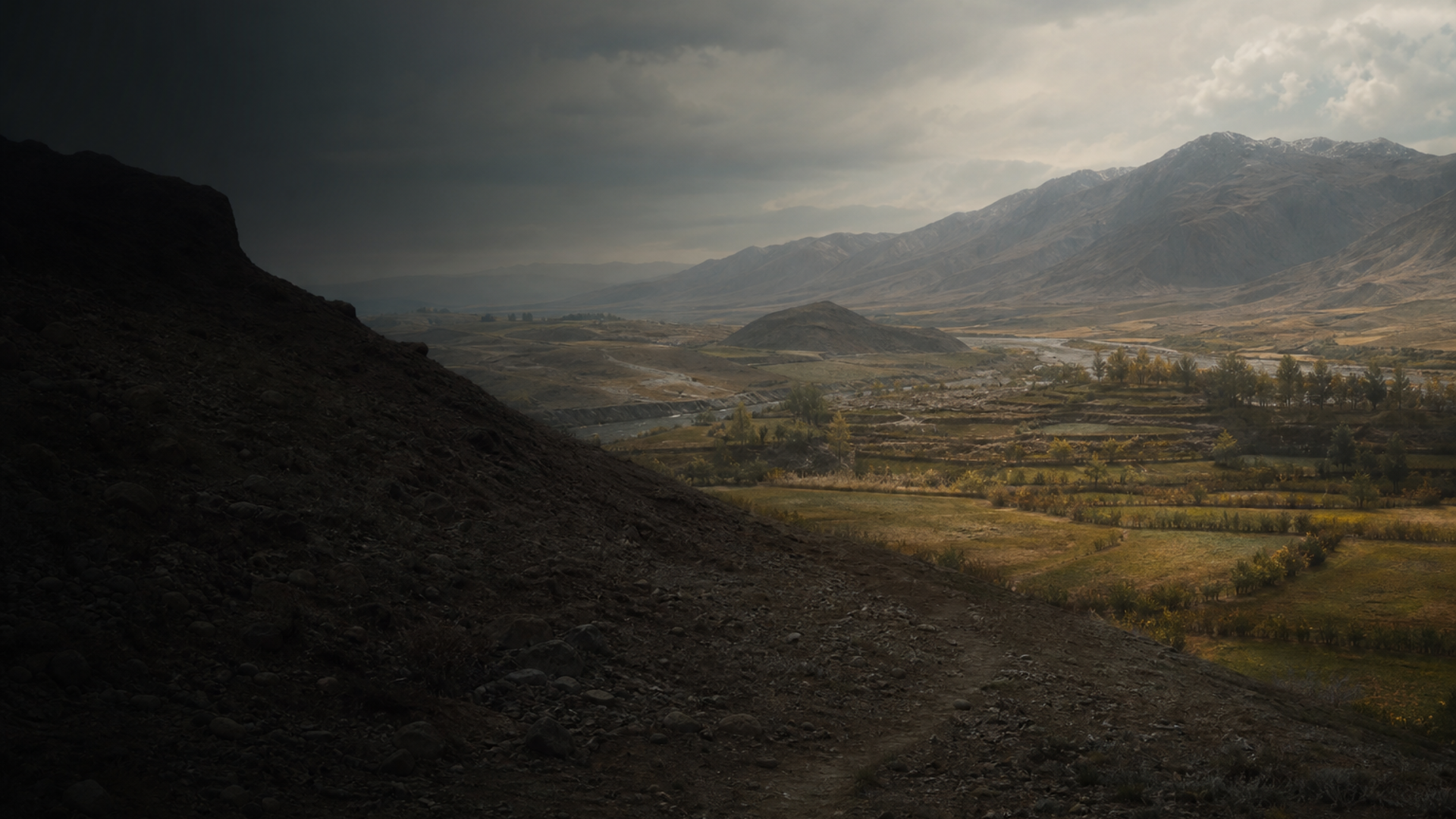
Conchalí Echoes, ~700 Years Ago

Download PDF creates a visual, rasterized copy. Use Print for selectable text and better assistive-technology support.

Bericht wird vorbereitet

Verfügbare Informationen und Referenzen werden geladen

Verbindung mit dem archäologischen Quellenbestand...

Alte Quellen werden zusammengestellt

Zum Hauptinhalt springen
Conchalí Echoes, ~700 Years Ago
Zivilisations-Spotlight

Conchalí Echoes, ~700 Years Ago

A brief, DNA-informed portrait of Conchalí life on the banks of precolonial Santiago

1040 CE - 1410 CE
Conchalí, Santiago Metropolitan Region, Chile
Scrollen zum Start
Kapitel I

Die Geschichte

Die Conchalí Echoes, ~700 Years Ago-Kultur verstehen

Archaeological remains from Conchalí (Santiago, Chile; c. 1040–1410 CE) and two ancient genomes offer a preliminary window into a late precontact community. Material culture and genetic markers (Y‑Q; mtDNA B, D) align with broader Native American lineages, though samples are few.

Time Period

c. 1040–1410 CE (Conchali era)

Region

Conchalí, Santiago Metropolitan Region, Chile

Common Y-DNA

Q (observed in 2 samples)

Common mtDNA

B (1), D (1)

Kapitel II

Zeitleiste

Zentrale Momente in der Geschichte dieser Kultur

1040 CE

Onset of prominent Conchalí occupations

Archaeological contexts indicate intensified settlement and distinctive material culture around Conchalí beginning circa 1040 CE.

1410 CE

Late precontact occupation

By about 1410 CE the Conchalí horizon represents one of the late precontact expressions in the Santiago basin prior to sustained European contact.

Kapitel III

Origins & Emergence

The Conchalí assemblage sits within the layered soils of the Santiago basin, where people negotiated riverine plains and coastal influences. Archaeological data indicates settlement activity in this sector from at least the late first millennium CE, coalescing into recognizable Conchali ceramic and architectural styles by the second millennium’s close. Radiocarbon-calibrated contexts associated with the Conchali phase place intensive occupation between roughly 1040 and 1410 CE, a span that precedes the sustained European presence.

Cultural emergence here appears as a mosaic: pottery with local temper and decoration points to locally rooted craft traditions, while tradeable raw materials attest to connections across valleys and the coastal margin. Limited evidence suggests shifts in settlement density and possibly in subsistence emphasis—responses to climatic variability and social dynamics.

Cinematic image: imagine a riverside cluster of hearths and middens, smoke and pottery silhouettes against the Andes foothills. Yet scientific caution is essential: the current genomic dataset consists of just two individuals from Conchalí, so hypotheses about population origins and migrations remain provisional. Archaeology provides the physical stage; genetics begins to illuminate the actors, but the story is still fragmentary.

  • Occupation concentrated c. 1040–1410 CE in Santiago basin
  • Local pottery traditions with regional exchange evident
  • Interpretations remain provisional due to small sample sizes
Kapitel IV

Daily Life & Society

Material remains from Conchalí evoke a lifeworld shaped by rivers, gardens, and crafted objects. Archaeological data indicates households organized around hearths and storage pits; botanical and faunal remains from nearby contexts suggest mixed economies of cultivated crops, gathered plants, and littoral or riverine fish and shellfish. Households likely combined farming with focused seasonal forays, weaving a rhythm of life tuned to the Central Chile environment.

Social life can be glimpsed through burial practice and mortuary goods when available: variability in grave offerings suggests differentiation of roles or status, though evidence at Conchalí is modest. Ceramic motifs and vessel forms indicate shared symbolic languages across the region—cups and storage jars that speak to foodways and communal feasting.

Visually evocative scene: morning smoke over drying gourds; a child learning pottery on a sun-warmed bench. Yet these images must be tempered by archaeological caution. Many specifics of household composition, gendered labor, and political organization remain underdetermined by current excavation and sampling. Continued fieldwork and more genetic sampling could refine this portrait, making the everyday of Conchalí clearer.

  • Mixed subsistence: cultivation, gathering, and river resources
  • Household and mortuary variability hint at social differentiation
Kapitel V

Genetic Profile

Two ancient genomes from Conchalí provide a slender but illuminating genetic thread. Both male individuals carry Y‑DNA haplogroup Q, a lineage broadly associated with Indigenous populations across the Americas and interpreted as a descendant of early founding paternal lineages. The mitochondrial results show haplogroups B and D—both recognized as major founding maternal lineages in the Americas. Together, these results align the Conchalí individuals with pan‑American ancestral components identified in other Andean and southern cone ancient samples.

Important caveats shape interpretation. The sample count is only two individuals; with n < 10, conclusions about population structure, demographic continuity, or admixture are highly preliminary. These two genomes can suggest affinities—shared ancestry with other precontact South American groups—but they cannot on their own resolve finer-scale questions such as population replacement, sex‑biased migration, or the timing of local gene flow.

Genetics and archaeology together offer a richer picture: archaeological associations anchor these genetic signals in place and time (Conchalí, c. 1040–1410 CE), while future targeted sampling across nearby sites and additional isotopic or proteomic analyses could reveal mobility patterns, kinship, and diet. For now, the genetic data confirm continuity with broader Native American founding lineages and encourage expanded sampling.

  • Both males: Y‑DNA haplogroup Q — consistent with Native American paternal lineages
  • mtDNA B and D observed; these are founding maternal lineages in the Americas
Kapitel VI

Legacy & Modern Connections

The Conchalí material and genetic traces whisper across centuries into modern Central Chile. Archaeological continuity in material styles and settlement locations suggests cultural threads that likely contributed to the region’s later historic populations. Genetic signals—Q on the Y chromosome and mtDNA B and D—tie these Conchalí individuals into the deep pan‑American story of migration and diversification.

However, connecting ancient individuals directly to present-day communities requires care and collaboration. Limited sample numbers mean that claims of direct ancestry or continuity are tentative. Ethical engagement with descendant communities, combined with expanded sampling and transparent data sharing, is essential for responsibly tracing legacies.

Cinematic close: a contemporary family walking through Santiago may pass over ground once inhabited by Conchalí households; their genomes may carry echoes of those riverside fires. Science can detect those echoes, but only with broader datasets and community-guided research can we begin to translate genetic fragments into lived cultural continuities.

  • Genetic lineages align Conchalí with broader Native American ancestry
  • Broader, ethically guided sampling needed to trace direct modern connections
KI-gestützt

KI-Assistent

Stellen Sie Fragen zur Conchalí Echoes, ~700 Years Ago-Kultur

KI-Assistent von DNAGENICS

Funktion freischalten
Stellen Sie Fragen zur Kultur Conchalí Echoes, ~700 Years Ago. Unser KI-Assistent kann genetische Befunde, historischen Kontext, archäologische Belege und moderne Verbindungen erläutern.
Beispiel einer KI-Analyse

Die Conchalí Echoes, ~700 Years Ago-Kultur ist ein faszinierendes Kapitel der Menschheitsgeschichte...

Genetische Analysen zeigen Übereinstimmungen mit früheren Populationen und Hinweise auf besondere Anpassungen und kulturelle Innovationen. Alte DNA-Proben liefern Einblicke in Migrationsmuster, soziale Strukturen und genetische Verbindungen zwischen Populationen.

Dies ist eine Vorschau der KI-Analyse. Schalten Sie den vollständigen KI-Assistenten frei, um detaillierte Einblicke zu erkunden:

  • Genetische Zusammensetzung und genetische Ähnlichkeit
  • Migrationsmuster und Ursprünge
  • Alltag und kulturelle Praktiken
  • Genetischer Bezug zu heutigen Populationen

Weitere antike Kulturen erkunden

Geschichten von Zivilisationen aus der antiken Welt entdecken

Use code for 30% off • Expires Nov 08