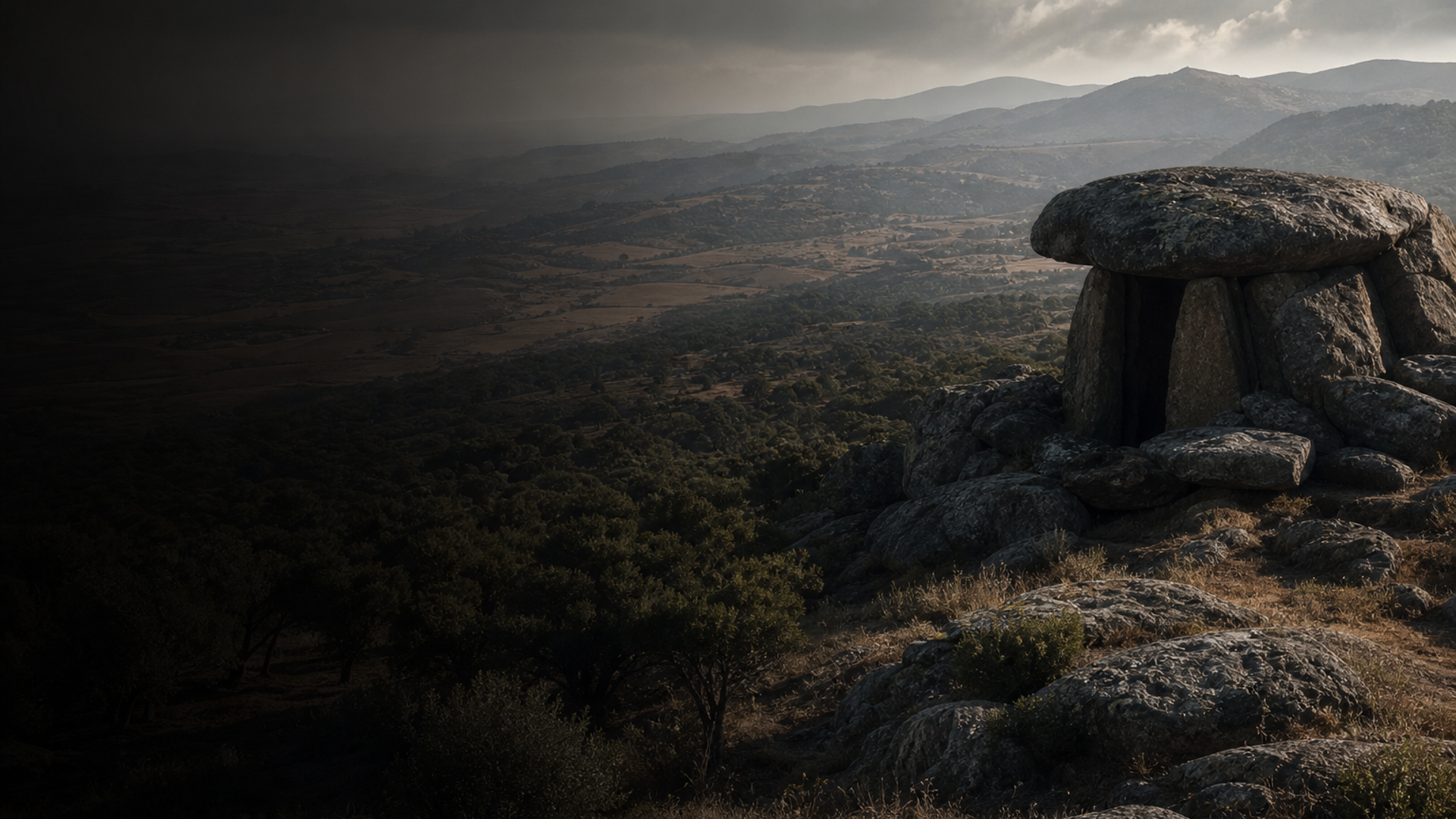
Copper‑Age Voices of Southwest Iberia

Download PDF creates a visual, rasterized copy. Use Print for selectable text and better assistive-technology support.

Zum Hauptinhalt springen
Zivilisations-Spotlight

Copper‑Age Voices of Southwest Iberia

Archaeology and ancient DNA from Valencina & Montelirio (3300–1500 BCE)

3300 CE - 1500 BCE
Southwest Iberia (Sevilla, Spain)

Die Geschichte

Archaeological remains from Sevilla's Valencina and PP4‑Montelirio (3300–1500 BCE) reveal complex Chalcolithic societies. DNA from 11 individuals shows frequent Y‑haplogroup I and maternal lineages dominated by mtDNA K, suggesting layered ancestry and local continuity amid long‑distance connections.

Time Period

3300–1500 BCE

Region

Southwest Iberia (Sevilla, Spain)

Common Y-DNA

I (noted in 5/11 samples)

Common mtDNA

K (predominant: 5/11), U, H3, T, H

Zeitleiste

2500 BCE

Peak Chalcolithic monumentality

Montelirio and Valencina contexts show intensive tomb use, elite deposits, and expanding craft specialization around 2500 BCE.

Origins & Emergence

The Chalcolithic communities of southwest Iberia rose along the fertile Guadalquivir plain, where Valencina de la Concepción and the Montelirio complex (PP4‑Montelirio) near Sevilla became focal points for ritual and social display. Archaeological data indicates intensive monument construction and emergent social differentiation between ca. 3300 and 2500 BCE, with large megalithic tombs, special‑purpose enclosures, and rich burial offerings that evoke an increasingly unequal society.

Cinematic scenes—copper glinting in lamplight, processions at stone portals, the hush of ancestral chambers—are built from pottery styles, metalworking debris, and burial architecture. Material culture and isotope studies suggest long‑range exchange of copper and finished goods across Iberia and beyond. Limited evidence suggests that some elite mortuary spaces were used repeatedly over generations, hinting at hereditary status or kin‑based control of ritual landscapes.

Archaeological interpretation remains cautious: stratigraphy and radiocarbon sequences anchor a broad timeline, but local developments unfolded unevenly. The cultural horizon known as Chalcolithic Southwest Iberia is therefore best seen as a tapestry of linked communities—networked by trade, ritual, and marriage—rather than a single centralized polity.

  • Major sites: Valencina de la Concepción and PP4‑Montelirio near Sevilla
  • Monumental tombs and metalworking mark social complexity
  • Exchange networks connected Iberian Atlantic and Mediterranean coasts

Daily Life & Society

Daily life in the region balanced agrarian routines with episodes of craft specialization and ritual spectacle. Archaeobotanical remains indicate cereal cultivation and animal husbandry supported dense village life, while metallurgical slag and mould fragments attest to local copper production and skilled artisans. Archaeological contexts show carefully produced ceramics and personal ornaments—markers of identity visible in both everyday and funerary contexts.

Mortuary evidence paints a portrait of hierarchical society: a minority of richly furnished burials contrasted with simpler interments, suggesting differential access to wealth and possibly control over resources like metal and ritual sites. Caves and constructed tombs served as stages for ancestral veneration; repeated burial activity at places such as Montelirio links households through shared commemoration. Functional spaces—workshops, dwellings, ritual enclosures—intermingled in settlements, implying that production, consumption, and display were integrated into social life.

Archaeological data indicates connections to coastal trade routes, bringing exotic materials and ideas. Ethnographic analogy and material patterning hint at complex social roles (craft specialists, ritual specialists, lineages), but direct evidence for institutions like chieftaincies is limited and debated.

  • Agriculture and pastoralism formed the economic base
  • Artifacts and burials indicate social inequality and craft specialization

Genetic Profile

Eleven individuals attributed to Spain_SW_Iberia_CA (dated ca. 3300–1500 BCE) provide a first window into the biological makeup of Chalcolithic southwest Iberia. Y‑chromosome data show a notable frequency of haplogroup I (observed in 5 of the 11 males sampled). MtDNA is dominated by haplogroup K (recorded in five individuals), with two cases of U and single instances of H3, T, and H—while one sample lacks a confidently assigned mitochondrial lineage in the published count.

These patterns mirror broader regional tendencies: mtDNA K is commonly associated with Neolithic farmer maternal lineages in western Europe, whereas Y‑haplogroup I has deep roots in European hunter‑gatherer populations and later local continuity. Archaeogenetic interpretation suggests a layered ancestry in which farmer‑derived maternal lineages coexist with substantial local male‑line continuity—consistent with archaeological models of assimilation and local persistence.

Caveats are essential. Eleven samples offer promising insights but remain limited; population heterogeneity across sites and time slices means broader sampling could change frequency estimates. The relative absence of R1b in this small set does not preclude its presence elsewhere or later. Future ancient DNA from surrounding regions and chronological horizons will better resolve migration, kinship, and sex‑biased processes hinted at here.

  • Y‑DNA: Haplogroup I common (5/11)—suggests male‑line continuity
  • MtDNA: K predominant (5/11), with U, H3, T, H—reflecting farmer‑associated maternal ancestry

Legacy & Modern Connections

The genetic legacy of Chalcolithic southwest Iberia is woven into later Iberian population history. Lineages detected in these 11 individuals—especially mtDNA K and Y‑haplogroup I—survive at varying frequencies in modern Iberian gene pools, layered with subsequent Bronze Age and historic movements. Archaeological continuity in settlement and ritual suggests that cultural practices and local elite traditions influenced later social landscapes.

Connecting ancient DNA to living populations must be done carefully: genetic continuity can exist alongside cultural change, and modern distributions reflect millennia of migration and admixture. Still, the Valencina and Montelirio genomes offer evocative glimpses of ancestors who shaped regional demography. Ongoing sampling across Iberia, combined with isotopic and archaeological analyses, will refine how these Chalcolithic threads contributed to the tapestry of contemporary Iberian diversity.

  • Some ancient haplogroups persist in modern Iberian populations
  • Further sampling needed to trace continuity and admixture through the Bronze Age

KI-Assistent

KI-Assistent von DNAGENICS

Funktion freischalten
Stellen Sie Fragen zur Kultur Copper‑Age Voices of Southwest Iberia. Unser KI-Assistent kann genetische Befunde, historischen Kontext, archäologische Belege und moderne Verbindungen erläutern.

Beispiel einer KI-Analyse

Die Copper‑Age Voices of Southwest Iberia-Kultur ist ein faszinierendes Kapitel der Menschheitsgeschichte...

Genetische Analysen zeigen Übereinstimmungen mit früheren Populationen und Hinweise auf besondere Anpassungen und kulturelle Innovationen. Alte DNA-Proben liefern Einblicke in Migrationsmuster, soziale Strukturen und genetische Verbindungen zwischen Populationen.

Dies ist eine Vorschau der KI-Analyse. Schalten Sie den vollständigen KI-Assistenten frei, um detaillierte Einblicke zu erkunden:

  • Genetische Zusammensetzung und genetische Ähnlichkeit
  • Migrationsmuster und Ursprünge
  • Alltag und kulturelle Praktiken
  • Genetischer Bezug zu heutigen Populationen
Use code for 30% off • Expires Nov 14