Dnieper Neolithic: Riverborne Ancestors

Download PDF creates a visual, rasterized copy. Use Print for selectable text and better assistive-technology support.

Bericht wird vorbereitet

Verfügbare Informationen und Referenzen werden geladen

Verbindung mit dem archäologischen Quellenbestand...

Alte Quellen werden zusammengestellt

Zum Hauptinhalt springen
Dnieper Neolithic: Riverborne Ancestors
Zivilisations-Spotlight

Dnieper Neolithic: Riverborne Ancestors

Communities along the Dnipro from 6500–4000 BCE where graves and genomes speak together

6500 CE - 4000 BCE
Ukraine (Dnieper basin, Central & Southern)
Scrollen zum Start
Kapitel I

Die Geschichte

Die Dnieper Neolithic: Riverborne Ancestors-Kultur verstehen

Ukraine_N represents Neolithic communities along the Dnieper (6500–4000 BCE). Archaeology from Vovnigi, Dereivka and Vasil'evka pairs with 72 ancient genomes showing dominant hunter‑gatherer lineages (Y I/R; mtDNA U). Genetic and material evidence together trace lifeways on the Pontic–Caspian frontier.

Time Period

6500–4000 BCE

Region

Ukraine (Dnieper basin, Central & Southern)

Common Y-DNA

I (≈35), R (≈21), rare M/FGC

Common mtDNA

U (≈47) — includes U4a/b/d; T2 present

Kapitel II

Zeitleiste

Zentrale Momente in der Geschichte dieser Kultur

5500 BCE

Peak cemetery activity at Vovnigi and Vasil'evka

Cemeteries along the Dnipro show intensive burial use and ritual continuity, marking a stable riverine Neolithic lifeway in central Ukraine.

Kapitel III

Origins & Emergence

Archaeological data indicates that the Ukraine_N assemblage represents communities settled along the Dnipro and its tributaries between roughly 6500 and 4000 BCE. Excavations at Vasil'evka, Vovnigi and Dereivka reveal dense cemeteries, repeated burial rituals, and material culture continuity suggesting local development from Mesolithic foragers into Neolithic riverine lifeways.

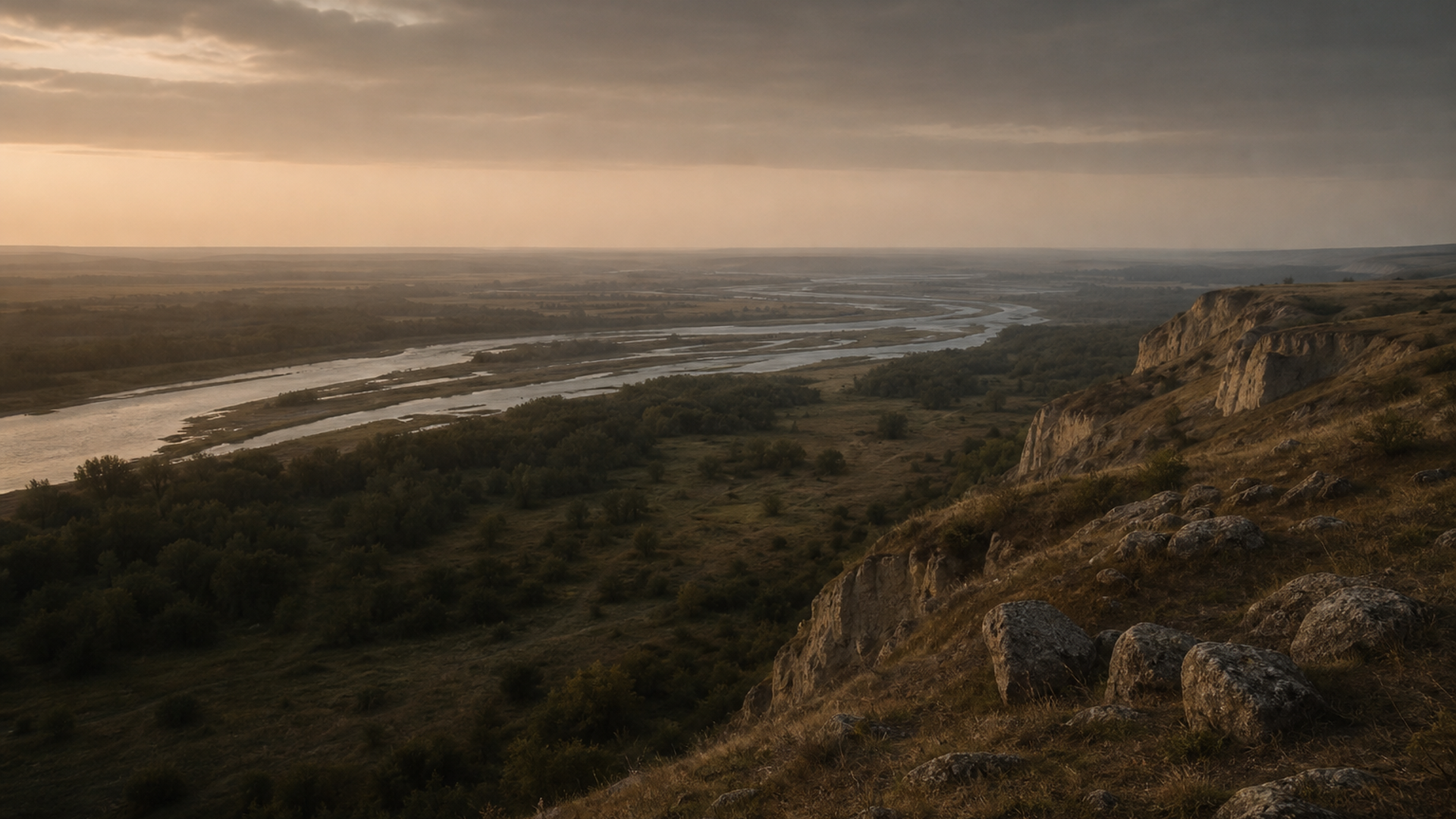
The landscape was a mosaic of floodplain forests, reed beds and open steppe, where fishing, hunting and plant gathering were bolstered by new tools and pottery. Sites such as Vovnigi (large cemeteries on the Dnipro floodplain) and Dereivka I (on the middle Dniester–Dnepr corridor) show long-term occupation and ritual landscapes. Archaeological stratigraphy and radiocarbon dates cluster across the 7th–5th millennia BCE, but there is geographic variability: western and southern localities show subtle differences in grave goods and pottery styles.

Limited evidence suggests contacts with neighboring Neolithic groups to the west and south, but major cultural change appears gradual rather than abrupt. Where the archaeological record thins, genetic data provide an independent thread for tracing connections and population continuity.

  • Local development from Mesolithic to Neolithic along the Dnipro
  • Key sites: Vasil'evka, Vovnigi, Dereivka, Vovnihy, Vasylivka
  • Evidence for sustained riverine lifeways and interregional contacts
Kapitel IV

Daily Life & Society

Material remains paint a cinematic picture: communities clustered on river terraces, smoke rising from reed-thatched huts as boats slid along braided channels. Fishing gear, bone and antler tools, and decorated ceramics appear across cemeteries and settlements, indicating a mixed subsistence economy tuned to aquatic and terrestrial resources.

Burials—often in flexed or supine positions—are concentrated at sites like Vovnigi and Vasil'evka. Grave inventories range from few personal items to more elaborate assemblages, hinting at social differentiation but not rigid hierarchies. Archaeological data indicates communal traditions: repeated grave orientations, collective monuments and patterned use of certain cemetery sectors across generations. Seasonal mobility is probable, with fishing and wild plant exploitation complemented by small-scale cultivation where environmental conditions allowed.

Interpretations rely on both organic and durable artifacts; preservation biases mean wooden structures and textiles are rarely preserved, so reconstructions of domestic interiors remain partly speculative.

  • Mixed fishing, hunting and gathering economy with some cultivation
  • Cemeteries show recurring funerary practices and emerging social differences
Kapitel V

Genetic Profile

The Ukraine_N dataset (72 samples) offers a robust genetic window into Neolithic Dnipro communities. Y-chromosome lineages are dominated by haplogroup I (≈35 samples) with substantial representation of R (≈21). M and FGC occur rarely (1 each). Maternal lineages are overwhelmingly haplogroup U (≈47 samples), including subclades U4d (~6), U4b (~5) and U4a (~4); T2 appears in a small number (~3).

This uniparental profile aligns with expectations for European hunter‑gatherer–derived populations: mtDNA U lineages and Y I/R affiliations are commonly associated with Mesolithic and Neolithic forager ancestry across northern and eastern Europe. Genome‑wide data (where available) indicate continuity with local hunter‑gatherer gene pools and limited input from Anatolian farmer sources during much of this period, though admixture signals vary by site and time. Because 72 genomes provide substantial power, conclusions about regional structure are stronger than many earlier studies, but caution remains: fine-scale migrations, sex‑biased mobility, and localized contacts can produce heterogeneity that is not fully captured by uniparental markers alone.

Finally, rare haplogroups (M, FGC) recorded here highlight occasional deeper or more distant lineages; their low counts mean such findings should be interpreted conservatively.
  • Dominant maternal U lineages and Y I/R consistent with hunter‑gatherer ancestry
  • 72 genomes provide strong evidence for regional continuity with variable local admixture
Kapitel VI

Legacy & Modern Connections

The genetic and archaeological tapestry of Ukraine_N contributes to our understanding of how pre‑Bronze Age populations shaped later Eurasian genetic landscapes. Maternal U lineages and Y I/R variants detected here persist at varying frequencies in modern populations of Eastern Europe, reflecting deep roots of hunter‑gatherer ancestry in the region. Archaeological continuities—ritual burial places, riverine settlement patterns—also informed later cultural trajectories across the Pontic–Caspian frontier.

However, transformations after 4000 BCE, including increased mobility and incoming ancestries during the Eneolithic and Bronze Age, altered genetic profiles across the steppe. Thus Ukraine_N represents a crucial chapter: a long‑lasting regional foundation whose signals are preserved but also reshaped in subsequent millennia. Where sample density is high, we can trace continuity; where sparse, uncertainty remains and new genomes may revise the picture.

  • Contributes hunter‑gatherer ancestry components seen in later Eastern European genomes
  • Serves as a regional baseline before major Eneolithic and Bronze Age transitions
KI-gestützt

KI-Assistent

Stellen Sie Fragen zur Dnieper Neolithic: Riverborne Ancestors-Kultur

KI-Assistent von DNAGENICS

Funktion freischalten
Stellen Sie Fragen zur Kultur Dnieper Neolithic: Riverborne Ancestors. Unser KI-Assistent kann genetische Befunde, historischen Kontext, archäologische Belege und moderne Verbindungen erläutern.
Beispiel einer KI-Analyse

Die Dnieper Neolithic: Riverborne Ancestors-Kultur ist ein faszinierendes Kapitel der Menschheitsgeschichte...

Genetische Analysen zeigen Übereinstimmungen mit früheren Populationen und Hinweise auf besondere Anpassungen und kulturelle Innovationen. Alte DNA-Proben liefern Einblicke in Migrationsmuster, soziale Strukturen und genetische Verbindungen zwischen Populationen.

Dies ist eine Vorschau der KI-Analyse. Schalten Sie den vollständigen KI-Assistenten frei, um detaillierte Einblicke zu erkunden:

  • Genetische Zusammensetzung und genetische Ähnlichkeit
  • Migrationsmuster und Ursprünge
  • Alltag und kulturelle Praktiken
  • Genetischer Bezug zu heutigen Populationen

Weitere antike Kulturen erkunden

Geschichten von Zivilisationen aus der antiken Welt entdecken

Use code for 30% off • Expires Nov 08




