Ebla: Voices of the Early–Middle Bronze Age

Download PDF creates a visual, rasterized copy. Use Print for selectable text and better assistive-technology support.

Zum Hauptinhalt springen
Zivilisations-Spotlight

Ebla: Voices of the Early–Middle Bronze Age

Tell Mardikh's citizens in DNA and clay — tracing lives at Ebla, 2700–1800 BCE

2700 CE - 1800 BCE
Idlib Governorate, Tell Mardikh (Ebla), Syria

Die Geschichte

Archaeogenetic and archaeological evidence from 15 individuals at Tell Mardikh (Ebla), Idlib, Syria (2700–1800 BCE) reveals a Near Eastern genetic profile dominated by Y haplogroups J, T, E, G and diverse maternal lineages (J, U, T, H, K). Findings suggest regional continuity with local diversity and connections across the Levant.

Time Period

2700–1800 BCE

Region

Idlib Governorate, Tell Mardikh (Ebla), Syria

Common Y-DNA

J (4), T (2), E (1), G (1)

Common mtDNA

J (2), U (2), T (1), H (1), K (1)

Zeitleiste

2500 BCE

Urban consolidation at Tell Mardikh (Ebla)

Archaeological evidence indicates urban growth and administrative complexity at Ebla, setting the stage for its role as a regional node in the Early–Middle Bronze Age.

Origins & Emergence

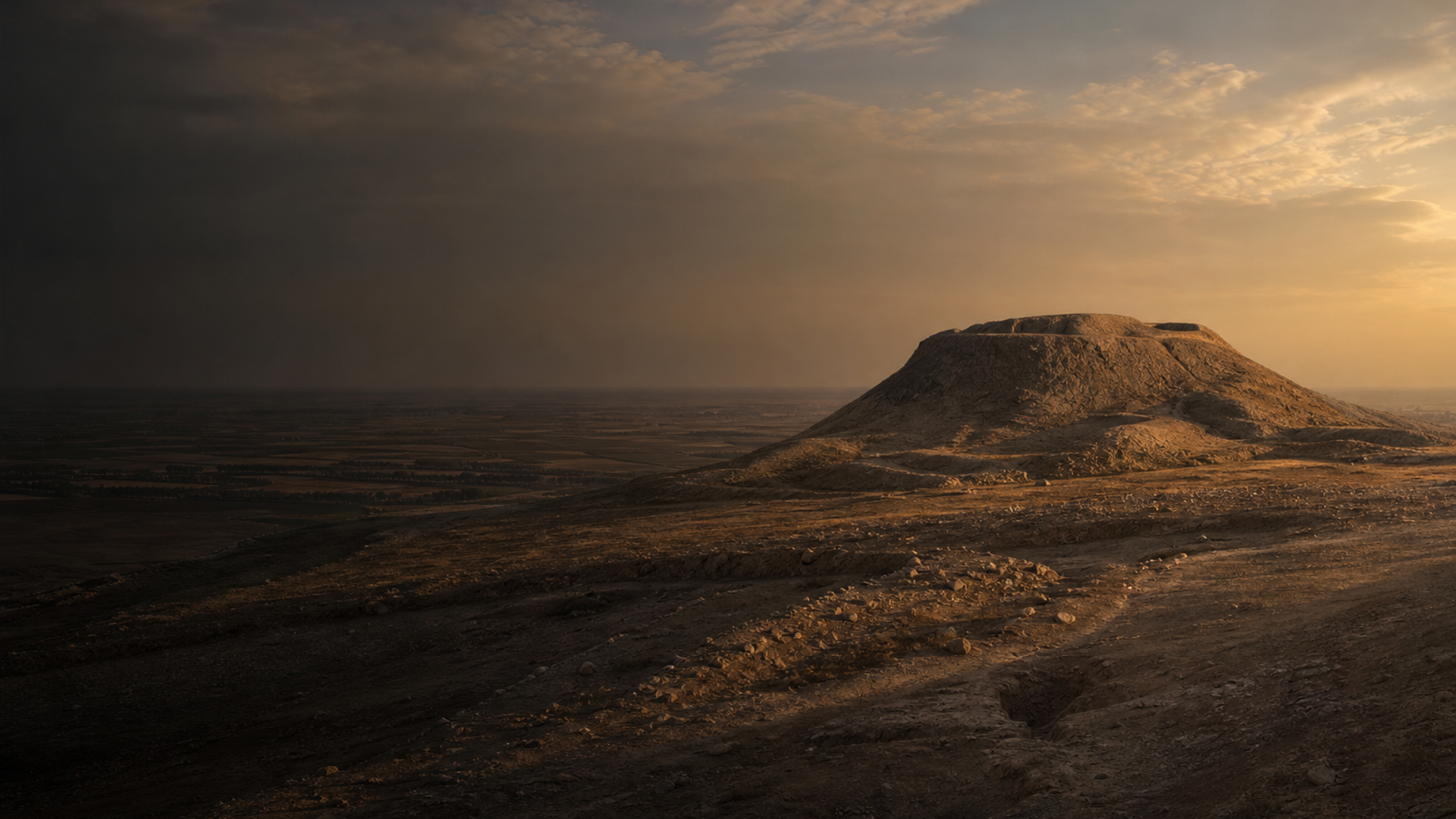
The city at Tell Mardikh — ancient Ebla — rose to prominence during the long arc from the late 3rd to the mid 2nd millennium BCE (here sampled 2700–1800 BCE). Archaeological stratigraphy and radiocarbon anchoring place urban expansion and complex administration within the Early–Middle Bronze Age horizon of northern Syria. Excavations have revealed large building complexes, administrative archives in clay, and material culture that links Ebla to both the northern Mesopotamian plains and the coastal Levant.

Cinematic in scale, Ebla’s urban silhouette would have been a patchwork of mudbrick palaces, workshops, and markets — a node in long-distance networks exchanging metals, textiles, and ritual objects. Material connections to Anatolia and the Levant are visible in pottery styles and imported goods, indicating trade and mobility rather than simple isolation.

From a genetic perspective, the sampled individuals reflect a population rooted in the regional Near Eastern gene pool. The presence of multiple Y-chromosome lineages (notably haplogroup J) and diverse maternal haplogroups suggests an emergent urban community formed through local continuity plus recurrent connections with neighboring regions. Archaeological data indicates a city shaped by internal development and external ties; genetic evidence complements this picture by revealing the biological traces of those interactions.

  • Urban growth at Tell Mardikh spans late 3rd to mid 2nd millennium BCE
  • Material culture shows links across northern Mesopotamia and the Levant
  • Genetics indicate regional Near Eastern roots with multiple lineages

Daily Life & Society

Life in Bronze Age Ebla would have been textured and dynamic: households cultivated cereals and pulses on irrigated fields, flocks grazed the steppe margins, and craftsmen worked copper, faience, and shell. Archaeological remains from Tell Mardikh reveal workshops, storage facilities, and standardized administrative records — evidence for craft specialization and economic management. Ritual life likely threaded through public spaces; preserved sanctuaries and offerings speak to communal identities and belief systems.

Burial practices recovered around the site vary in form and grave goods, providing the physical contexts from which ancient DNA is now recovered. These funerary deposits give snapshots of diet, health, and social differentiation, but preservation bias means our picture is partial. Organic materials survive unevenly; wealthy or monumental contexts are overrepresented in the record.

Mobility shaped everyday experience: traders, artisans, and seasonal herders moved goods and genes across valleys and coasts. Archaeobotanical and zooarchaeological data suggest a mixed agrarian-pastoral economy capable of supporting a sizeable urban population. When read alongside the genetic signatures from 15 individuals, the archaeological record describes a city where continuity and contact coexisted — familiar daily rhythms punctuated by long-distance exchange.

  • Mixed agrarian–pastoral economy with specialized crafts and administration
  • Burial contexts provide DNA but are subject to preservation and sampling bias

Genetic Profile

Fifteen ancient individuals sampled from Tell Mardikh (Ebla) across 2700–1800 BCE yield a coherent but nuanced genetic picture. On the male side, Y-chromosome haplogroups are dominated by J (4 individuals), with additional lineages T (2), E (1), and G (1). These lineages are commonly observed across the ancient and modern Near East: haplogroup J associates broadly with Levantine and Mesopotamian ancestries, while T and G also appear in regional contexts and E has a broader distribution that includes North Africa, the Levant, and parts of the eastern Mediterranean.

Mitochondrial diversity in this sample set includes J (2), U (2), T (1), H (1), and K (1), reflecting a tapestry of maternal ancestries typical of a crossroads population. Overall autosomal affinities (archaeogenetic clustering) align these individuals with regional Near Eastern populations rather than distant steppe or European groups, though limited sampling across two millennia leaves room for temporal shifts.

Interpretation cautions: 15 samples provide moderate power to observe population structure but may miss rarer lineages or short-lived migrations. Archaeological contexts suggest persistent local occupation with episodic contact; the genetic data are consistent with a community shaped by long-term regional continuity, layered with gene flow tied to trade and mobility rather than wholesale replacement.

  • Y-DNA mix (J dominant) matches broader Near Eastern male lineages
  • mtDNA diversity indicates multiple maternal origins typical of a trade hub

Legacy & Modern Connections

Ebla’s material and textual legacy endures in the archaeological record and in the genetic echoes carried by populations of the Levant. Haplogroup J — prominent among the sampled males — remains common in modern populations across Syria and the eastern Mediterranean, suggesting elements of genetic continuity. Yet centuries of movement, conquest, and exchange have reworked ancestry repeatedly; the Ebla samples capture a chapter rather than the whole story.

Culturally, Ebla’s administrative innovations and regional networks helped shape Bronze Age politics and commerce in the Levant. Genetically, the pattern is one of continuity with complexity: a local core augmented by incoming lineages through trade and intermarriage. Future, denser sampling across time and sites will refine how these threads combine into the modern population tapestry. For now, Ebla stands as a vivid archaeological and genetic waypoint in the unfolding human geography of the ancient Near East.

  • Genetic patterns show partial continuity with modern Levantine populations
  • Ebla exemplifies cultural influence and biological mixing via trade and mobility

KI-Assistent

KI-Assistent von DNAGENICS

Funktion freischalten
Stellen Sie Fragen zur Kultur Ebla: Voices of the Early–Middle Bronze Age. Unser KI-Assistent kann genetische Befunde, historischen Kontext, archäologische Belege und moderne Verbindungen erläutern.
Beispiel einer KI-Analyse

Die Ebla: Voices of the Early–Middle Bronze Age-Kultur ist ein faszinierendes Kapitel der Menschheitsgeschichte...

Genetische Analysen zeigen Übereinstimmungen mit früheren Populationen und Hinweise auf besondere Anpassungen und kulturelle Innovationen. Alte DNA-Proben liefern Einblicke in Migrationsmuster, soziale Strukturen und genetische Verbindungen zwischen Populationen.

Dies ist eine Vorschau der KI-Analyse. Schalten Sie den vollständigen KI-Assistenten frei, um detaillierte Einblicke zu erkunden:

  • Genetische Zusammensetzung und genetische Ähnlichkeit
  • Migrationsmuster und Ursprünge
  • Alltag und kulturelle Praktiken
  • Genetischer Bezug zu heutigen Populationen
Use code for 30% off • Expires Nov 14




