Echoes from the Amur: Paleolithic Moment

Download PDF creates a visual, rasterized copy. Use Print for selectable text and better assistive-technology support.

Bericht wird vorbereitet

Verfügbare Informationen und Referenzen werden geladen

Verbindung mit dem archäologischen Quellenbestand...

Alte Quellen werden zusammengestellt

Zum Hauptinhalt springen
Echoes from the Amur: Paleolithic Moment
Zivilisations-Spotlight

Echoes from the Amur: Paleolithic Moment

A single 32,000-year-old individual illuminates riverine life on the Amur’s ancient floodplains

32159 CE - 31169 BCE
Amur River Basin, China
Scrollen zum Start
Kapitel I

Die Geschichte

Die Echoes from the Amur: Paleolithic Moment-Kultur verstehen

Archaeogenetic and archaeological evidence from a single Paleolithic individual (c. 32,159–31,169 BCE) in the Amur River Basin, China, offers a tentative glimpse into early Northeast Asian lifeways and maternal lineages (mtDNA B). Limited sample size makes conclusions provisional.

Time Period

c. 32,159–31,169 BCE

Region

Amur River Basin, China

Common Y-DNA

Not reported / undetermined

Common mtDNA

B (single sample)

Kapitel II

Zeitleiste

Zentrale Momente in der Geschichte dieser Kultur

32159 BCE

Radiocarbon date for Amur individual

Direct dating places the sampled individual at c. 32,159–31,169 BCE, providing a rare Paleolithic genetic snapshot from the Amur Basin.

Kapitel III

Origins & Emergence

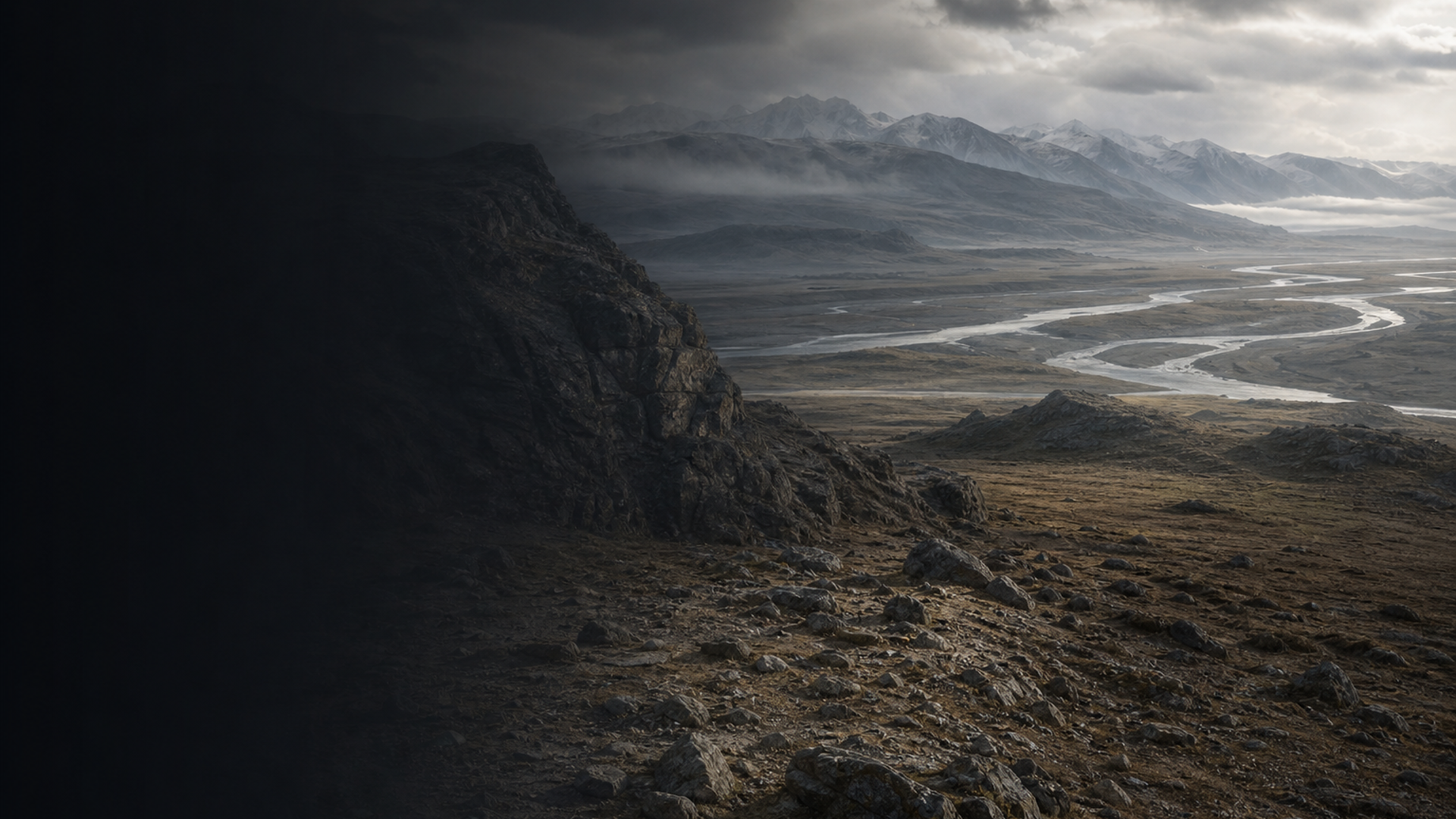
Beneath a cold, wind-swept sky and the braided channels of the Amur, a human hand—one genetic profile recovered from riverine deposits—anchors a moment of deep prehistory. Radiocarbon dates place this individual between c. 32,159 and 31,169 BCE, in the Upper Paleolithic landscape of what is now the Amur River Basin in northeastern China. Archaeological data indicates a focus on river and wetland resources across the broader region during this period: lithic scatters, hearths and faunal remains at nearby localities suggest specialized hunting, fishing, and seasonal mobility.

Climatically, this interval predates the Last Glacial Maximum and sits within a fluctuating, cold-adapted environment. Limited evidence suggests human groups exploited diverse ecological niches—floodplains, wooded terraces and ice-free refugia—allowing for both local continuity and long-distance interactions across Northeast Asia. Because the genetic record here currently rests on a single sampled individual, interpretations of population origins and movements must remain cautious. Archaeology frames a landscape of adaptation; genetics offers the first maternal signal, a single strand of the larger human story waiting to be woven by further discoveries.

  • Single ancient individual dated to c. 32,159–31,169 BCE
  • Found in the Amur River Basin, northeastern China
  • Context suggests riverine and wetland exploitation
Kapitel IV

Daily Life & Society

Imagining daily life along the ancient Amur requires threading together fragile archaeological traces with environmental inference. Stone tools recovered in regional Paleolithic contexts include bladelets, truncated pieces and simple retouched implements consistent with hunting, processing hides and butchering fish and large mammals. Archaeological data indicates hearth features and concentrations of bone that hint at ephemeral camps rather than long-lived sedentary sites.

Seasonality likely structured movement: warm months for fishing and plant gathering along riverbanks, colder seasons for hunting in forest margins or terraces. Social groups were probably small, mobile bands with flexible kin networks that could coalesce for resource-rich seasons. Ornamentation and curated tools—seen regionally—suggested social signaling and long-distance exchange of ideas or raw materials. However, the single genetic sample constrains our ability to generalize about social complexity, kinship patterns or population size; ethnographic analogy and regional excavation remain essential to flesh out daily life on these paleolandscapes.

  • Riverine subsistence: fishing, hunting, and plant gathering
  • Mobile camps with curated stone toolkits and hearths
Kapitel V

Genetic Profile

The recovered genetic information from this individual is sparse but evocative. Mitochondrial DNA places the person in haplogroup B—an East Asian maternal lineage that, in later millennia, is present across East Asia and also in populations of the Americas. This single mtDNA assignment provides a maternal snapshot rather than a full population portrait. No Y‑chromosome data are reported for this specimen, and autosomal coverage is limited, so assessments of ancestry, admixture or direct continuity with later groups are highly provisional.

Because sample count = 1, statistical inference is essentially impossible: the mtDNA B signal could represent a locally common maternal line, a transient lineage, or an individual of mixed ancestry. Nevertheless, when combined with other ancient genomes from Northeast Asia, such mitochondrial data help map the deep-time presence of lineages that later appear across wider regions. Archaeogenetics here primarily serves as a directional indicator—suggesting maternal connections across East Asia—rather than definitive proof of population movements. Future samples from the Amur and adjacent regions, especially with robust autosomal data, will be required to test hypotheses of continuity, migration, and the role of the Amur as a corridor linking interior Siberia, the Russian Far East and northeastern China.

  • mtDNA haplogroup B identified (single sample)
  • Y‑DNA not recovered; autosomal data limited — interpretations provisional
Kapitel VI

Legacy & Modern Connections

The genetic echo of this lone Paleolithic individual offers a poetic glimpse of deep maternal roots in Northeast Asia. Haplogroup B’s later presence across East Asia and into the Americas means this find sits within a broader tapestry of population dispersals, but any direct line of descent to modern groups remains hypothetical given the tiny sample size. Archaeologically, the Amur corridor continued to be important through the Holocene: it appears in later records as a zone of cultural exchange, resource abundance and demographic resilience.

For researchers and the public, this discovery underscores both the promise and limits of early ancient DNA: a single genome can illuminate possibilities but cannot substitute for the dense sampling needed to trace ancestry and cultural transmission. The true legacy of the site will come as more individuals are sequenced and integrated with archaeological contexts, enabling a clearer picture of how Ice Age communities on the Amur contributed to the genetic and cultural mosaic of Northeast Asia.

  • mtDNA B connects this individual to broader East Asian maternal lineages
  • Additional sampling is needed to assess long-term continuity and links to modern populations
KI-gestützt

KI-Assistent

Stellen Sie Fragen zur Echoes from the Amur: Paleolithic Moment-Kultur

KI-Assistent von DNAGENICS

Funktion freischalten
Stellen Sie Fragen zur Kultur Echoes from the Amur: Paleolithic Moment. Unser KI-Assistent kann genetische Befunde, historischen Kontext, archäologische Belege und moderne Verbindungen erläutern.
Beispiel einer KI-Analyse

Die Echoes from the Amur: Paleolithic Moment-Kultur ist ein faszinierendes Kapitel der Menschheitsgeschichte...

Genetische Analysen zeigen Übereinstimmungen mit früheren Populationen und Hinweise auf besondere Anpassungen und kulturelle Innovationen. Alte DNA-Proben liefern Einblicke in Migrationsmuster, soziale Strukturen und genetische Verbindungen zwischen Populationen.

Dies ist eine Vorschau der KI-Analyse. Schalten Sie den vollständigen KI-Assistenten frei, um detaillierte Einblicke zu erkunden:

  • Genetische Zusammensetzung und genetische Ähnlichkeit
  • Migrationsmuster und Ursprünge
  • Alltag und kulturelle Praktiken
  • Genetischer Bezug zu heutigen Populationen

Weitere antike Kulturen erkunden

Geschichten von Zivilisationen aus der antiken Welt entdecken

Use code for 30% off • Expires Nov 08




