Echoes of the Atlantic: Portugal Late Neolithic

Download PDF creates a visual, rasterized copy. Use Print for selectable text and better assistive-technology support.

Bericht wird vorbereitet

Verfügbare Informationen und Referenzen werden geladen

Verbindung mit dem archäologischen Quellenbestand...

Alte Quellen werden zusammengestellt

Zum Hauptinhalt springen
Echoes of the Atlantic: Portugal Late Neolithic
Zivilisations-Spotlight

Echoes of the Atlantic: Portugal Late Neolithic

A fragile portrait of coastal communities from 3700–2000 BCE in Portugal

3700 CE - 2000 BCE
Portugal (Atlantic and interior sites)
Scrollen zum Start
Kapitel I

Die Geschichte

Die Echoes of the Atlantic: Portugal Late Neolithic-Kultur verstehen

Archaeological and genetic traces from five individuals at Cova da Moura, Dolmen de Ansião and Monte Canelas 1 illuminate Late Neolithic–Chalcolithic Portugal. Limited samples suggest local continuity with hints of diverse paternal lineages (I, H) and varied maternal haplogroups (U, J, K, H).

Time Period

3700–2000 BCE

Region

Portugal (Atlantic and interior sites)

Common Y-DNA

I (3), H (1)

Common mtDNA

U, J, K, H

Kapitel II

Zeitleiste

Zentrale Momente in der Geschichte dieser Kultur

2500 BCE

Intensification of Megalithic Use

Dolmen use and monument building in central Portugal peak, reflecting community-level ritual and memory practices across generations.

Kapitel III

Origins & Emergence

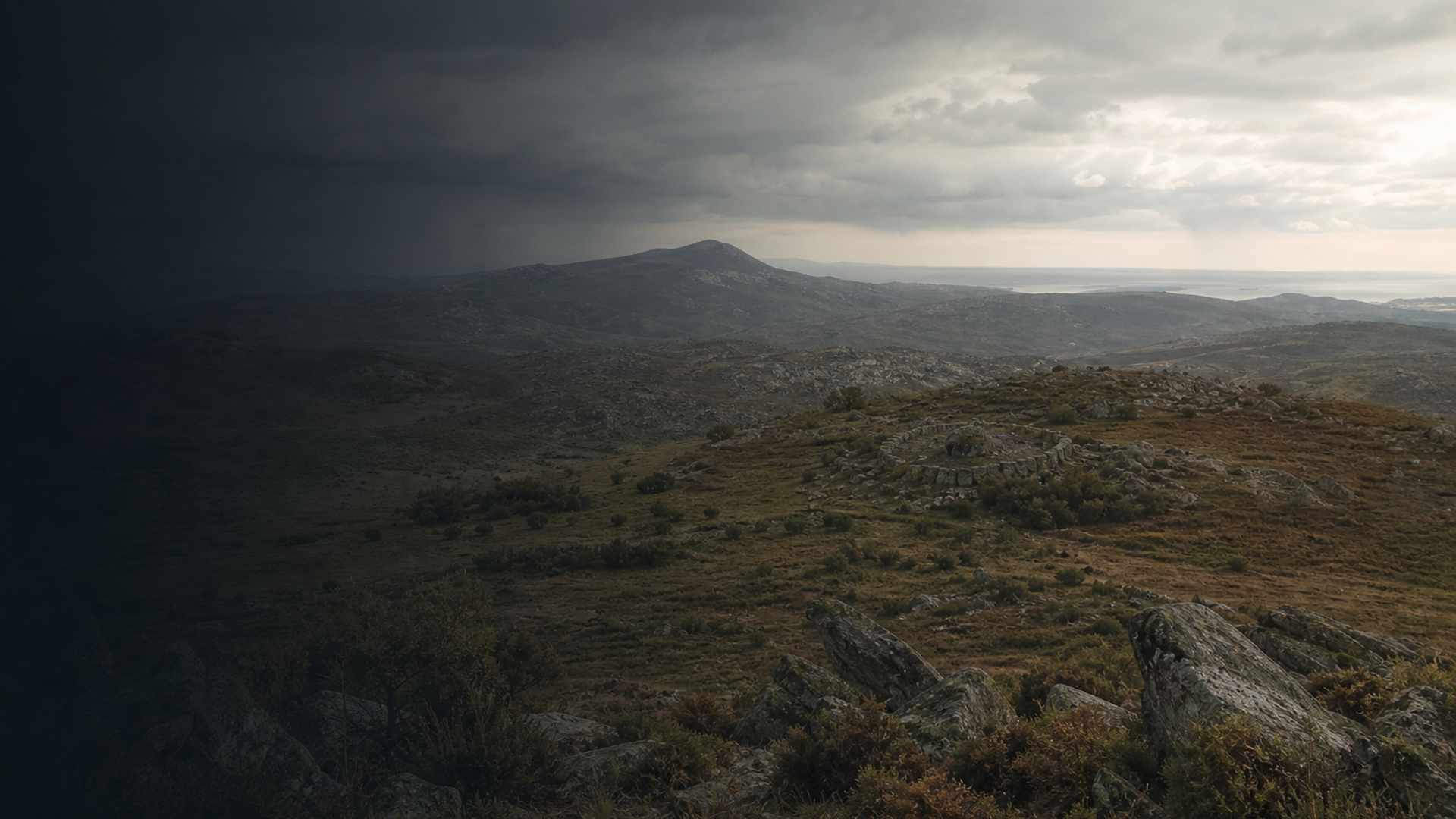
Along the wind-battered coasts and quiet interior tombs of western Iberia, communities that archaeologists group as Portugal_LN_C emerged between about 3700 and 2000 BCE. The material record — dolmens, megalithic tombs and settlement debris from sites such as Dolmen de Ansião, Cova da Moura and Monte Canelas 1 — evokes a landscape shaped by ritual architecture, pastoralism and growing exchange networks.

Archaeological data indicates continuity with earlier Neolithic farming traditions, while Chalcolithic horizons show increased long-distance connections: exotic stone tools, new pottery styles and elaborate burial practices. This cultural horizon sits at the threshold between the Neolithic world of local farming communities and the more mobile, hierarchical societies that later characterize the Copper Age.

Limited evidence suggests these communities maintained strong local lifeways even as exchange intensified: megalithic monuments continued to anchor regional identities while trade and small-scale migrations introduced new goods and ideas. Given the small genetic sample set (n=5), conclusions about population origins remain preliminary, but the combined archaeological and genetic picture hints at a community tapestry woven from deep local roots and intermittent outside threads.

  • Sites include Dolmen de Ansião, Cova da Moura, Monte Canelas 1
  • Dates span Late Neolithic into Chalcolithic (3700–2000 BCE)
  • Archaeology shows local continuity with growing long-distance exchange
Kapitel IV

Daily Life & Society

In imagining daily life for Portugal_LN_C communities, picture households clustered near fertile terraces and rocky promontories, where shepherds tended flocks and farmers cultivated barley, wheat and legumes. Archaeobotanical remains at regional Neolithic and Chalcolithic sites indicate mixed farming economies; zooarchaeological assemblages point to sheep, cattle and pig husbandry as dietary mainstays.

Megalithic tombs such as Dolmen de Ansião served as communal memory theaters: repeated burial, curated grave goods and monumental architecture suggest sustained social bonds and ritual investment across generations. Pottery sherds, stone tools and personal ornaments recovered at Monte Canelas 1 and Cova da Moura hint at everyday craftsmanship and a material culture shaped by both local traditions and external contacts.

Mobility likely varied by season and role: itinerant herders, coastal fishers and inland farmers all contributed to a mosaic of lifeways. Social organization probably balanced household autonomy with communal rites centered on tombs and exchange fairs. However, archaeological resolution is uneven and many inferences remain cautious, especially when linking artifacts to specific social hierarchies.

  • Mixed farming and herding economy with regional specializations
  • Megalithic tombs functioned as communal ritual centers
Kapitel V

Genetic Profile

Genome-wide data from five individuals (sample count = 5) assigned to Portugal_LN_C provide a tentative genetic snapshot. Paternal lineages are dominated by haplogroup I (three individuals), with one occurrence of haplogroup H. Maternal lineages among the sampled individuals include U, J, K and H.

The predominance of Y-haplogroup I in this small set is consistent with persistence of lineages linked to long-established European hunter‑gatherer and early farmer interactions in Atlantic Iberia. The single H Y‑lineage is notable but must be treated cautiously; haplogroup H is relatively uncommon in ancient western Europe and its presence in one sample could reflect rare local diversity or low-frequency migration. Mitochondrial diversity (U, J, K, H) suggests maternal lineages typical of Neolithic and Chalcolithic Europe, indicating continuity alongside admixture.

Archaeological patterns of regional continuity and intermittent exchange align with a genetic picture of local ancestry with some influxes. Because the dataset is small (<10 samples), all genetic inferences are preliminary: additional sampling across sites and time slices is required to test hypotheses about migration, sex-biased gene flow, and the timing of external influences in Late Neolithic–Chalcolithic Portugal.

  • Y-DNA dominated by I (3) with a single H instance — interpret cautiously
  • mtDNA diversity (U, J, K, H) indicates maternal continuity with Neolithic Europe
Kapitel VI

Legacy & Modern Connections

The stones and bones of Portugal_LN_C whisper into the present: some maternal and paternal lineages visible in these samples are part of genetic threads that persist in Iberia today. Archaeological monuments like the Dolmen de Ansião remain cultural landmarks, linking modern communities to millennia-old ritual landscapes.

Genetic continuity implied by these limited samples suggests that much of the region’s ancestry derives from local Neolithic roots, later interwoven with episodic external inputs during the Chalcolithic and beyond. While dramatic narratives of massive population replacement are not supported by this small dataset, the fuller story will unfold only with more extensive genomic and archaeological sampling. For now, Portugal_LN_C stands as a careful reminder: the deep past is a tapestry—some threads bright and clear, others still awaiting discovery.

  • Monuments and genetic threads suggest continuity into modern Iberian populations
  • Small sample size mandates caution; broader sampling could change interpretations
KI-gestützt

KI-Assistent

Stellen Sie Fragen zur Echoes of the Atlantic: Portugal Late Neolithic-Kultur

KI-Assistent von DNAGENICS

Funktion freischalten
Stellen Sie Fragen zur Kultur Echoes of the Atlantic: Portugal Late Neolithic. Unser KI-Assistent kann genetische Befunde, historischen Kontext, archäologische Belege und moderne Verbindungen erläutern.
Beispiel einer KI-Analyse

Die Echoes of the Atlantic: Portugal Late Neolithic-Kultur ist ein faszinierendes Kapitel der Menschheitsgeschichte...

Genetische Analysen zeigen Übereinstimmungen mit früheren Populationen und Hinweise auf besondere Anpassungen und kulturelle Innovationen. Alte DNA-Proben liefern Einblicke in Migrationsmuster, soziale Strukturen und genetische Verbindungen zwischen Populationen.

Dies ist eine Vorschau der KI-Analyse. Schalten Sie den vollständigen KI-Assistenten frei, um detaillierte Einblicke zu erkunden:

  • Genetische Zusammensetzung und genetische Ähnlichkeit
  • Migrationsmuster und Ursprünge
  • Alltag und kulturelle Praktiken
  • Genetischer Bezug zu heutigen Populationen

Weitere antike Kulturen erkunden

Geschichten von Zivilisationen aus der antiken Welt entdecken

Use code for 35% off • Expires Nov 09