Echoes of the Mycenaean Palaces

Download PDF creates a visual, rasterized copy. Use Print for selectable text and better assistive-technology support.

Bericht wird vorbereitet

Verfügbare Informationen und Referenzen werden geladen

Verbindung mit dem archäologischen Quellenbestand...

Alte Quellen werden zusammengestellt

Zum Hauptinhalt springen
Echoes of the Mycenaean Palaces
Zivilisations-Spotlight

Echoes of the Mycenaean Palaces

A cinematic view of Bronze Age Greece where archaeology meets ancient DNA

1610 CE - 950 BCE
Greece (Peloponnese, Attica, Salamis)
Scrollen zum Start
Kapitel I

Die Geschichte

Die Echoes of the Mycenaean Palaces-Kultur verstehen

Archaeological remains from Peloponnese and Attica (1610–950 BCE) illuminate the Mycenaean world. Nineteen genomes link palatial centers such as Pylos and Salamis to broader Aegean and steppe-related ancestries while maternal lineages reveal diverse Mediterranean connections.

Time Period

1610–950 BCE

Region

Greece (Peloponnese, Attica, Salamis)

Common Y-DNA

J (observed, low frequency)

Common mtDNA

X2(2), J(2), HV(2), H7(2), X2d(1)

Kapitel II

Zeitleiste

Zentrale Momente in der Geschichte dieser Kultur

1600 BCE

Rise of Palatial Centers

Palaces form in mainland Greece (Pylos, Mycenae), concentrating administration, craft production and storage.

1450 BCE

Expansion and Administration

Linear B appears in palatial archives; maritime trade intensifies with Crete and the eastern Mediterranean.

1200 BCE

Late Bronze Age Disruptions

A series of destructions and declines affect many palatial centers across Greece during regional upheavals.

1050 BCE

Regional Transformation

Post‑palatial communities reconfigure; some sites show continuity while others diminish in scale.

Kapitel III

Origins & Emergence

The Mycenaean horizon rises from a landscape of fortified citadels, palace workshops and coastal harbors. By around 1600 BCE southern Greece saw the consolidation of palatial centers — Pylos (Palace of Nestor), fortified settlements in the Peloponnese, and maritime sites on Salamis — that coordinated craft production, redistribution and long-distance exchange. Archaeological evidence indicates increasing social complexity: monumental architecture, Linear B administration (from c. 1450 BCE in mainland contexts), and rich grave goods that attest to elite mobilities and extensive trade networks with Crete, Anatolia and the wider eastern Mediterranean.

Material culture — Mycenaean pottery styles, bronze weaponry and imported luxury objects — marks both local innovation and adoption of external forms. Limited evidence suggests regional variation in settlement trajectories after the palatial destructions of the Late Bronze Age; some centers show continuity, others decline. Palaces acted as hubs that linked inland agricultural hinterlands to seafaring routes, shaping a distinctive Aegean civilization whose footprints survive in earthworks, tombs and archives of clay tablets recovered at palatial sites.

  • Palatial centers emerged c. 1600–1450 BCE (Pylos, Salamis region)
  • Material links to Crete and Anatolia indicate wide exchange
  • Evidence points to regional variability after Late Bronze Age disruptions
Kapitel IV

Daily Life & Society

Beneath the grandeur of palaces lay daily rhythms of craft, agriculture and ritual. Farmers cultivated wheat, barley and olives on terraced hills; shepherds moved flocks across seasonally varied landscapes. At sites like Galatas Apatheia and Peristeria Tryfilia, archaeological layers record household pottery, food processing installations and small-scale metallurgy that sustained local economies. Urban households in palatial towns engaged specialist artisans — potters, seal-carvers, bronze-workers — whose goods crossed the sea in exchange networks that extended to the eastern Mediterranean.
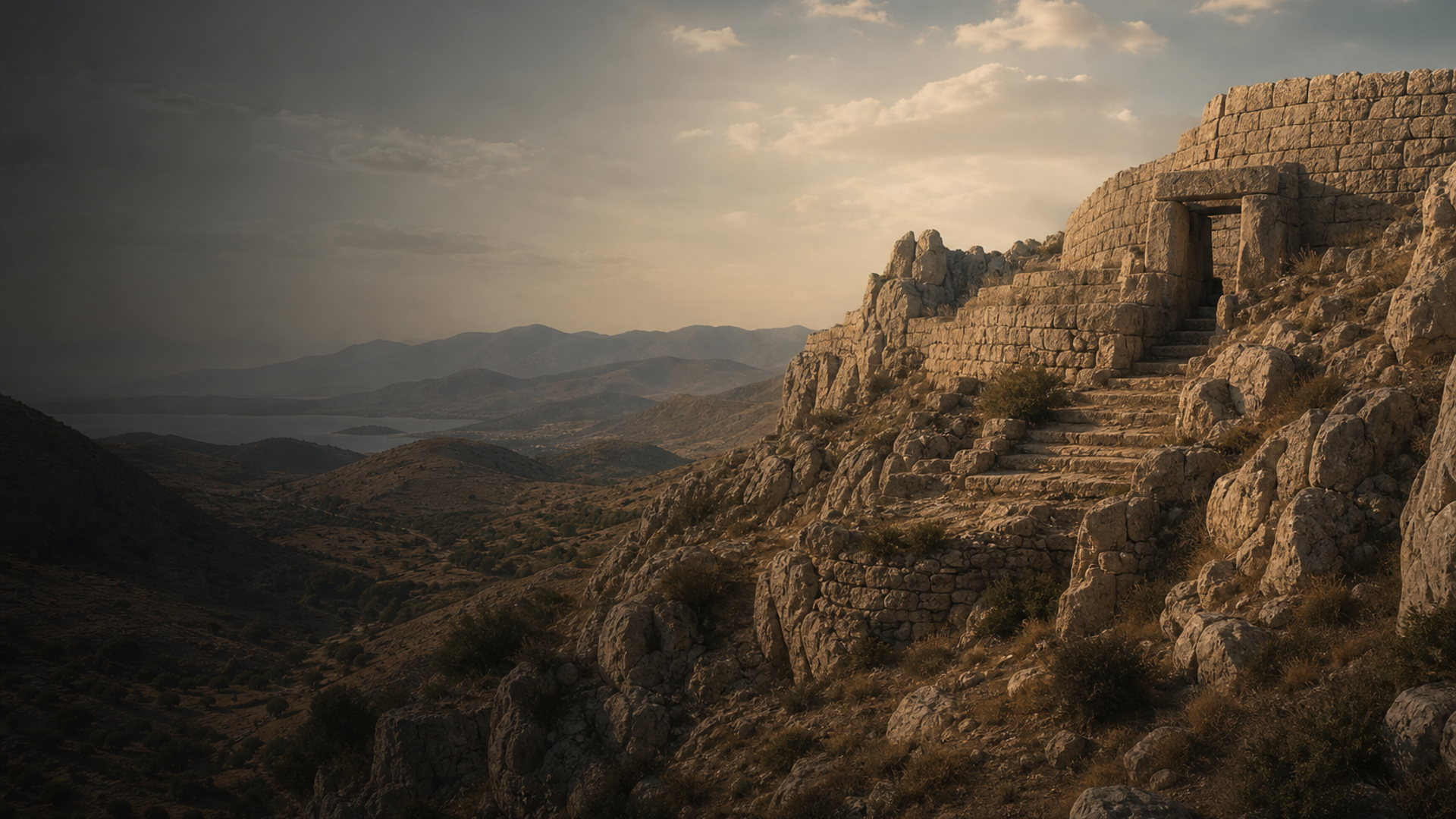

Burial practices and funerary wealth reveal social distinctions: some tombs contained rich assemblages suggesting elite status, while other interments were modest. Linear B archives from contemporary palaces refer to organized labor, grain stores and commodity redistribution; archaeological data indicates a bureaucratic backbone supporting sophisticated economic coordination. Seasonal festivals, ritual depositions and symbolic art—visible in fresco fragments and carved stones—hint at communal identities tied to place, lineage and exchange.

  • Agriculture and pastoralism underpinned palatial economies
  • Artisans and long-distance trade connected villages to palaces
Kapitel V

Genetic Profile

Nineteen sampled individuals dated between 1610 and 950 BCE from Peloponnese and Attica (sites: Galatas Apatheia; Agia Kyriaki, Salamis; Peristeria Tryfilia; Pylos, Palace of Nestor; Kolikrepi‑Spata) provide a modest but informative genetic window into Mycenaean populations. Genomic patterns are consistent with previous Aegean Bronze Age results: ancestry is primarily derived from local Neolithic farmer-related backgrounds combined with a detectable component of northern/steppe‑related ancestry introduced earlier in the 3rd–2nd millennium BCE. This mixed profile mirrors archaeological evidence for both deep local continuity and incoming influences.

Uniparental markers in this set show low-frequency Y‑DNA haplogroup J (observed in 1 sample), while maternal diversity is higher — mtDNA lineages include X2, J, HV and H7 among others. The presence of X2 and HV variants suggests maternal links reaching into Anatolia and the wider Mediterranean, consistent with maritime exchange and long-standing farmer ancestry in the Aegean. Because the dataset comprises 19 individuals and is geographically focused, conclusions about population-wide patterns must be cautious: the sample size permits regionally specific insights but cannot capture the full demographic complexity of all Mycenaean Greece.

  • Genome-wide mix of Neolithic farmer-related and steppe-related ancestry
  • Uniparental markers: Y‑DNA J (1); mtDNA diverse (X2, J, HV, H7)
Kapitel VI

Legacy & Modern Connections

The genetic and archaeological traces of Mycenaean Greece linger in modern populations and cultural memory. Modern Greeks carry portions of the continuum that includes Neolithic Aegean ancestries and later inputs; some maternal lineages seen in Mycenaean-era samples are still present in the region today, reflecting millennia of local persistence and maritime connectivity. Archaeology and DNA together illuminate how palatial economies, craft traditions and seafaring shaped lineages and cultural practices that influenced successor Iron Age societies.

However, genetic continuity is not uniform: centuries of migrations, trade and regional upheavals altered population landscapes after the Late Bronze Age collapse. The 19-sample dataset offers concrete glimpses into regional Mycenaean demography but should be read alongside broader genomic studies and archaeological contexts to trace connections to later populations. Together, bones and tablets, pottery and genomes let us hear the distant pulse of a civilization that once knit the Aegean into a network of palaces and ports.

  • Some maternal lineages persist into the modern Aegean gene pool
  • Combined DNA and archaeology reveal continuity and later change
KI-gestützt

KI-Assistent

Stellen Sie Fragen zur Echoes of the Mycenaean Palaces-Kultur

KI-Assistent von DNAGENICS

Funktion freischalten
Stellen Sie Fragen zur Kultur Echoes of the Mycenaean Palaces. Unser KI-Assistent kann genetische Befunde, historischen Kontext, archäologische Belege und moderne Verbindungen erläutern.
Beispiel einer KI-Analyse

Die Echoes of the Mycenaean Palaces-Kultur ist ein faszinierendes Kapitel der Menschheitsgeschichte...

Genetische Analysen zeigen Übereinstimmungen mit früheren Populationen und Hinweise auf besondere Anpassungen und kulturelle Innovationen. Alte DNA-Proben liefern Einblicke in Migrationsmuster, soziale Strukturen und genetische Verbindungen zwischen Populationen.

Dies ist eine Vorschau der KI-Analyse. Schalten Sie den vollständigen KI-Assistenten frei, um detaillierte Einblicke zu erkunden:

  • Genetische Zusammensetzung und genetische Ähnlichkeit
  • Migrationsmuster und Ursprünge
  • Alltag und kulturelle Praktiken
  • Genetischer Bezug zu heutigen Populationen

Weitere antike Kulturen erkunden

Geschichten von Zivilisationen aus der antiken Welt entdecken

Use code for 30% off • Expires Nov 08




