Echoes of the Steppe: G218 Scythian‑Era Graves

Download PDF creates a visual, rasterized copy. Use Print for selectable text and better assistive-technology support.

Bericht wird vorbereitet

Verfügbare Informationen und Referenzen werden geladen

Verbindung mit dem archäologischen Quellenbestand...

Alte Quellen werden zusammengestellt

Zum Hauptinhalt springen
Echoes of the Steppe: G218 Scythian‑Era Graves
Zivilisations-Spotlight

Echoes of the Steppe: G218 Scythian‑Era Graves

Iron Age burials from Xinjiang that hint at steppe ties and mixed west‑east ancestry

386 CE - 8 BCE
Xinjiang, China (Yili Region, Nileke County, G218)
Scrollen zum Start
Kapitel I

Die Geschichte

Die Echoes of the Steppe: G218 Scythian‑Era Graves-Kultur verstehen

Six Iron Age individuals (386–8 BCE) from G218, Nileke County, Xinjiang show a mosaic of steppe and East Asian maternal lineages and a Y‑lineage Q signal. Limited samples make results preliminary but evocative of Scythian/Wusun-era connections.

Time Period

386–8 BCE (Iron Age)

Region

Xinjiang, China (Yili Region, Nileke County, G218)

Common Y-DNA

Q (observed in 1 of 6)

Common mtDNA

H (2), D (2), HV (1), C (1)

Kapitel II

Zeitleiste

Zentrale Momente in der Geschichte dieser Kultur

200 BCE

Iron Age steppe influence in Xinjiang

Regional burials and material culture in Xinjiang show Scythian‑style influences and increased mobility across the steppe corridors (descriptive, based on regional archaeological patterns).

Kapitel III

Origins & Emergence

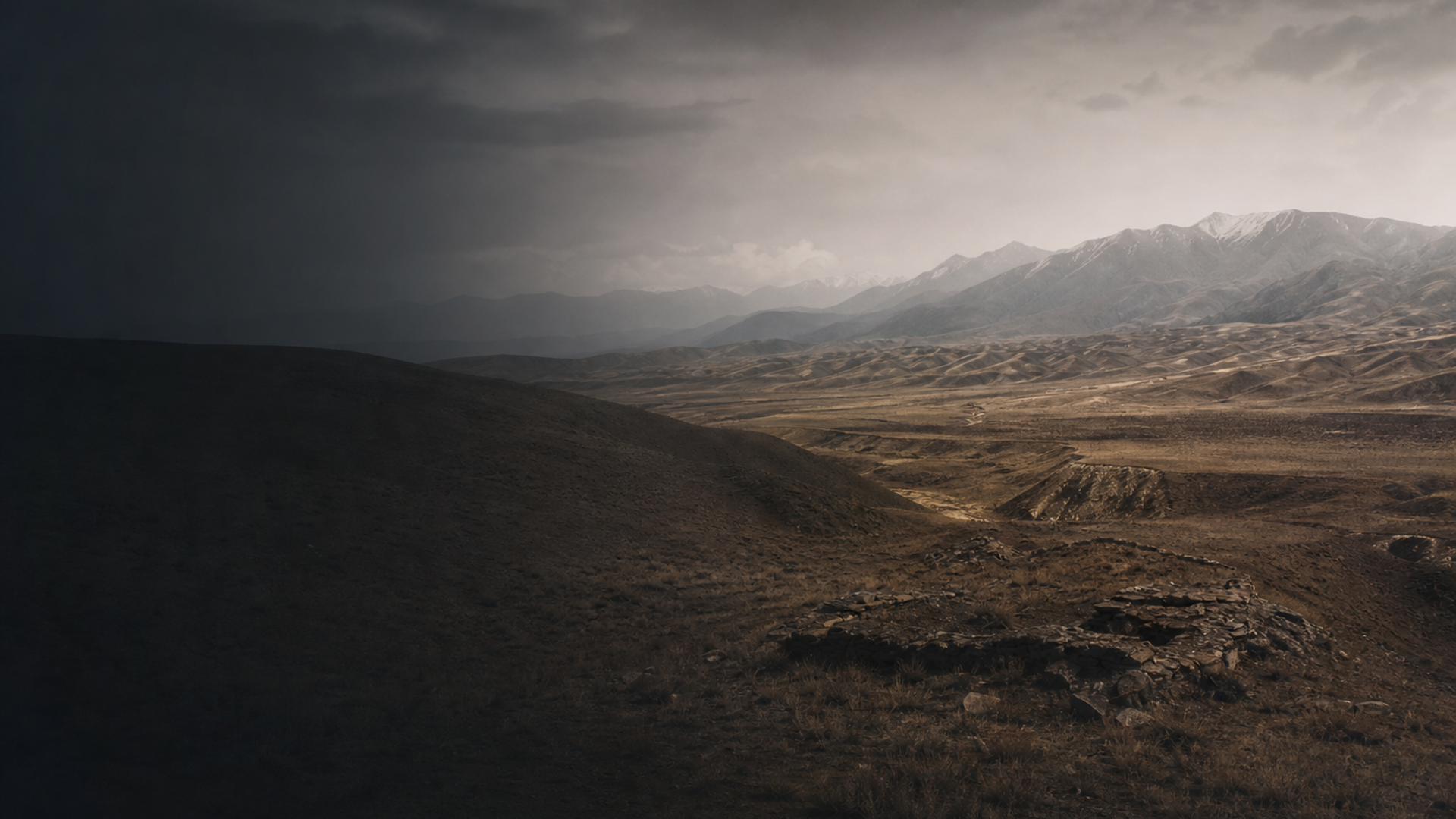
A cinematic horizon of grass and wind: the G218 assemblage sits at the crossroads where the Eurasian steppe brushes the mountains of western China. Archaeological data indicates these burials fall within the later Iron Age (386–8 BCE), a period of mobile societies, mounted warriors, and long‑distance contacts. The site in Nileke County, Yili Region, lies within an area where Scythian-style material culture—ornamented metalwork, horse equipment, and certain burial rites—has been reported in surrounding Xinjiang localities. Such artifacts suggest cultural currents flowing from the western steppe into Central Asia.

Genetically and materially, the people represented at G218 appear to embody mixture: west Eurasian maternal lineages (mtDNA H, HV) alongside East Asian/Siberian lineages (mtDNA D, C). This mosaic is consistent with historical narratives that place groups like the Wusun and Yuezhi within a web of steppe interactions. However, limited sample size (six individuals) and uneven contextual data mean interpretations remain provisional. Archaeological parallels are suggestive rather than definitive, and more excavations and a larger ancient DNA sample will be required to solidify models of origin and movement for these specific burials.

  • G218 dates to 386–8 BCE, Iron Age Xinjiang
  • Material culture in the region shows Scythian‑style influences
  • Mixed west‑east ancestry hinted by maternal lineages
Kapitel IV

Daily Life & Society

The lives behind the bones at G218 can only be sketched in broad strokes, but archaeological context and regional analogies allow evocative reconstructions. Steppe economies emphasized mobility: pastoral herds, horses, and seasonal camps. In the Yili basin, fertile valleys and trade routes would have paired animal husbandry with exchange of metalwork, textiles, and grains. Archaeological data from nearby Xinjiang sites indicate funerary practices that sometimes combine inhumation with grave goods—objects that signal status, craft connections, and links to long‑distance networks.

Social organization likely ranged from household herders to mounted elites. If Wusun or Yuezhi identities were present in the region, they may have formed clans or confederations engaged in pastoralism, trade, and intermittent conflict. Gendered burial patterns elsewhere in the steppe show high status weapons and horse gear with some individuals, while others bear ornaments and textiles; such variability suggests complex hierarchies and rich material culture. Yet for G218 itself, small sample count (n=6) limits confident reconstructions of social roles. The archaeological picture remains fragmentary: compelling, cinematic, but cautious.

  • Economy likely based on pastoralism and horse use
  • Burials suggest participation in broader steppe social networks
Kapitel V

Genetic Profile

Ancient DNA from G218 yields a compact but intriguing genetic signal. Among six individuals, a single Y‑chromosome assignment to haplogroup Q was observed. Haplogroup Q is widespread across northern Eurasia and is a signature of many Siberian, Central Asian, and some Native American ancestries; in a steppe context it can reflect eastern steppe genetic components or long‑distance male lineages. Mitochondrial diversity at G218 is notable: two H, two D, one HV, and one C. MtDNA H and HV are traditionally more common in western Eurasia, while D and C are common in East Asian and Siberian populations. This mix implies maternal contributions from both western and eastern gene pools.

Genomic patterns consistent with admixture between steppe‑related western ancestry and eastern Eurasian ancestry have been documented across Iron Age Central Asia; G218 fits this broader pattern. That said, with only six samples, population‑level inferences are preliminary. Small sample counts can overrepresent rare lineages or miss local diversity. Future work with larger sample sizes, genome‑wide data, and radiocarbon dating will be required to resolve whether G218 represents a transient frontier group, a stable mixed community, or specific kin groups tied to Wusun/Yuezhi or Scythian networks.

  • Y‑DNA Q suggests eastern steppe or Siberian-linked male ancestry
  • mtDNA mix (H, HV vs D, C) indicates west‑east maternal admixture
Kapitel VI

Legacy & Modern Connections

The G218 individuals speak to processes that shaped Central Asia: movement, mixture, and cultural entanglement. Maternal and paternal lineages reflect the long history of interaction across the steppe corridor that later fed into the formation of groups historically called Wusun, Yuezhi, and broader Scythian‑related communities. Modern populations of Xinjiang and adjacent regions retain a tapestry of genetic ancestries; the signals seen at G218 may be echoes of those deep processes.

Because the dataset is small, any direct link to contemporary groups must be made cautiously. Nevertheless, G218 contributes a vivid chapter to the story of how steppe mobility produced the genetic and cultural landscapes of Eurasia. Ongoing sampling and integrated archaeological study will tell whether these graves are representative of a broader demographic shift or the snapshot of a small, mobile lineage passing through the Yili corridor.

  • Contributes to understanding of steppe‑to‑Xinjiang population interactions
  • Preliminary data hint at ancestral strands present in modern Central Asian genomes
KI-gestützt

KI-Assistent

Stellen Sie Fragen zur Echoes of the Steppe: G218 Scythian‑Era Graves-Kultur

KI-Assistent von DNAGENICS

Funktion freischalten
Stellen Sie Fragen zur Kultur Echoes of the Steppe: G218 Scythian‑Era Graves. Unser KI-Assistent kann genetische Befunde, historischen Kontext, archäologische Belege und moderne Verbindungen erläutern.
Beispiel einer KI-Analyse

Die Echoes of the Steppe: G218 Scythian‑Era Graves-Kultur ist ein faszinierendes Kapitel der Menschheitsgeschichte...

Genetische Analysen zeigen Übereinstimmungen mit früheren Populationen und Hinweise auf besondere Anpassungen und kulturelle Innovationen. Alte DNA-Proben liefern Einblicke in Migrationsmuster, soziale Strukturen und genetische Verbindungen zwischen Populationen.

Dies ist eine Vorschau der KI-Analyse. Schalten Sie den vollständigen KI-Assistenten frei, um detaillierte Einblicke zu erkunden:

  • Genetische Zusammensetzung und genetische Ähnlichkeit
  • Migrationsmuster und Ursprünge
  • Alltag und kulturelle Praktiken
  • Genetischer Bezug zu heutigen Populationen

Weitere antike Kulturen erkunden

Geschichten von Zivilisationen aus der antiken Welt entdecken

Use code for 30% off • Expires Nov 08




