Gold and Genes of Varna

Download PDF creates a visual, rasterized copy. Use Print for selectable text and better assistive-technology support.

Bericht wird vorbereitet

Verfügbare Informationen und Referenzen werden geladen

Verbindung mit dem archäologischen Quellenbestand...

Alte Quellen werden zusammengestellt

Zum Hauptinhalt springen
Gold and Genes of Varna
Zivilisations-Spotlight

Gold and Genes of Varna

Chalcolithic coastal elites at Varna revealed through archaeology and ancient DNA

4750 CE - 4347 BCE
Varna, Bulgaria (Black Sea coast)
Scrollen zum Start
Kapitel I

Die Geschichte

Die Gold and Genes of Varna-Kultur verstehen

Varna Chalcolithic (4750–4347 BCE) cemetery in Bulgaria shows striking wealth, complex society, and a diverse genetic signature in 23 ancient samples — hinting at local European maternal lineages alongside unusually varied male haplogroups that suggest long-distance connections.

Time Period

4750–4347 BCE (Chalcolithic)

Region

Varna, Bulgaria (Black Sea coast)

Common Y-DNA

L (7), V88 (4), PF (3), M70 (1)

Common mtDNA

H (5), K (3), U (3), T (2), X2 (1)

Kapitel II

Zeitleiste

Zentrale Momente in der Geschichte dieser Kultur

4600 BCE

Flourishing of Varna Necropolis

The Varna cemetery sees the interment of richly furnished elite graves with gold and copper—evidence of social stratification and long-distance exchange.

Kapitel III

Origins & Emergence

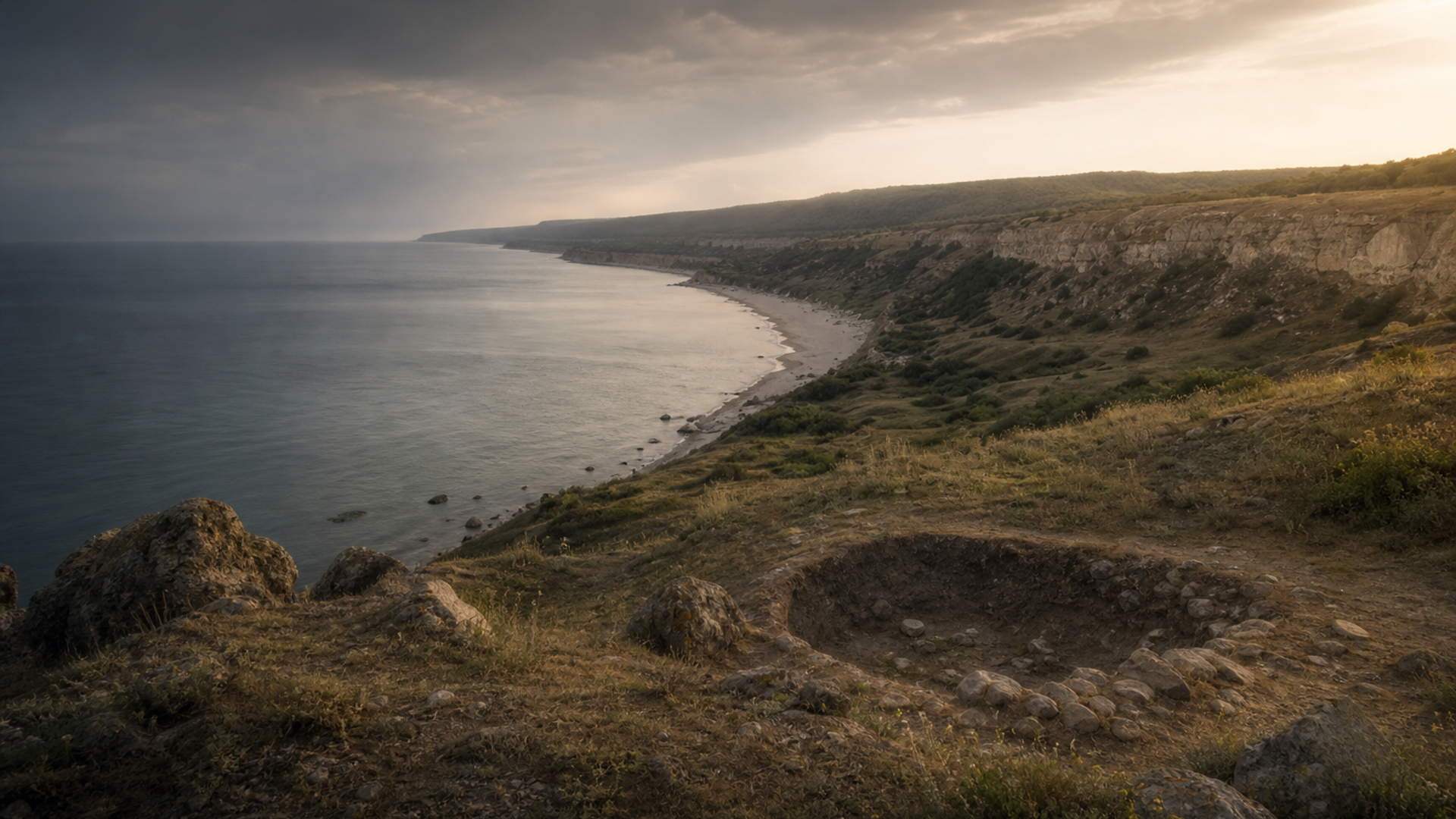
The Varna Chalcolithic horizon unfolds along the western Black Sea littoral between c. 4750 and 4347 BCE. Archaeological data from the Varna necropolis (prov. Varna, municipality Varna) reveal one of Europe’s earliest and most spectacular concentrations of metal wealth, with rich graves containing worked gold, copper ornaments, and prestige goods. These funerary assemblages belong to what archaeologists call the Varna Culture — a regional expression within broader southeast European Chalcolithic societies.

Excavation contexts and material culture indicate rapid social differentiation: some burials contain abundant symbolic wealth while others are modest. Metallurgy and long-distance exchange in raw materials and finished objects imply Varna sat within maritime and overland networks across the Balkans and beyond. Limited evidence suggests that this economic complexity developed from local Neolithic farming communities that adopted early copper technology and intensified social ranking.

Caution is warranted: chronological precision varies between cemetery sectors and many aspects of social change remain debated. Nevertheless, the combination of monumental graves, crafted metalwork, and coastal geography paints a cinematic picture of a community experimenting with wealth display, craft specialization, and far-reaching connections at the dawn of the Copper Age.

  • Varna necropolis dates to 4750–4347 BCE and anchors the Varna Culture
  • Rich gold and copper grave goods indicate pronounced social inequality
  • Location on the Black Sea coast suggests participation in regional exchange networks
Kapitel IV

Daily Life & Society

Archaeological remains allow glimpses into everyday rhythms beneath the dazzling funerary displays. Pottery, polished stone tools, and copper implements point to a mixed economy of cereal agriculture, animal husbandry, fishing, and specialized crafts. The Varna cemetery itself is a funerary landscape: body placement, grave goods, and collective vs. single interments reflect a society that used ritualized death to convey status.

Metalwork — thin beaten gold sheets, copper tools, and sophisticated ornaments — suggests skilled workshops and artisans. Textile impressions on some finds imply woven clothing; shells, Spondylus beads, and exotic raw materials signal exchange along coastal routes. Stable isotope studies elsewhere in the region indicate diets based on cereals, pulses, and varying proportions of animal protein; similar patterns are plausible at Varna but require more direct dietary sampling to confirm locally.

Social life at Varna was likely hierarchical and performative. Public displays in death (grave architecture and wealth concentration) probably mirrored living inequalities: elites controlled access to prestigious goods and the social memory preserved in monumental burials. Yet many aspects of household organization, gender roles, and daily ritual remain archaeologically subtle and are interpreted cautiously.

  • Mixed farming, animal husbandry, fishing, and specialist craft production
  • Wealth concentrated in funerary contexts suggests elite display and control of prestige goods
Kapitel V

Genetic Profile

Ancient DNA from 23 Varna Chalcolithic individuals provides a window into the biological diversity of this coastal community. The Y-chromosome pool is notably heterogeneous: seven individuals carry haplogroup L, four carry V88, three fall in PF-defined branches, and one in M70. These male lineages stand out because some — particularly L and V88 — are today more frequent in regions outside Europe, which makes their presence at Varna intriguing.

Mitochondrial DNA is dominated by lineages commonly associated with Neolithic and later European populations: H (5), K (3), U (3), T (2), and X2 (1). This pattern suggests that maternal ancestry in Varna was broadly continuous with the southern and central European farming-derived gene pool known from the Neolithic and Chalcolithic.

Interpreting Y-haplogroup signals requires caution. The presence of haplogroups today concentrated in Africa or South Asia does not necessarily mean recent migration from those regions in the 5th millennium BCE; they may represent deep, complex West Eurasian branches or the outcomes of earlier prehistoric movements. With 23 samples the data are informative but not exhaustive: population structure, sex-biased mobility, and the timing of external contacts remain provisional until larger genome-wide datasets and direct radiocarbon-linked samples are integrated. Archaeology — trade goods, exotic raw materials, and coastal connectivity — provides a plausible context for the genetic diversity observed, pointing to Varna as a hub where local European maternal lineages mixed with a more varied set of paternal lineages.

  • 23 samples reveal diverse male lineages (L, V88, PF, M70) and European maternal haplogroups (H, K, U, T, X2)
  • Patterns hint at long-distance contacts and possible sex-biased mobility, but conclusions remain provisional
Kapitel VI

Legacy & Modern Connections

Varna’s archaeological and genetic traces have a resonant legacy. The cemetery provides one of the earliest material testimonies of wealth inequality in prehistoric Europe and enriches our understanding of how craft, trade, and social ranking coalesced during the Copper Age. Genetic data from Varna contribute to broader models of population dynamics in the Balkans: mitochondrial lineages align with continental Neolithic ancestry, while unusual paternal markers highlight complexity in male-mediated connections.

For contemporary genetic landscapes, Varna is a deep-time chapter rather than a direct precursor; contributions to modern populations are filtered by millennia of movement, admixture, and demographic change. Nevertheless, by linking burial wealth, maritime exchange, and a distinctive genetic signature, the Varna Chalcolithic helps explain why the Balkans have been a crossroads of peoples and cultures. Future, larger-scale ancient DNA studies will refine how these early coastal networks fed into later Bronze Age and historic genetic patterns.

  • Varna illustrates early institutionalized inequality and craft specialization in Europe
  • Ancient DNA shows continuity in maternal lineages but complex paternal inputs, informing Balkan population history
KI-gestützt

KI-Assistent

Stellen Sie Fragen zur Gold and Genes of Varna-Kultur

KI-Assistent von DNAGENICS

Funktion freischalten
Stellen Sie Fragen zur Kultur Gold and Genes of Varna. Unser KI-Assistent kann genetische Befunde, historischen Kontext, archäologische Belege und moderne Verbindungen erläutern.
Beispiel einer KI-Analyse

Die Gold and Genes of Varna-Kultur ist ein faszinierendes Kapitel der Menschheitsgeschichte...

Genetische Analysen zeigen Übereinstimmungen mit früheren Populationen und Hinweise auf besondere Anpassungen und kulturelle Innovationen. Alte DNA-Proben liefern Einblicke in Migrationsmuster, soziale Strukturen und genetische Verbindungen zwischen Populationen.

Dies ist eine Vorschau der KI-Analyse. Schalten Sie den vollständigen KI-Assistenten frei, um detaillierte Einblicke zu erkunden:

  • Genetische Zusammensetzung und genetische Ähnlichkeit
  • Migrationsmuster und Ursprünge
  • Alltag und kulturelle Praktiken
  • Genetischer Bezug zu heutigen Populationen

Weitere antike Kulturen erkunden

Geschichten von Zivilisationen aus der antiken Welt entdecken

Use code for 30% off • Expires Nov 08




