Guanche of the Canary Islands

Download PDF creates a visual, rasterized copy. Use Print for selectable text and better assistive-technology support.

Bericht wird vorbereitet

Verfügbare Informationen und Referenzen werden geladen

Verbindung mit dem archäologischen Quellenbestand...

Alte Quellen werden zusammengestellt

Zum Hauptinhalt springen
Guanche of the Canary Islands
Zivilisations-Spotlight

Guanche of the Canary Islands

Island-born peoples whose stone sanctuaries and ancient DNA trace North African and Atlantic ties

1031 BCE - 1500 CE
Canary Islands (Tenerife, Gran Canaria)
Scrollen zum Start
Kapitel I

Die Geschichte

Die Guanche of the Canary Islands-Kultur verstehen

The Guanche were the indigenous inhabitants of the Canary Islands (c. 1031 BCE–1500 CE). Archaeology from Gran Canaria and Tenerife and DNA from 46 individuals reveal primarily North African affinities with some maternal sub‑Saharan and European signals, illuminating island lifeways and migrations.

Time Period

1031 BCE – 1500 CE

Region

Canary Islands (Tenerife, Gran Canaria)

Common Y-DNA

E (observed in 5 samples)

Common mtDNA

L (2), H2a (2), T (2), U (2)

Kapitel II

Zeitleiste

Zentrale Momente in der Geschichte dieser Kultur

1031 BCE

Earliest dated island occupations (archaeological)

Archaeological contexts and calibrated dates mark human presence on Canary Islands by c. 1031 BCE, initiating island adaptations and local cultural trajectories.

Kapitel III

Origins & Emergence

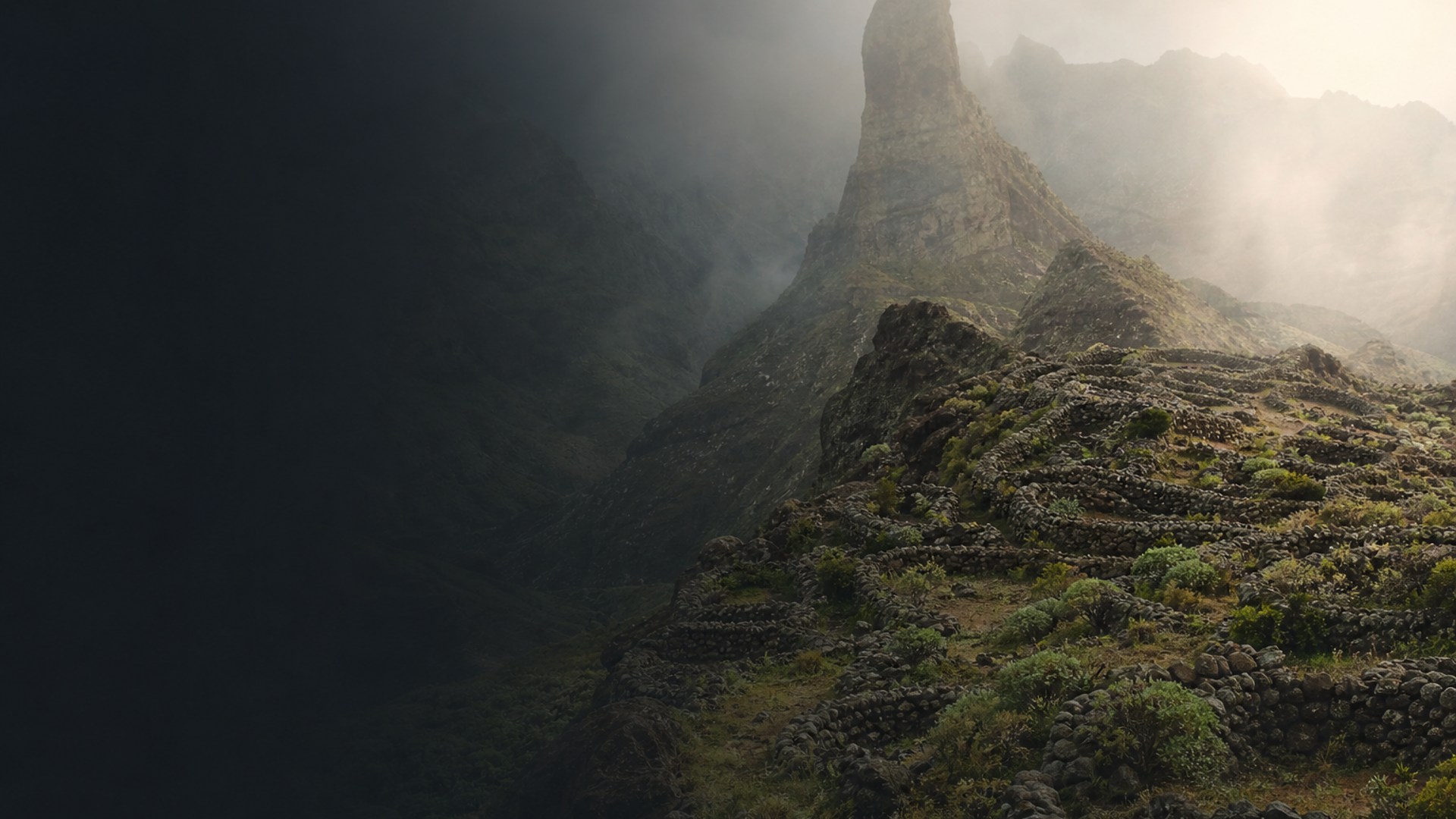
The story of the Guanche begins like a slow tide: people crossing the Atlantic fringe from North Africa and settling volcanic islands whose cliffs and caves became repositories of memory. Archaeological evidence on Tenerife and Gran Canaria — including cave occupations, rock-cut funerary chambers and dry-stone architecture at sites associated with Risco Caído (Gran Canaria) and cave systems such as Cueva del Viento (Tenerife) — indicates island colonization during the first millennium BCE, consistent with calibrated radiocarbon dates in the input range (earliest ~1031 BCE).

Material culture is characterized by simple pastoral and agricultural adaptations to island environments: pottery fragments, stone tools, terraced fields, and elaborate burial constructions carved into rock. These features point to small, mobile kin groups adapting North African traditions to Atlantic islands. Limited evidence suggests staggered settlement pulses rather than a single colonizing wave; island-to-island interaction and local innovation generated distinct island cultures within the broader Guanche identity.

Archaeological data indicates continuity in ritual landscapes — burial caves, mountain sanctuaries, and talayotic-like structures — but also change over time as new resources and external contacts influenced practices. Where preservation is uneven, interpretations remain provisional and benefit from integration with ancient DNA to clarify population origins and movement.

  • Early settlements visible in cave sites on Tenerife and Gran Canaria
  • Material culture blends North African pastoral traits with island innovations
  • Settlement likely involved multiple arrivals and local diversification
Kapitel IV

Daily Life & Society

Life for the Guanche was shaped by the sea and the mountain. Archaeological contexts reveal a mixed economy: animal herding (goats and sheep), small-scale cultivation on terraced slopes, fishing, and the gathering of wild resources. Domestic sites often cluster near sheltered caves or rock shelters where wind and volcanic landscapes provided natural protection.

Social organization appears to have been kin-based and place-centered. Funerary architecture — from individual pit burials to communal cave interments — suggests varied mortuary practices and social differentiation. Rock art, personal ornaments, and grave goods indicate symbolic worlds where ancestry and landscape were deeply entangled. Craft specializations such as weaving and bone tool production are visible in the material record, while the use of caves as both homes and sanctuaries lends a cinematic quality to island ritual life.

Contact with Mediterranean and North African networks was likely intermittent; trade and episodic voyaging may explain the presence of non-local raw materials. By the late medieval period, increasing European contact culminated in profound social upheaval after the 15th-century Castilian conquest, which dramatically altered Guanche lifeways and demographic continuity.

  • Economy centered on herding, small-scale farming, fishing, and gathering
  • Mortuary diversity: individual and communal cave burials reflect social complexity
Kapitel V

Genetic Profile

Genetic data from 46 ancient individuals associated with the Guanche span c. 1031 BCE to the threshold of European contact. These samples provide a moderate dataset that allows reasonable inferences about population history while still requiring caution in finer-scale interpretations.

Y-chromosome lineages in this dataset show a presence of haplogroup E (5 instances), a marker commonly associated with North African and Saharan populations. Mitochondrial DNA is diverse: counts include L (2), H2a (2), T (2), and U (2). The presence of haplogroup L on the maternal side indicates episodes of sub‑Saharan maternal ancestry, while H2a, T and U are lineages found across North Africa and Europe, reflecting complex maternal origins.

When combined with archaeological context, the genetic profile supports a model of predominant North African (likely Berber-related) ancestry with additional inputs: maternal lineages point to connections with both North African and sub‑Saharan gene pools, and some European-affiliated mtDNA might reflect later contacts or pre-contact maritime links. Admixture patterns are consistent with island colonization from the Maghreb followed by genetic drift and island-specific developments. Because the dataset, although larger than many island studies, remains regionally limited, some population structure and timing of admixture events remain uncertain and benefit from further sampling across islands and time.

  • 46 samples provide moderate power to infer North African affinity and island-specific drift
  • Y-DNA dominated by E (5); mtDNA includes L indicating sub‑Saharan maternal input
Kapitel VI

Legacy & Modern Connections

The Guanche are not only archaeological figures but ancestors traced in the genomes and place names of modern Canary Islanders. Genetic continuity is partial: post‑15th‑century European colonization introduced substantial Iberian ancestry, but ancient DNA shows persistent island lineages surviving in modern populations. Cultural memory is tangible in toponyms, folklore, and archaeological landscapes such as the mountain sanctuaries and cave cemeteries that remain visible today.

Museums, protected sites like Risco Caído, and ongoing aDNA projects continue to illuminate how islands mediate human stories of migration, adaptation, and resilience. Scientific synthesis of archaeology and genetics offers a cinematic but evidence-based portrait: island societies rooted in North African origins, shaped by the Atlantic environment, and transformed by historic encounters.

  • Partial genetic continuity with modern Canary Islanders alongside Iberian admixture
  • Archaeological sites remain living landmarks of Guanche cultural memory
KI-gestützt

KI-Assistent

Stellen Sie Fragen zur Guanche of the Canary Islands-Kultur

KI-Assistent von DNAGENICS

Funktion freischalten
Stellen Sie Fragen zur Kultur Guanche of the Canary Islands. Unser KI-Assistent kann genetische Befunde, historischen Kontext, archäologische Belege und moderne Verbindungen erläutern.
Beispiel einer KI-Analyse

Die Guanche of the Canary Islands-Kultur ist ein faszinierendes Kapitel der Menschheitsgeschichte...

Genetische Analysen zeigen Übereinstimmungen mit früheren Populationen und Hinweise auf besondere Anpassungen und kulturelle Innovationen. Alte DNA-Proben liefern Einblicke in Migrationsmuster, soziale Strukturen und genetische Verbindungen zwischen Populationen.

Dies ist eine Vorschau der KI-Analyse. Schalten Sie den vollständigen KI-Assistenten frei, um detaillierte Einblicke zu erkunden:

  • Genetische Zusammensetzung und genetische Ähnlichkeit
  • Migrationsmuster und Ursprünge
  • Alltag und kulturelle Praktiken
  • Genetischer Bezug zu heutigen Populationen

Weitere antike Kulturen erkunden

Geschichten von Zivilisationen aus der antiken Welt entdecken

Use code for 30% off • Expires Nov 08




