Hanben: Taiwan's Iron Age Shores

Download PDF creates a visual, rasterized copy. Use Print for selectable text and better assistive-technology support.

Bericht wird vorbereitet

Verfügbare Informationen und Referenzen werden geladen

Verbindung mit dem archäologischen Quellenbestand...

Alte Quellen werden zusammengestellt

Zum Hauptinhalt springen
Hanben: Taiwan's Iron Age Shores
Zivilisations-Spotlight

Hanben: Taiwan's Iron Age Shores

Coastal lifeways on Taiwan's east coast, 1–800 CE — where archaeology meets DNA

1 CE - 800 CE
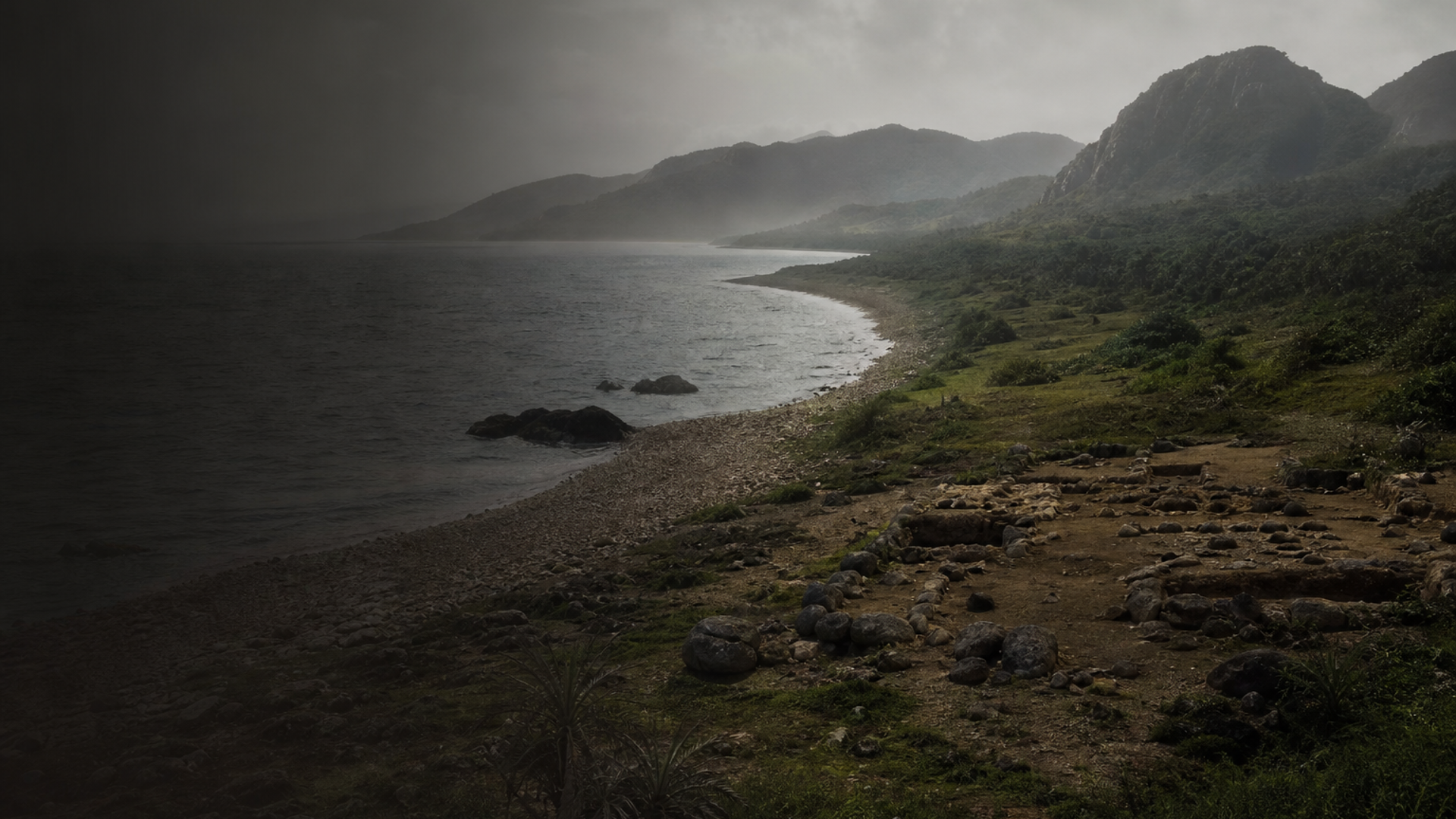
Taiwan (Hanben, Blihun site)
Scrollen zum Start
Kapitel I

Die Geschichte

Die Hanben: Taiwan's Iron Age Shores-Kultur verstehen

Archaeological and genetic evidence from the Hanben (Blihun) site in eastern Taiwan (1–800 CE) reveals coastal Iron Age communities with Austronesian connections. Ancient Y and mtDNA patterns illuminate mobility, ancestry, and continuity with modern East Asian and Austronesian populations.

Time Period

1–800 CE

Region

Taiwan (Hanben, Blihun site)

Common Y-DNA

O (18), NO (1), F (1)

Common mtDNA

F (14), E (8), R (7), B (6), M (3)

Kapitel II

Zeitleiste

Zentrale Momente in der Geschichte dieser Kultur

1 CE

Approximate start of Hanben horizon

Archaeological deposits at Hanben (Blihun) date from about 1 CE, marking intensified coastal settlement and material traditions through 800 CE.

Kapitel III

Origins & Emergence

Along the rocky coves and shell-rich terraces of eastern Taiwan, the Hanben horizon emerges in the archaeological record between roughly 1 and 800 CE. Excavations at the Blihun locality within the Hanben complex reveal dense shell middens, pottery with distinctive cord-marked and impressed styles, ground stone tools, and personal ornaments carved from shell and bone. These material signatures situate Hanben within the broader tapestry of Iron Age Taiwan, yet the term 'Iron Age' here primarily indexes a regional chronology rather than ubiquitous metal use; iron artifacts are uncommon and often imported.

Hanben communities participated in coastal networks that extended across the northern Philippines and the archipelagic margins of Southeast Asia. Obsidian and other exotic lithics hint at long-distance exchange, while local craft traditions retained continuity with earlier Neolithic coastal sites. Archaeological data indicates a persistent maritime orientation: sites are often located on raised beaches or river mouths, where fishing and shellfish gathering left visible deposits.

Genetically, ancient DNA from Hanben individuals provides a new lens on origins. The observed maternal and paternal lineages align broadly with East and Southeast Asian ancestries, supporting archaeological interpretations that link Hanben peoples to Austronesian-speaking coastal traditions. However, the full story of population formation is complex: demographic shifts, episodic contacts, and local continuity all likely contributed. Limited preservation and the uneven spatial sampling of sites mean that archaeological and genetic narratives should be held as provisional and open to refinement.

  • Hanben dated ca. 1–800 CE, coastal site complex including Blihun
  • Material culture shows continuity with Neolithic coastal traditions and regional exchange
  • Archaeological and genetic evidence both point to Austronesian-era connections, with uncertainties
Kapitel IV

Daily Life & Society

The Hanben archaeological horizon paints a cinematic scene: low stone hearths, piles of discarded shells, scattered pottery sherds, and the glint of shell beads once worn at the throat or wrist. Faunal remains and midden composition at Blihun indicate a heavy reliance on marine resources—fish, shellfish, and coastal mollusks—complemented by horticulture and foraged plant foods where soils permitted. Ground-stone tools and adzes attest to woodworking and canoe construction, essential skills for communities living on the island's exposed shorelines.

Burial practices at Hanben are variable but often include flexed inhumations with grave goods such as shell ornaments, simple pottery, and occasionally stone implements. Such mortuary variability can reflect social differentiation, age- and gender-specific roles, or shifting ritual choices through time. Houses likely stood on post pads or shallow foundations; organic architecture rarely survives, but posthole patterns and associated floor deposits suggest semi-permanent villages with seasonal intensification of coastal harvesting.

Craftsmanship centered on local materials: coarse to fine ceramics, shell-working, and polished stone. Trade items—obsidian flakes or non-local shell types—point to mobility and exchange beyond the immediate coastline. Archaeological data indicates resilient lifeways adapted to Taiwan's dynamic coastal environment, though the details of social organization, leadership, and belief systems remain only partially visible in the material record.

  • Coastal foraging dominated diet, supported by horticulture where possible
  • Shell ornaments, pottery, and stone tools indicate local craft and regional exchange
Kapitel V

Genetic Profile

Ancient DNA analysis from 48 individuals associated with the Hanben horizon (Blihun site) offers one of the more substantial genetic windows into Iron Age Taiwan. On the paternal side, the majority of typed Y-DNA markers fall into haplogroup O (18 of 20 Y-lineage calls), with single instances of NO and F. Haplogroup O is widespread across East and Southeast Asia today and is frequently associated with populations speaking Austronesian and other Tai–Kadai and Sino-Tibetan languages. The presence of NO and F, though rare in this sample, indicates additional paternal diversity or historical contact with nearby mainland groups.

Mitochondrial DNA shows greater diversity in maternal lineages: haplogroups F (14), E (8), R (7), B (6), and M (3) are represented. Haplogroups F and E are common in island Southeast Asia and among Austronesian-speaking populations, while B and R lineages have broader pan-Asian distributions. The mix of maternal lineages is consistent with longstanding coastal population continuity and also with regional interactions that introduced genetic inputs over time.

Interpretation: the Hanben genetic profile aligns with an Austronesian-associated coastal population that carries deep East and Southeast Asian maternal diversity and predominantly O-lineage paternal ancestry. With a sample set of 48, conclusions are moderately robust compared with very small datasets, but caution remains: temporal span (1–800 CE), potential kin clustering within graves, and uneven geographic sampling mean that inferred population structure and sex-biased processes should be treated as provisional. Further sampling across Taiwan and adjacent islands will refine models of migration, admixture, and continuity.

  • Sample set: 48 individuals — moderate confidence in population-level patterns
  • Paternal dominance of haplogroup O; maternal diversity includes F, E, R, B, M
Kapitel VI

Legacy & Modern Connections

Hanben's archaeological deposits and genetic fingerprints form a palpable bridge to Taiwan's later coastal societies and to the broader Austronesian diaspora. The prominence of maternal haplogroups common in modern Austronesian-speaking groups suggests degrees of continuity in maternal lines, while the paternal O-lineages reflect regional affinities found across island Southeast Asia and southern China.

That said, direct ancestry from Hanben individuals to any single modern community cannot be assumed. Centuries of mobility, demographic change, and later migrations have modified genetic landscapes. Archaeogenetic evidence from Hanben offers a baseline: it demonstrates that the east coast of Taiwan hosted populations with a mix of local continuity and external ties during the first millennium CE. For modern populations, these data help contextualize shared genetic components and illuminate the deep-time processes—maritime connectivity, exchange, and local adaptation—that shaped Taiwan's human story. Continued interdisciplinary research will better reveal how Hanben fits into the island's long sequence of human occupation.

  • Genetic patterns suggest continuity with Austronesian-associated lineages, but not direct one-to-one descent
  • Hanben provides a foundation for understanding Iron Age coastal populations and modern connections
KI-gestützt

KI-Assistent

Stellen Sie Fragen zur Hanben: Taiwan's Iron Age Shores-Kultur

KI-Assistent von DNAGENICS

Funktion freischalten
Stellen Sie Fragen zur Kultur Hanben: Taiwan's Iron Age Shores. Unser KI-Assistent kann genetische Befunde, historischen Kontext, archäologische Belege und moderne Verbindungen erläutern.
Beispiel einer KI-Analyse

Die Hanben: Taiwan's Iron Age Shores-Kultur ist ein faszinierendes Kapitel der Menschheitsgeschichte...

Genetische Analysen zeigen Übereinstimmungen mit früheren Populationen und Hinweise auf besondere Anpassungen und kulturelle Innovationen. Alte DNA-Proben liefern Einblicke in Migrationsmuster, soziale Strukturen und genetische Verbindungen zwischen Populationen.

Dies ist eine Vorschau der KI-Analyse. Schalten Sie den vollständigen KI-Assistenten frei, um detaillierte Einblicke zu erkunden:

  • Genetische Zusammensetzung und genetische Ähnlichkeit
  • Migrationsmuster und Ursprünge
  • Alltag und kulturelle Praktiken
  • Genetischer Bezug zu heutigen Populationen

Weitere antike Kulturen erkunden

Geschichten von Zivilisationen aus der antiken Welt entdecken

Use code for 30% off • Expires Nov 08




