Huatuyan Cave: Ming-era Mothers of Guangxi

Download PDF creates a visual, rasterized copy. Use Print for selectable text and better assistive-technology support.

Bericht wird vorbereitet

Verfügbare Informationen und Referenzen werden geladen

Verbindung mit dem archäologischen Quellenbestand...

Alte Quellen werden zusammengestellt

Zum Hauptinhalt springen
Huatuyan Cave: Ming-era Mothers of Guangxi
Zivilisations-Spotlight

Huatuyan Cave: Ming-era Mothers of Guangxi

Cave burials in Hechi reveal maternal lineages spanning late Ming to early Qing transitions

1400 CE - 1700 CE
Guangxi, southern China (Hechi, Nandan County)
Scrollen zum Start
Kapitel I

Die Geschichte

Die Huatuyan Cave: Ming-era Mothers of Guangxi-Kultur verstehen

Archaeological excavations at Huatuyan Cave (Nandan County, Guangxi) — dated 1400–1700 CE — reveal a small set of human remains whose mitochondrial DNA (mtDNA) points to East and Southeast Asian maternal lineages. Limited sample size makes conclusions tentative, but data connect local archaeology with broader population histories.

Time Period

1400–1700 CE (late Ming–early Qing)

Region

Guangxi, southern China (Hechi, Nandan County)

Common Y-DNA

Not reported / insufficient data

Common mtDNA

D, F, N, M, R (counts: D=2, F=1, N=1, M=1, R=1)

Kapitel II

Zeitleiste

Zentrale Momente in der Geschichte dieser Kultur

1400 CE

Initial use of Huatuyan Cave

Archaeological context suggests the cave began to be used for burial or deposition around the late Ming period (c. 1400 CE).

1644 CE

Late Ming to Early Qing transition

The date range overlaps the Ming–Qing transition (mid-17th century), a period of social change that may have affected local communities.

Kapitel III

Origins & Emergence

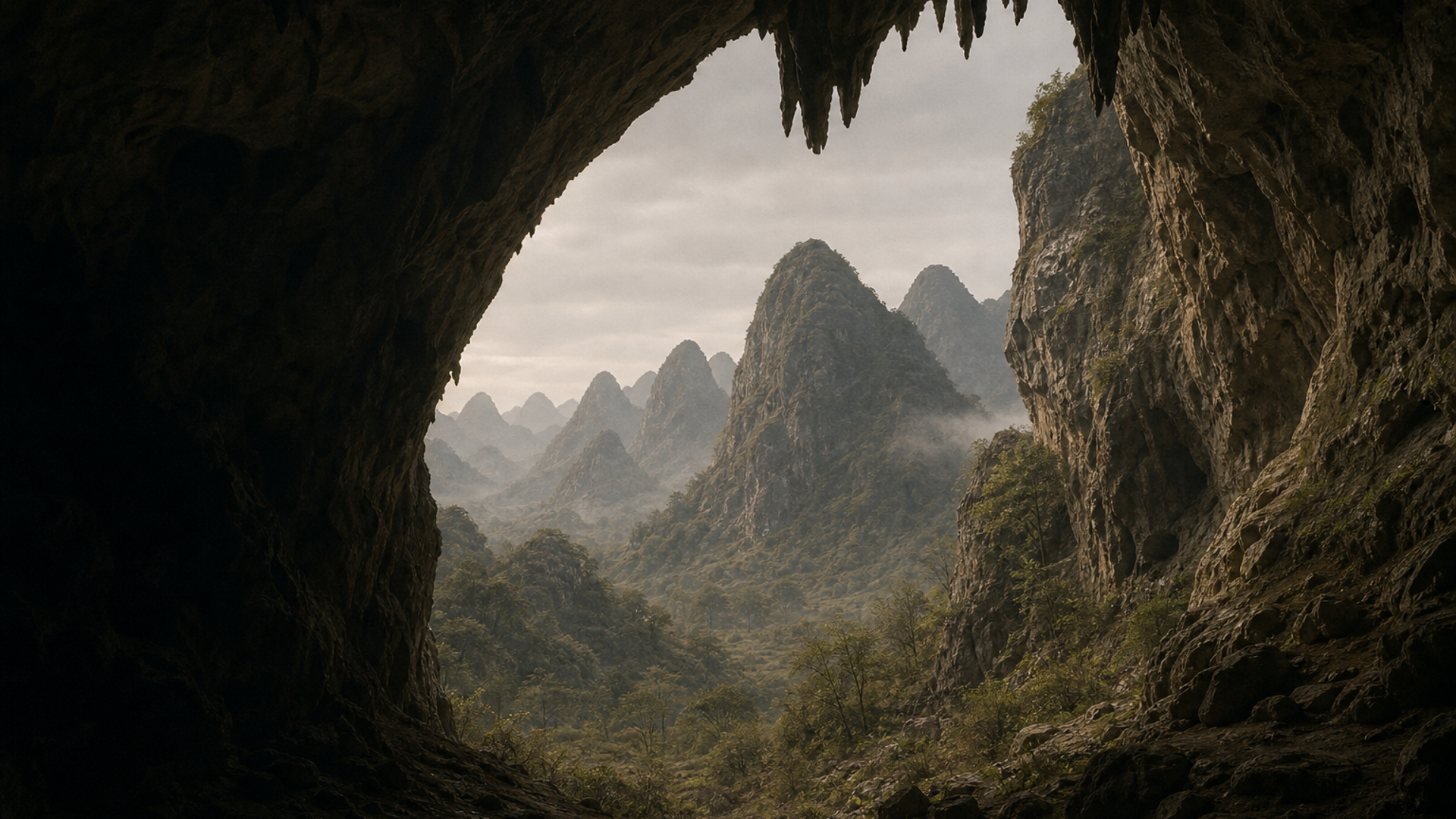
The Huatuyan assemblage is rooted in the limestone hills of Lihu Yaozu Town, Huatu Village, within modern Hechi City, Nandan County. Archaeological data indicates that the cave was used for human deposition or burial during a period spanning the late Ming dynasty into the early Qing (c. 1400–1700 CE). The stratigraphy and associated organic remains suggest episodic use rather than continuous habitation.

Culturally, this period in Guangxi was one of agrarian communities and local ethnic diversity; records and material culture from nearby sites hint at interactions among Han migrants, Yao communities, and other southern populations. The Huatuyan human remains appear in contexts that align with small-scale village mortuary practices rather than elite tomb architecture of coastal plains.

Limited evidence suggests that the people represented at Huatuyan were part of long-standing local populations in southern China, with deep continuity of maternal lineages typical of East and Southeast Asia. Given the small sample count (n=8) and incomplete contextual data, any model of population movement or demographic change must remain provisional. Future excavation and direct radiocarbon dating of individual remains will refine chronologies and clarify relationships with regional historical events such as Ming-era migrations and Qing consolidation.

  • Site: Huatuyan Cave, Huatu Village, Lihu Yaozu Town, Nandan County, Hechi City, Guangxi
  • Date range: 1400–1700 CE (late Ming to early Qing overlap)
  • Evidence indicates episodic cave burial linked to local village groups
Kapitel IV

Daily Life & Society

Archaeological remains from Huatuyan Cave do not preserve extensive household assemblages, but the mortuary context evokes daily life on the limestone margins: small agrarian communities exploiting terraced fields, mountain forest resources, and narrow river valleys. Contemporary ethnographic analogies and regional archaeological surveys point to mixed rice cultivation, foraging, and craft exchange as likely economic activities.

Material traces recovered nearby in the region include utilitarian ceramics, simple iron tools, and occasional personal ornaments—items typical of rural Ming-period lifeways. The cave burials themselves suggest social practices centered on family or kin groups; burials in caves and rock shelters are documented across southern China and often reflect local ritual landscapes rather than centralized state funerary forms.

Cinematic asides aside, the archaeological record from Huatuyan is fragmentary: soil acidity and post-depositional disturbance mean that organic artifacts and textiles rarely survive. Nevertheless, the human remains provide a direct window into the people who lived and died here—their bodies carrying biological signatures that complement fragmentary material culture, illuminating diet, mobility, and kinship in ways that pottery and iron alone cannot.

  • Likely rural agrarian economy: rice terraces, forest resources
  • Mortuary practice suggests local kinship-based burial use of caves
Kapitel V

Genetic Profile

Ancient DNA analysis of eight individuals from Huatuyan Cave produced maternally inherited mitochondrial haplogroups indicative of East and Southeast Asian affinities. Observed mtDNA lineages include haplogroup D (2 individuals), F (1), N (1), M (1) and R (1). These haplogroups are common across southern China, mainland Southeast Asia, and among many modern Sino-Tibetan and Austroasiatic-speaking populations.

No consistent Y-DNA signal is reported for this dataset, and limited male-specific markers or preservation may have prevented paternal lineage characterization. Because the total sampled individuals number only eight, and mtDNA represents only maternal ancestry, conclusions about the broader population must remain tentative. Small sample sizes can overrepresent particular lineages and obscure diversity.

Nonetheless, the mitochondrial profile aligns with archaeological expectations for Guangxi: continuity of regional maternal lineages through the late first millennium into the historic era, and genetic connections that mirror known cultural networks linking southern China and Southeast Asia. Future sampling, genome-wide data, and direct radiocarbon dating of individuals will be essential to test hypotheses about migration, admixture, and social structure.

  • mtDNA haplogroups: D (2), F (1), N (1), M (1), R (1)
  • Y-DNA: insufficient/unspecified; small sample size (n=8) makes findings preliminary
Kapitel VI

Legacy & Modern Connections

The people of Huatuyan Cave stand as a quiet corridor between past and present: their mitochondrial lineages persist in modern southern Chinese and Southeast Asian populations, suggesting long-term regional continuity. Archaeogenetic evidence gently reinforces historical narratives of local resilience amid dynastic change—late Ming social networks and the early Qing reordering of the frontier.

For descendants and regional communities today, the Huatuyan data underline deep maternal ties to the land around Hechi and the broader Guangxi landscape. However, given the small number of samples and the lack of comprehensive genome-wide data, linking these ancient individuals directly to specific modern ethnic groups would be premature. These remains are best viewed as an initial genetic snapshot that complements archaeological context and invites further research.

  • mtDNA continuity suggests long-standing maternal ties in southern China
  • Current findings are a preliminary snapshot; more genome-wide sampling needed
KI-gestützt

KI-Assistent

Stellen Sie Fragen zur Huatuyan Cave: Ming-era Mothers of Guangxi-Kultur

KI-Assistent von DNAGENICS

Funktion freischalten
Stellen Sie Fragen zur Kultur Huatuyan Cave: Ming-era Mothers of Guangxi. Unser KI-Assistent kann genetische Befunde, historischen Kontext, archäologische Belege und moderne Verbindungen erläutern.
Beispiel einer KI-Analyse

Die Huatuyan Cave: Ming-era Mothers of Guangxi-Kultur ist ein faszinierendes Kapitel der Menschheitsgeschichte...

Genetische Analysen zeigen Übereinstimmungen mit früheren Populationen und Hinweise auf besondere Anpassungen und kulturelle Innovationen. Alte DNA-Proben liefern Einblicke in Migrationsmuster, soziale Strukturen und genetische Verbindungen zwischen Populationen.

Dies ist eine Vorschau der KI-Analyse. Schalten Sie den vollständigen KI-Assistenten frei, um detaillierte Einblicke zu erkunden:

  • Genetische Zusammensetzung und genetische Ähnlichkeit
  • Migrationsmuster und Ursprünge
  • Alltag und kulturelle Praktiken
  • Genetischer Bezug zu heutigen Populationen

Weitere antike Kulturen erkunden

Geschichten von Zivilisationen aus der antiken Welt entdecken

Use code for 30% off • Expires Nov 08




