Island of Winds: Early Modern Faroes

Download PDF creates a visual, rasterized copy. Use Print for selectable text and better assistive-technology support.

Bericht wird vorbereitet

Verfügbare Informationen und Referenzen werden geladen

Verbindung mit dem archäologischen Quellenbestand...

Alte Quellen werden zusammengestellt

Zum Hauptinhalt springen
Island of Winds: Early Modern Faroes
Zivilisations-Spotlight

Island of Winds: Early Modern Faroes

Church burials and DNA reveal a compact, maritime community in the Faroe Islands (1500–1700 CE)

1500 CE - 1700 CE
Faroe Islands
Scrollen zum Start
Kapitel I

Die Geschichte

Die Island of Winds: Early Modern Faroes-Kultur verstehen

Archaeological and ancient DNA data from Church2 in the Faroe Islands (1500–1700 CE) reveal a compact Early Modern community dominated by Western European maternal lineages and a majority R paternal signal. Findings suggest continuity with North Atlantic networks but require broader sampling.

Time Period

1500–1700 CE

Region

Faroe Islands

Common Y-DNA

R (majority, 12), I1 (1)

Common mtDNA

H (majority, 12), J, H17, U, H5

Kapitel II

Zeitleiste

Zentrale Momente in der Geschichte dieser Kultur

1500 CE

Church2 burials begin (documented era)

Church2 cemetery provides primary archaeological and genetic material dated to the Early Modern Faroes (1500–1700 CE).

Kapitel III

Origins & Emergence

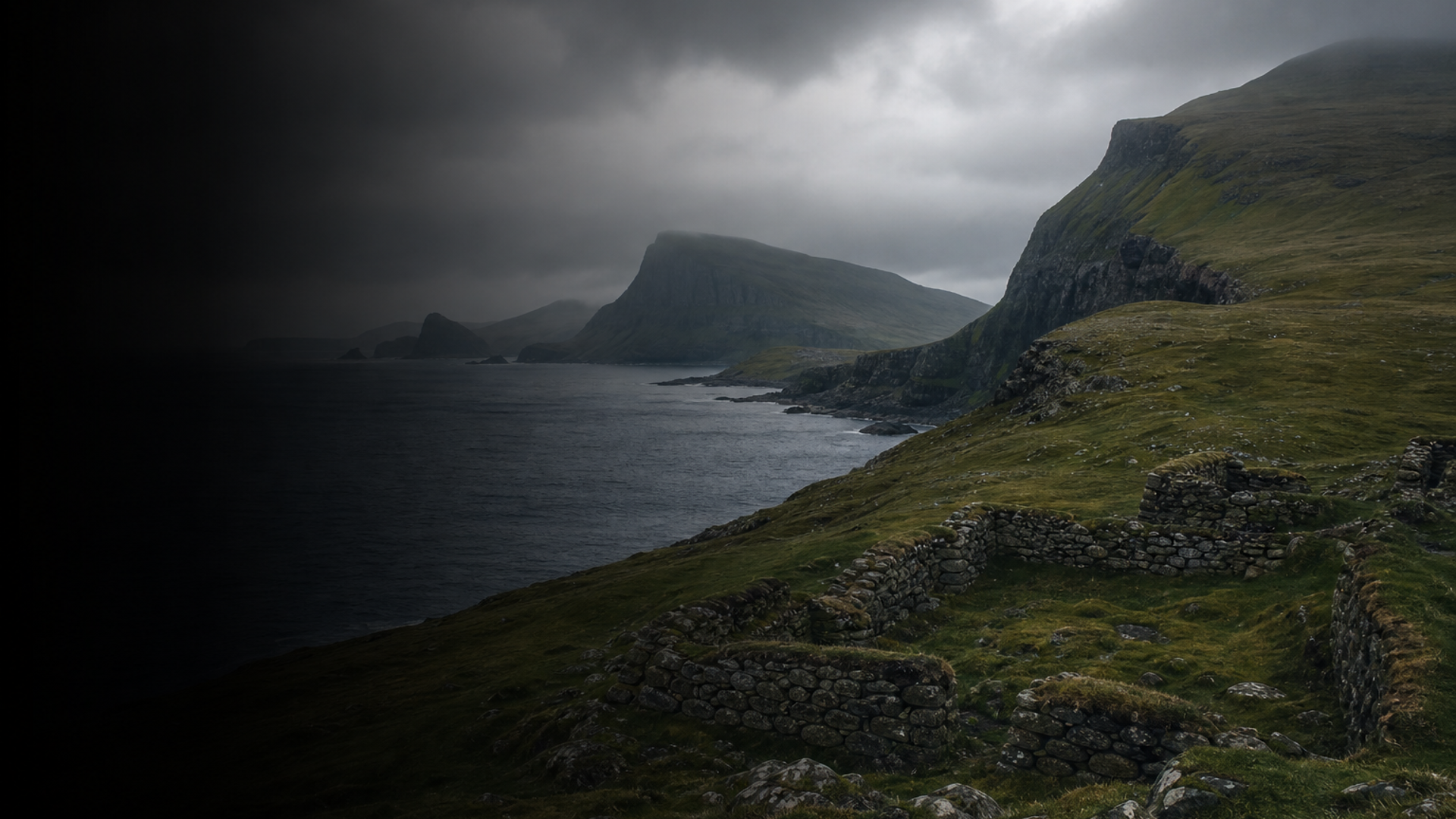
The Early Modern Faroes (1500–1700 CE) unfold against a landscape of wind-swept grass and stone—an archipelago long shaped by seafaring horizons. Archaeological data from Church2 (Faroes) places burials and associated material culture in the domestic and ecclesiastical heart of island life. While Norse settlement of the Faroes began many centuries earlier (c. 9th–10th centuries CE), the 16th–17th century record at Church2 reflects a community negotiating continuity and change: sustaining pastoral and maritime economies, using churchyard burial practices, and maintaining connections across the North Atlantic.

Material remains and burial contexts suggest a settled, small-population society where local traditions layered over centuries of contact. Historical documents from the North Atlantic hint at fishing, sheep husbandry, and periodic links to Norway, Scotland, and Iceland; the archaeological footprint at Church2 echoes those networks. Limited evidence means we must be cautious about precise migration events, but the combined archaeological and genetic picture suggests the Early Modern Faroes were at once insular and interconnected—an island culture whose everyday life bore traces of broader Atlantic currents.

  • Church2 provides primary burial context for 1500–1700 CE Faroes
  • Archaeological data indicates continuity with earlier Norse settlement patterns
  • Island isolation coupled with Atlantic contacts shaped emergence
Kapitel IV

Daily Life & Society

Life on the Early Modern Faroes was organized around sea, sheep, and stone. Archaeological indicators—settlement traces, churchyard burials, and recovered artefacts—paint a scene of modest households oriented to coastal resources. Fish and small-boat technologies were central to subsistence; sheep grazing shaped the inland landscape. Church2 sits at the center of ritual life, where interments reflect community structure and perhaps family plots that persisted through generations.

Social organization likely combined kin groups and parish ties. Graves at Church2 imply established burial rites associated with Christian practice, but variation in graves and associated objects hints at social differences—age, sex, and perhaps status within a small population. Craft activities, repair of boats and tools, and seasonal travel for trade or kin-visiting would have punctuated the year. Archaeological data indicates resilience: islanders adapted material culture and economic strategies to the North Atlantic environment while maintaining cultural links across sea routes.

  • Subsistence centered on fishing and sheep husbandry
  • Churchyard burials suggest enduring parish and kin structures
Kapitel V

Genetic Profile

Sixteen individuals sampled from Church2 (Faroes) provide an Early Modern snapshot linking bones to biological lineages. Y-chromosome data show a clear majority labeled as R (12 individuals) with a single I1; a small number of male lineages are not assigned to named categories in the provided counts. Mitochondrial DNA is dominated by haplogroup H (12 individuals), with additional maternal types J, H17, U, and H5 represented.

The prevalence of mtDNA H suggests continuity with widespread Western European maternal lineages common across the North Atlantic; the paternal R majority is consistent with broader Western European and Atlantic signals observed in many historical-period populations, though the dataset does not specify subclades (e.g., R1b) so direct assignment to particular migratory events is not possible here. The single I1 instance aligns with a known Scandinavian-associated paternal lineage but is rare in this sample.

Genetic patterns hint at a community shaped by admixture across Atlantic networks—maternal continuity paired with a predominantly R paternal signal—yet these inferences remain provisional. With 16 samples the dataset is informative for local structure but modest in size: broader geographic and temporal sampling, and subclade resolution, would strengthen interpretations about migration, kinship, and sex-biased mobility.

  • Majority Y-DNA R (12) with one I1 — suggests Western Atlantic/pan-European paternal signals
  • mtDNA dominated by H (12) — indicates strong Western European maternal continuity
Kapitel VI

Legacy & Modern Connections

The genetic and archaeological imprint of the Early Modern Faroes continues to echo in the present. The dominance of mitochondrial H and a majority R paternal signal at Church2 resonates with broader patterns seen in North Atlantic populations, suggesting continuity of maternal lineages and persistent links to wider European gene pools. Local cultural practices—church-centered burial, maritime livelihoods, and small kin-based communities—helped conserve genetic signals over generations.

However, these results should be read with caution: 16 samples offer a meaningful but limited window into population history. Future ancient DNA work with finer Y-chromosome subclade resolution and wider sampling across islands, cemeteries, and time periods will clarify how Early Modern Faroese communities contributed to the genetic landscape of the modern Faroe Islands. For now, Church2 provides a cinematic glimpse of island lives shaped by sea and stone, and a tangible genetic thread connecting Early Modern islanders to the broader North Atlantic story.

  • Findings suggest maternal continuity and Atlantic connectivity into the present
  • Broader sampling and subclade resolution are needed to confirm long-term patterns
KI-gestützt

KI-Assistent

Stellen Sie Fragen zur Island of Winds: Early Modern Faroes-Kultur

KI-Assistent von DNAGENICS

Funktion freischalten
Stellen Sie Fragen zur Kultur Island of Winds: Early Modern Faroes. Unser KI-Assistent kann genetische Befunde, historischen Kontext, archäologische Belege und moderne Verbindungen erläutern.
Beispiel einer KI-Analyse

Die Island of Winds: Early Modern Faroes-Kultur ist ein faszinierendes Kapitel der Menschheitsgeschichte...

Genetische Analysen zeigen Übereinstimmungen mit früheren Populationen und Hinweise auf besondere Anpassungen und kulturelle Innovationen. Alte DNA-Proben liefern Einblicke in Migrationsmuster, soziale Strukturen und genetische Verbindungen zwischen Populationen.

Dies ist eine Vorschau der KI-Analyse. Schalten Sie den vollständigen KI-Assistenten frei, um detaillierte Einblicke zu erkunden:

  • Genetische Zusammensetzung und genetische Ähnlichkeit
  • Migrationsmuster und Ursprünge
  • Alltag und kulturelle Praktiken
  • Genetischer Bezug zu heutigen Populationen

Weitere antike Kulturen erkunden

Geschichten von Zivilisationen aus der antiken Welt entdecken

Use code for 35% off • Expires Nov 09




