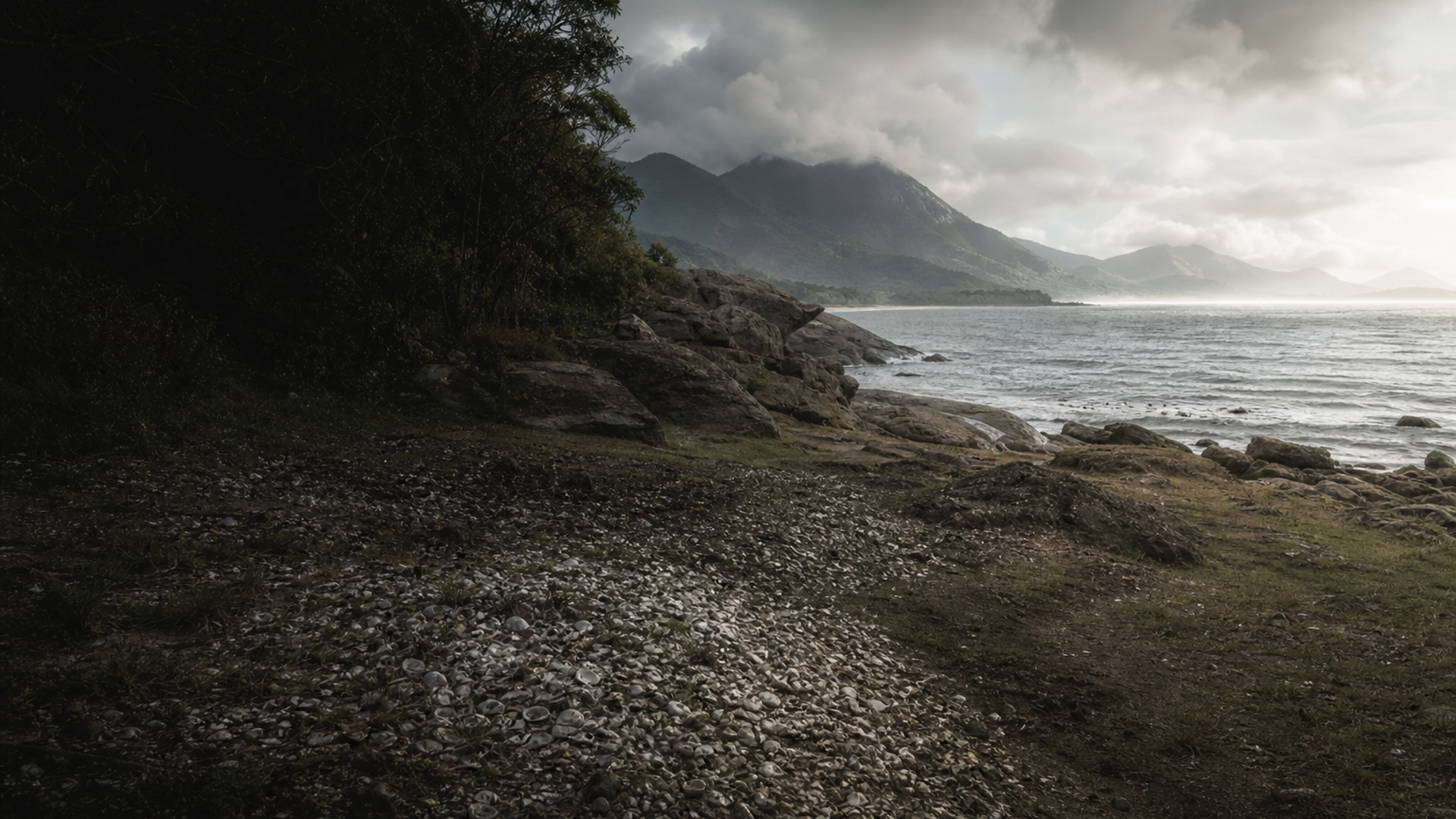
Jabuticabeira II: Shell-Midden Voices

Download PDF creates a visual, rasterized copy. Use Print for selectable text and better assistive-technology support.

Bericht wird vorbereitet

Verfügbare Informationen und Referenzen werden geladen

Verbindung mit dem archäologischen Quellenbestand...

Alte Quellen werden zusammengestellt

Zum Hauptinhalt springen
Jabuticabeira II: Shell-Midden Voices
Zivilisations-Spotlight

Jabuticabeira II: Shell-Midden Voices

Coastal lifeways from 410 BCE–880 CE revealed by shells, bones and ancient DNA

410 BCE - 8802000 CE
Coastal southern Brazil (Jabuticabeira Shell Midden II)
Scrollen zum Start
Kapitel I

Die Geschichte

Die Jabuticabeira II: Shell-Midden Voices-Kultur verstehen

Archaeological and genetic glimpses from Jabuticabeira Shell Midden II (Brazil) illuminate coastal hunter-gatherer-fisher communities ca. 410 BCE–880 CE. Limited ancient DNA (5 samples) shows Native American maternal lineages (C1c, B2) and a single Y-Q signal; conclusions remain preliminary.

Time Period

410 BCE–880 CE (≈2000 BP)

Region

Coastal southern Brazil (Jabuticabeira Shell Midden II)

Common Y-DNA

Q (observed: 1/5)

Common mtDNA

C1c (4/5), B2 (1/5)

Kapitel II

Zeitleiste

Zentrale Momente in der Geschichte dieser Kultur

410 BCE

Earliest radiocarbon evidence of occupation

Calibrated dates indicate midden accumulation begins around 410 BCE, marking long-term coastal use.

200 CE

Peak midden accumulation

Mid-late Holocene phases show thickened shell deposits and multiple human interments, suggesting sustained occupation.

1970 CE

Modern archaeological investigations

Systematic excavations and surveys begin to document stratigraphy, burials and material culture at Jabuticabeira II.

Kapitel III

Origins & Emergence

The Jabuticabeira Shell Midden II belongs to a wider tradition of coastal mound-building often grouped under the term "sambaqui." Situated on the southern Brazilian littoral, these middens accumulated as living floors and burial grounds where successive generations discarded shells, bones and charcoal. Radiocarbon-calibrated contexts from the site span roughly 410 BCE to 880 CE, placing these deposits in the late Holocene when maritime environments and rich estuaries shaped human lifeway choices.

Archaeological data indicates populations at Jabuticabeira II exploited diverse marine resources and constructed stratified deposits that can reflect long-term occupation. The material archive—layers of shell, fish bone and human interments—speaks to repeated seasonal or year-round use of the coast. Limited evidence suggests regional connections with other sambaqui sites, as well as localized traditions in burial treatment and midden architecture.

Genetically, the recovered ancient DNA from five individuals provides preliminary windows into ancestry. While maternal haplogroups (C1c, B2) fall within known Native American diversity, and a single Y-chromosome Q instance aligns with indigenous paternal lineages, the small sample count demands caution. Further sampling across stratigraphy and neighboring sites is required to resolve patterns of migration, continuity and interaction.

  • Occupation: ca. 410 BCE–880 CE (late Holocene)
  • Sambaqui tradition: extensive shell middens and burials
  • Preliminary aDNA shows Native American maternal and paternal signals
Kapitel IV

Daily Life & Society

Imagine a shoreline punctuated by low mounds of shell, charcoal lines from hearths and the steady rhythm of fishing and shellfish gathering—the daily life at Jabuticabeira II was woven from salt, tide and estuary. Archaeological excavations reveal dense concentrations of mollusc shells, abundant fish remains, and occasional terrestrial fauna, indicating a diet centered on marine resources but supplemented by hunting and foraging.

Households likely organized activities around seasonal fisheries, shell-processing areas, and communal hearths. The presence of human remains within midden contexts suggests integrated mortuary practices where the living and the dead occupied the same palimpsest of deposit and memory. Material culture—stone tools for cutting and grinding, bone implements, and ornaments fashioned from shell—reflects craftsmanship adapted to a coastal economy.

Social organization is inferred from spatial patterning: discrete burial clusters, variation in midden thickness, and artifact distributions point to household-level groups with broader community ties. However, direct evidence for social hierarchies or political centralization is limited; interpretations remain cautious and benefit from interdisciplinary study combining zooarchaeology, stratigraphy and ancient DNA.

  • Marine-focused subsistence: shellfish, fish, occasional terrestrial game
  • Integrated living and burial deposits within shell middens
Kapitel V

Genetic Profile

Ancient DNA from Jabuticabeira Shell Midden II comes from five individuals dated within the site's occupational range. Maternal lineages are dominated by haplogroup C1c (4 individuals) with one individual carrying B2, both haplogroups that are part of the broader pan-American mtDNA diversity. A single male-associated Y-chromosome was assigned to haplogroup Q, consistent with a common Native American paternal signal.

These genetic markers complement archaeological indications of long-term coastal occupation and affinity with Native American populations of South America. Yet with only five samples, statistical power is low: any inference about population continuity, gene flow, or sex-biased demography (for example, matrilineal persistence or male-biased mobility) must be presented as provisional. The observed mtDNA uniformity could reflect local maternal continuity, founder effects, or sampling bias.

Future work combining genome-wide data, higher-coverage sequencing and broader geographic sampling will be essential to test hypotheses about population structure, regional connectivity along the Brazilian coast, and relationships to contemporary indigenous groups. Ethical collaboration with descendant communities and careful contextualization of genetic results remain central to responsible interpretation.

  • mtDNA: C1c (4/5), B2 (1/5) — typical Native American maternal lineages
  • Y-DNA: Q observed (1/1 males) — matches indigenous paternal ancestry; sample size is small
Kapitel VI

Legacy & Modern Connections

The shell mounds of Jabuticabeira II stand as palimpsests of coastal lifeways—archives of diet, ritual and mobility. They connect present-day coastal ecologies and communities to a deep past shaped by maritime adaptation. Genetic signals identified so far echo broader Native American ancestries, suggesting that the people who built these middens were part of long-standing regional networks.

Because the ancient DNA sample set is small, any claims about direct ancestry to specific modern groups are tentative. The real legacy of these finds lies in inspiring collaborative research that blends archaeology, genomics and indigenous knowledge. Continued, ethically governed sampling and open dialogue with descendant communities will enrich narratives about continuity, resilience and change along Brazil's shores.

  • Middens as cultural and ecological archives linking past and present
  • Genetic echoes of Native American lineages — but conclusions are preliminary
KI-gestützt

KI-Assistent

Stellen Sie Fragen zur Jabuticabeira II: Shell-Midden Voices-Kultur

KI-Assistent von DNAGENICS

Funktion freischalten
Stellen Sie Fragen zur Kultur Jabuticabeira II: Shell-Midden Voices. Unser KI-Assistent kann genetische Befunde, historischen Kontext, archäologische Belege und moderne Verbindungen erläutern.
Beispiel einer KI-Analyse

Die Jabuticabeira II: Shell-Midden Voices-Kultur ist ein faszinierendes Kapitel der Menschheitsgeschichte...

Genetische Analysen zeigen Übereinstimmungen mit früheren Populationen und Hinweise auf besondere Anpassungen und kulturelle Innovationen. Alte DNA-Proben liefern Einblicke in Migrationsmuster, soziale Strukturen und genetische Verbindungen zwischen Populationen.

Dies ist eine Vorschau der KI-Analyse. Schalten Sie den vollständigen KI-Assistenten frei, um detaillierte Einblicke zu erkunden:

  • Genetische Zusammensetzung und genetische Ähnlichkeit
  • Migrationsmuster und Ursprünge
  • Alltag und kulturelle Praktiken
  • Genetischer Bezug zu heutigen Populationen

Weitere antike Kulturen erkunden

Geschichten von Zivilisationen aus der antiken Welt entdecken

Use code for 30% off • Expires Nov 08