Jōmon Echoes

Download PDF creates a visual, rasterized copy. Use Print for selectable text and better assistive-technology support.

Bericht wird vorbereitet

Verfügbare Informationen und Referenzen werden geladen

Verbindung mit dem archäologischen Quellenbestand...

Alte Quellen werden zusammengestellt

Zum Hauptinhalt springen
Jōmon Echoes
Zivilisations-Spotlight

Jōmon Echoes

Coastal hunter-gatherers of ancient Japan seen through archaeology and DNA

2472 CE - 835 BCE
Japan (Rokutsu, Funadomari)
Scrollen zum Start
Kapitel I

Die Geschichte

Die Jōmon Echoes-Kultur verstehen

Archaeological and ancient-DNA evidence from seven Jōmon individuals (2472–835 BCE) illuminates coastal lifeways in Japan. Shell middens at Rokutsu and skeletal finds at Funadomari, paired with haplogroups D (Y) and N/N9b (mtDNA), suggest deep East Asian roots with limited sample numbers.

Time Period

2472–835 BCE

Region

Japan (Rokutsu, Funadomari)

Common Y-DNA

D (4/7 samples)

Common mtDNA

N (4/7), N9b (3/7)

Kapitel II

Zeitleiste

Zentrale Momente in der Geschichte dieser Kultur

2500 BCE

Middle–Late Jōmon coastal intensification

Communities at Rokutsu and other middens intensify marine resource use; pottery and pit dwellings are widespread, leaving rich archaeological deposits.

Kapitel III

Origins & Emergence

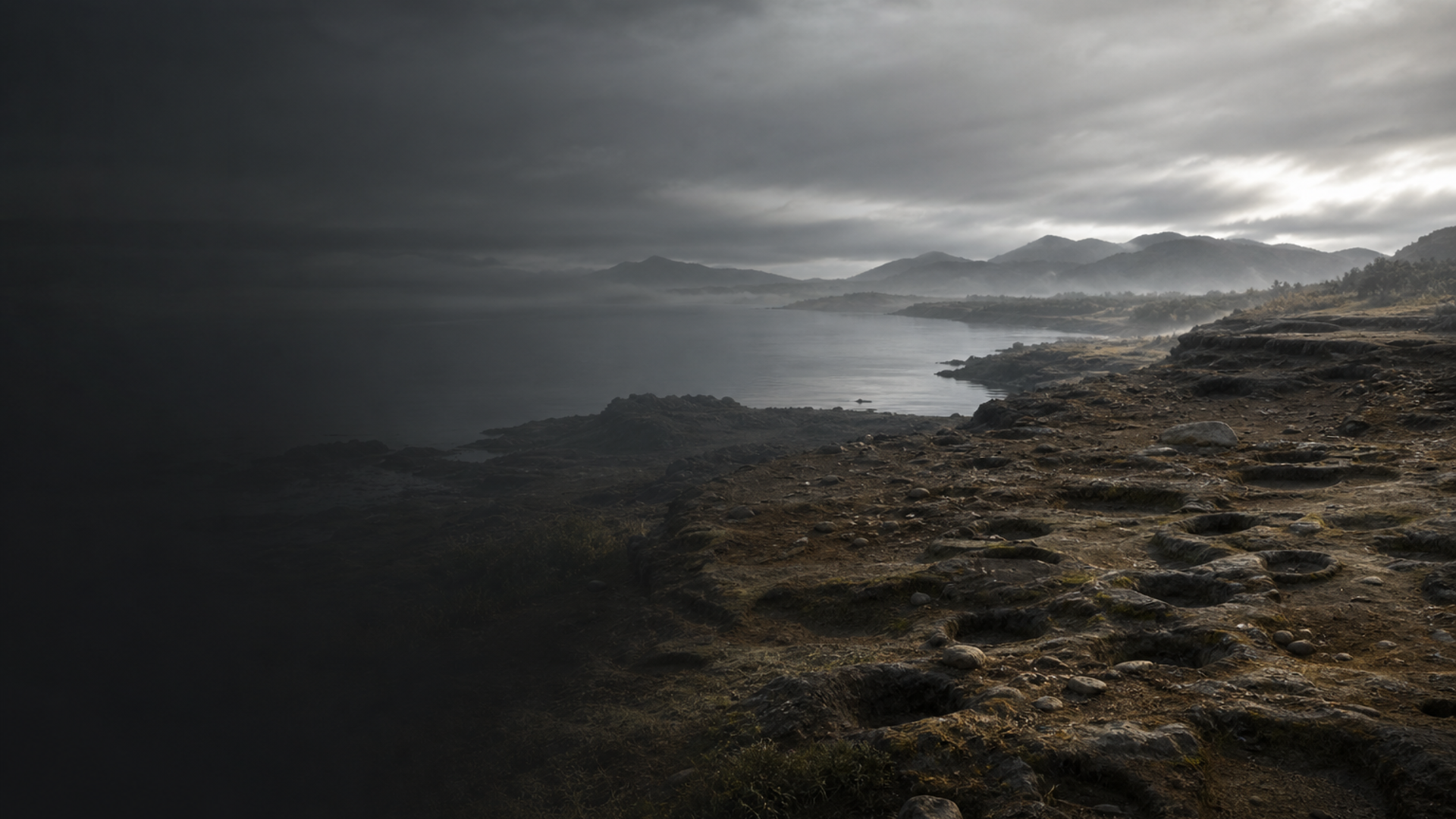
The Jōmon world arose along Japan’s indented coasts and forested valleys. Archaeological layers dated here to roughly 2472–835 BCE preserve a panorama of pottery-rich hunter-gatherer communities whose material signature — cord-marked ceramics, shell middens, and pit dwellings — distinguishes them from contemporaneous mainland groups. Sites such as the Rokutsu Shell Mound record repeated seasonal harvests of fish, shellfish, and migratory birds; Funadomari on Rebun Island preserves skeletal remains that yield direct biological data.

Archaeological data indicates long-term local continuity: many Jōmon technologies and settlement patterns persist for millennia. At the same time, the Jōmon were not a single static entity but a mosaic of regional lifeways shaped by coastal and interior environments. Environmental shifts and sea-level stability in this period supported dense exploitation of marine resources, enabling settled seasonal rounds and durable craft traditions.

Limited ancient DNA evidence — seven samples dated to the late Jōmon span represented here — begins to illuminate biological origins. While genetic data point to deep East Eurasian lineages on the archipelago, the small sample count means conclusions about population history remain provisional. Archaeology therefore provides the cultural tableau into which these early genetic finds are cautiously fitted.

  • Distinctive cord-marked pottery appears across Jōmon sites
  • Key sites: Rokutsu Shell Mound and Funadomari
  • Long-term regional continuity, but variable local adaptations
Kapitel IV

Daily Life & Society

Imagine hearth smoke drifting from low pit houses as communities processed the sea’s abundance. The Jōmon economy emphasized diversified foraging: shellfish, coastal fish, sea mammals in some areas, and wild plants and nuts inland. Middens like Rokutsu act as time capsules, containing fish vertebrae, shells, bone tools, and personal ornaments that speak to diet, craft, and ritual.

Material culture shows sophisticated craft specialization. Pottery — fired and often decorated with cord impressions — served both practical and likely ceremonial roles. Stone and bone tools, lacquered objects in some contexts, and ornamental beads and pierced teeth indicate long-distance exchange of materials and stylistic ideas. Social organization is inferred from settlement patterns: semi-sedentary villages that expanded and contracted with resource cycles, possible kin-based households, and differentiated mortuary practices preserved at sites such as Funadomari.

Archaeological evidence suggests symbolic life was rich: elaborate burial goods and figurative clay ‘dogū’ in broader Jōmon contexts point to belief systems and social identities. Yet many aspects — leadership structures, the degree of mobility, and exact household sizes — remain debated because preservation and excavation coverage vary by site.

  • Coastal foraging and shell middens record diet and seasonality
  • Complex material culture: pottery, bone tools, ornaments
Kapitel V

Genetic Profile

Seven ancient individuals from the late Jōmon (2472–835 BCE) provide the current genetic window for this dataset. Y-chromosome data show a strong presence of haplogroup D in four male samples — a lineage today concentrated in parts of Japan and among some Himalayan and Andaman populations — suggesting a continuity of paternal lineages on the archipelago. Mitochondrial haplogroups are dominated here by lineages labelled N (four individuals) and the sublineage N9b (three individuals), maternal markers that have been associated with East Eurasian and northern Asian prehistoric populations.

These genetic signals align with long-standing archaeological views of the Jōmon as an autochthonous hunter-gatherer population with deep regional roots. However, the sample size is small (<10), so patterns of diversity, regional structure, and relationships to later populations (for example, migrants associated with the Yayoi period) must be treated as provisional. Ancient DNA hints at partial continuity between some Jōmon lineages and modern groups such as the Ainu and Ryukyuan peoples, but admixture with later arrivals complicates direct lines of descent.

In short, the genetic profile supports an interpretation of deep East Eurasian ancestry in Jōmon individuals, combined with regional diversity. Greater sample coverage across time and space will be required to resolve migration, isolation, and admixture events with confidence.
  • Y haplogroup D prevalent in 4 of 7 samples
  • mtDNA dominated by N and N9b; conclusions provisional due to small sample size
Kapitel VI

Legacy & Modern Connections

The Jōmon left an indelible cultural and genetic imprint on the Japanese archipelago. Their pottery traditions, settlement forms, and symbolic artifacts influenced subsequent populations and provide a visible through-line from deep prehistory to later societies. Genetic evidence — while limited in number here — suggests threads of biological continuity that can be traced, with caveats, into some modern groups in Japan.

Contemporary populations such as the Ainu and Ryukyuan peoples are often discussed in relation to Jōmon ancestry; archaeological continuity and certain genetic markers (including N9b and portions of haplogroup D) support connections, but later migrations and admixture events mean that modern genetic landscapes are palimpsests. The romance of slow continuity must be balanced with the reality of movement, interaction, and replacement. Ultimately, the combination of archaeology and ancient DNA opens a cinematic window into lives lived on rocky coasts and forest margins — but fuller understanding awaits larger, geographically diverse genetic samples allied to careful excavation and context.

  • Material culture influenced later Japanese traditions
  • Genetic continuity suggested but complicated by later migrations
KI-gestützt

KI-Assistent

Stellen Sie Fragen zur Jōmon Echoes-Kultur

KI-Assistent von DNAGENICS

Funktion freischalten
Stellen Sie Fragen zur Kultur Jōmon Echoes. Unser KI-Assistent kann genetische Befunde, historischen Kontext, archäologische Belege und moderne Verbindungen erläutern.
Beispiel einer KI-Analyse

Die Jōmon Echoes-Kultur ist ein faszinierendes Kapitel der Menschheitsgeschichte...

Genetische Analysen zeigen Übereinstimmungen mit früheren Populationen und Hinweise auf besondere Anpassungen und kulturelle Innovationen. Alte DNA-Proben liefern Einblicke in Migrationsmuster, soziale Strukturen und genetische Verbindungen zwischen Populationen.

Dies ist eine Vorschau der KI-Analyse. Schalten Sie den vollständigen KI-Assistenten frei, um detaillierte Einblicke zu erkunden:

  • Genetische Zusammensetzung und genetische Ähnlichkeit
  • Migrationsmuster und Ursprünge
  • Alltag und kulturelle Praktiken
  • Genetischer Bezug zu heutigen Populationen

Weitere antike Kulturen erkunden

Geschichten von Zivilisationen aus der antiken Welt entdecken

Use code for 30% off • Expires Nov 08




