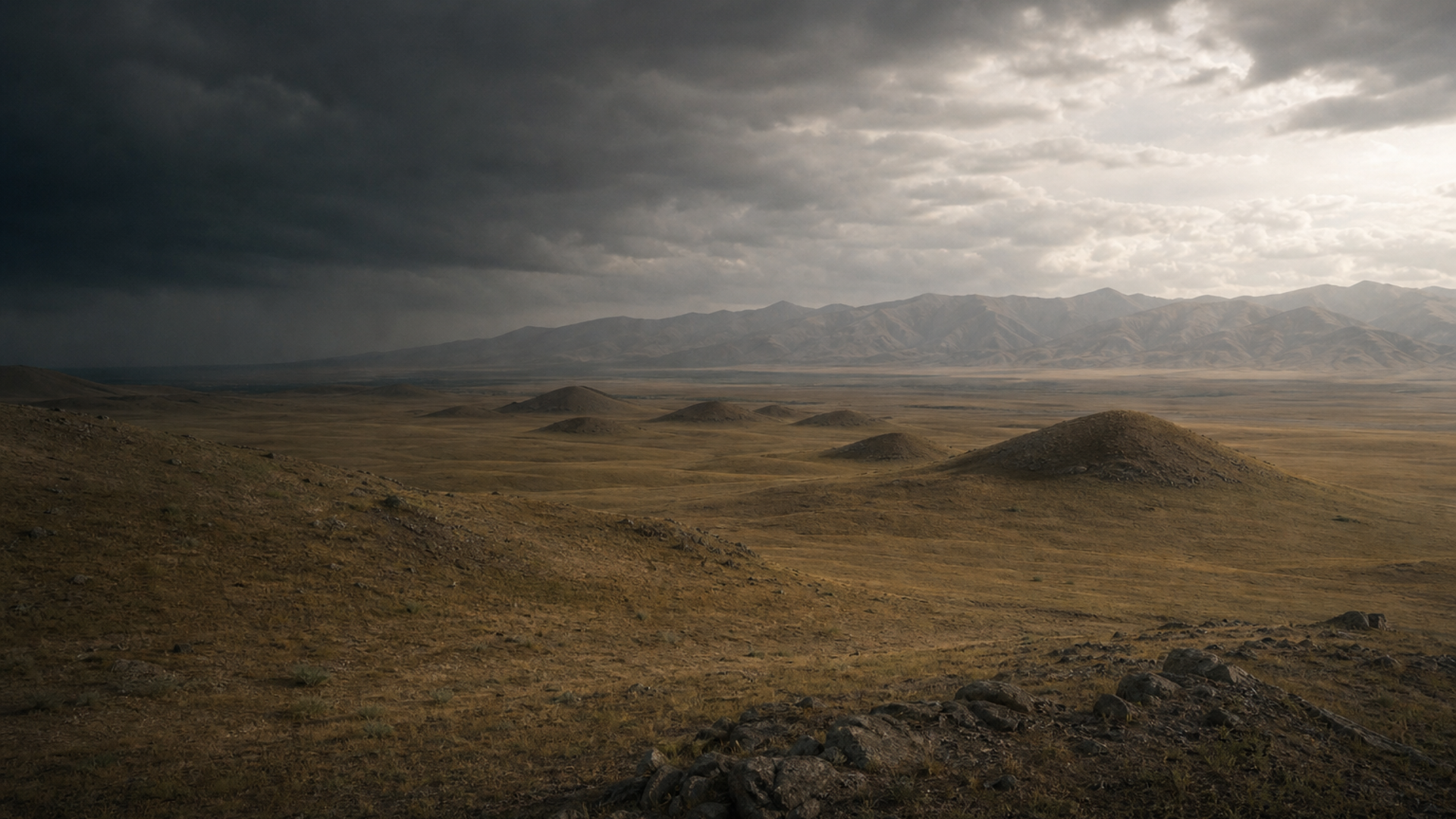
Kaspan Saka: Mounds of the Almaty Steppe

Download PDF creates a visual, rasterized copy. Use Print for selectable text and better assistive-technology support.

Bericht wird vorbereitet

Verfügbare Informationen und Referenzen werden geladen

Verbindung mit dem archäologischen Quellenbestand...

Alte Quellen werden zusammengestellt

Zum Hauptinhalt springen
Kaspan Saka: Mounds of the Almaty Steppe
Zivilisations-Spotlight

Kaspan Saka: Mounds of the Almaty Steppe

Four Iron Age Saka burials from Kaspan Valley linking archaeology and early steppe DNA

1499 BCE - 72 CE
Kaspan Valley, Almaty Region, Kazakhstan
Scrollen zum Start
Kapitel I

Die Geschichte

Die Kaspan Saka: Mounds of the Almaty Steppe-Kultur verstehen

Archaeological and genetic data from four Saka-era burials in Kaspan Valley (Almaty Region, Kazakhstan) suggest a mixed steppe heritage. Limited samples hint at western and eastern Eurasian ancestry within a pastoral, horse-centered culture. Conclusions remain preliminary.

Time Period

1499 BCE – 72 CE

Region

Kaspan Valley, Almaty Region, Kazakhstan

Common Y-DNA

R (2), Q (1)

Common mtDNA

G (1), I1b (1)

Kapitel II

Zeitleiste

Zentrale Momente in der Geschichte dieser Kultur

800 BCE

Emergence of Saka pastoral communities

Archaeological horizons show the consolidation of mobile, horse-centered Saka groups across the Eurasian steppe, forming the context for Kaspan Valley burials.

Kapitel III

Origins & Emergence

The Kaspan burials sit within the sweeping narrative of Iron Age nomads who animated the Central Asian steppe with mounted pastoralism and richly decorated metalwork. Archaeological data indicates a Saka cultural horizon across what is now eastern Kazakhstan from the first millennium BCE. The three excavated mounds at Kaspan-2 (mound 3) and Kaspan-6 (mounds 1 and 4) are local expressions of the broader kurgan tradition — earthen or stone mounds marking elite graves and community memory.

Material traces across the steppe — horse equipment, patterned gold, and textile imprints — often accompany Saka burials elsewhere and suggest a mobile economy based on horses and herds, tied by seasonal rounds to river valleys. In Kaspan Valley, the funerary architecture points toward these pastoral lifeways, though site-scale publication remains limited.

From a genetic perspective, the dated span associated with the Kaspan samples (1499 BCE–72 CE) overlaps long-term processes: the persistence of Bronze Age steppe ancestry and later interactions with eastern Eurasian groups. Limited evidence suggests these Kaspan individuals reflect that blend, but with only four samples the picture is fragmentary. Archaeological interpretation must therefore remain cautious: the mounds are evocative, but they are one small window into a dynamic Iron Age frontier.

  • Sites: Kaspan-2 (mound 3), Kaspan-6 (mounds 1 & 4) in Kaspan Valley
  • Cultural horizon: Iron Age Saka pastoralists across Kazakhstan
  • Evidence limited — only four genomic samples; interpretations are preliminary
Kapitel IV

Daily Life & Society

Archaeological data indicates a society organized around mobile herding, horse mastery, and seasonal exploitation of steppe resources. The Kaspan mounds represent ritualized treatment of the dead, often associated elsewhere with attached grave goods that display social rank and long-distance connections — for example, weapons, bridles, and adornments.

Ethnographic analogy and regional archaeology suggest households were semi-nomadic, moving animals between lowland pastures and upland summer grazing. Trade and raiding tied steppe communities into vast exchange networks: metalwork styles and raw materials at many Saka sites show links from the Altai to the Black Sea. The Kaspan Valley, a corridor in the foothills of southeastern Kazakhstan, would have been a seasonal node where mobility met riverine resources.

Osteological remains from such contexts can show wear patterns consistent with horseback riding and repetitive tasks, but the Kaspan skeletal series is small. Archaeological data thus highlights a life of mobility, social differentiation visible in burials, and cultural connectivity — while reminding us that local variation could be great.

  • Economy centered on pastoralism and horse culture
  • Burials likely reflect social differentiation and long-distance contacts
Kapitel V

Genetic Profile

Genetic data from four individuals recovered in the Kaspan Valley provide a tantalizing, but tentative, glimpse of Saka-era ancestry. Reported Y-chromosome lineages include R in two individuals and Q in one; mitochondrial haplogroups include G and I1b in at least two individuals. One Kaspan individual lacked a reported Y result in the available summary (likely female or unresolved), and mtDNA was not reported for all samples.

Interpretation: Haplogroup R is commonly associated with West Eurasian and steppe male lineages; Q has strong links to northeastern Eurasian and Siberian populations. On the maternal side, mtDNA G is typically found in eastern Eurasia, while I1b has a distribution more common in western and northern Eurasia. Taken together, these markers are consistent with archaeological expectations for the Saka: a mixture of western steppe ancestry and eastern Eurasian inputs reflecting centuries of contact along east–west corridors.

Uncertainty and sample size: With only four genomes, conclusions are preliminary. The small sample set risks overrepresenting rare lineages or local kin groups rather than population-wide patterns. Further sampling across time, sex, and burial contexts at Kaspan and neighboring valleys is required to robustly model admixture, continuity, and demographic shifts.

  • Y lineages: R (2), Q (1) — suggesting western and northeastern affinities
  • mtDNA: G and I1b — indicating mixed eastern and western maternal inputs
Kapitel VI

Legacy & Modern Connections

The Kaspan Saka remain part of a deep network of steppe peoples whose cultural forms — mounted pastoralism, rich burial rites, and decorative metalwork — influenced vast regions from the Altai to the Pontic steppe. Genetically, the mixed markers seen in the Kaspan individuals echo a broader pattern across Central Asia: enduring steppe ancestry layered with east–west admixture over millennia.

For modern populations of Kazakhstan, these burials illustrate one ancestral thread among many. Contemporary Kazakh genetic diversity reflects later migrations and empire-building as well as local continuity; the Kaspan data hint at continuity but are insufficient to draw direct lines to modern groups. As more genomes from the Almaty region and beyond are analyzed, we can better trace which elements of the Saka genetic legacy persist and how cultural traditions were transmitted in a mobile, interconnected landscape.

  • Connects to broader steppe cultural and genetic continuity
  • Current genetic links to modern populations are plausible but not yet proven
KI-gestützt

KI-Assistent

Stellen Sie Fragen zur Kaspan Saka: Mounds of the Almaty Steppe-Kultur

KI-Assistent von DNAGENICS

Funktion freischalten
Stellen Sie Fragen zur Kultur Kaspan Saka: Mounds of the Almaty Steppe. Unser KI-Assistent kann genetische Befunde, historischen Kontext, archäologische Belege und moderne Verbindungen erläutern.
Beispiel einer KI-Analyse

Die Kaspan Saka: Mounds of the Almaty Steppe-Kultur ist ein faszinierendes Kapitel der Menschheitsgeschichte...

Genetische Analysen zeigen Übereinstimmungen mit früheren Populationen und Hinweise auf besondere Anpassungen und kulturelle Innovationen. Alte DNA-Proben liefern Einblicke in Migrationsmuster, soziale Strukturen und genetische Verbindungen zwischen Populationen.

Dies ist eine Vorschau der KI-Analyse. Schalten Sie den vollständigen KI-Assistenten frei, um detaillierte Einblicke zu erkunden:

  • Genetische Zusammensetzung und genetische Ähnlichkeit
  • Migrationsmuster und Ursprünge
  • Alltag und kulturelle Praktiken
  • Genetischer Bezug zu heutigen Populationen

Weitere antike Kulturen erkunden

Geschichten von Zivilisationen aus der antiken Welt entdecken

Use code for 30% off • Expires Nov 08