Krepost Neolithic Echoes

Download PDF creates a visual, rasterized copy. Use Print for selectable text and better assistive-technology support.

Bericht wird vorbereitet

Verfügbare Informationen und Referenzen werden geladen

Verbindung mit dem archäologischen Quellenbestand...

Alte Quellen werden zusammengestellt

Zum Hauptinhalt springen
Krepost Neolithic Echoes
Zivilisations-Spotlight

Krepost Neolithic Echoes

A single voice from 6th-millennium BCE Bulgaria that links pottery, fields, and maternal lineage.

5723 CE - 5623 BCE
Bulgaria (Krepost)
Scrollen zum Start
Kapitel I

Die Geschichte

Die Krepost Neolithic Echoes-Kultur verstehen

Archaeological and genetic traces from Krepost (Bulgaria) ca. 5723–5623 BCE reveal a Neolithic farming presence. Limited ancient DNA (one sample, mtDNA H5) offers a tentative maternal link to broader Neolithic networks. Archaeological context points to early farming lifeways in the central Balkans.

Time Period

5723–5623 BCE

Region

Bulgaria (Krepost)

Common Y-DNA

Not reported (sample n=1)

Common mtDNA

H5 (1)

Kapitel II

Zeitleiste

Zentrale Momente in der Geschichte dieser Kultur

5700 BCE

Neolithic occupation at Krepost

Radiocarbon dates place human activity at Krepost ca. 5723–5623 BCE, indicating early farming occupation in central Bulgaria.

Kapitel III

Origins & Emergence

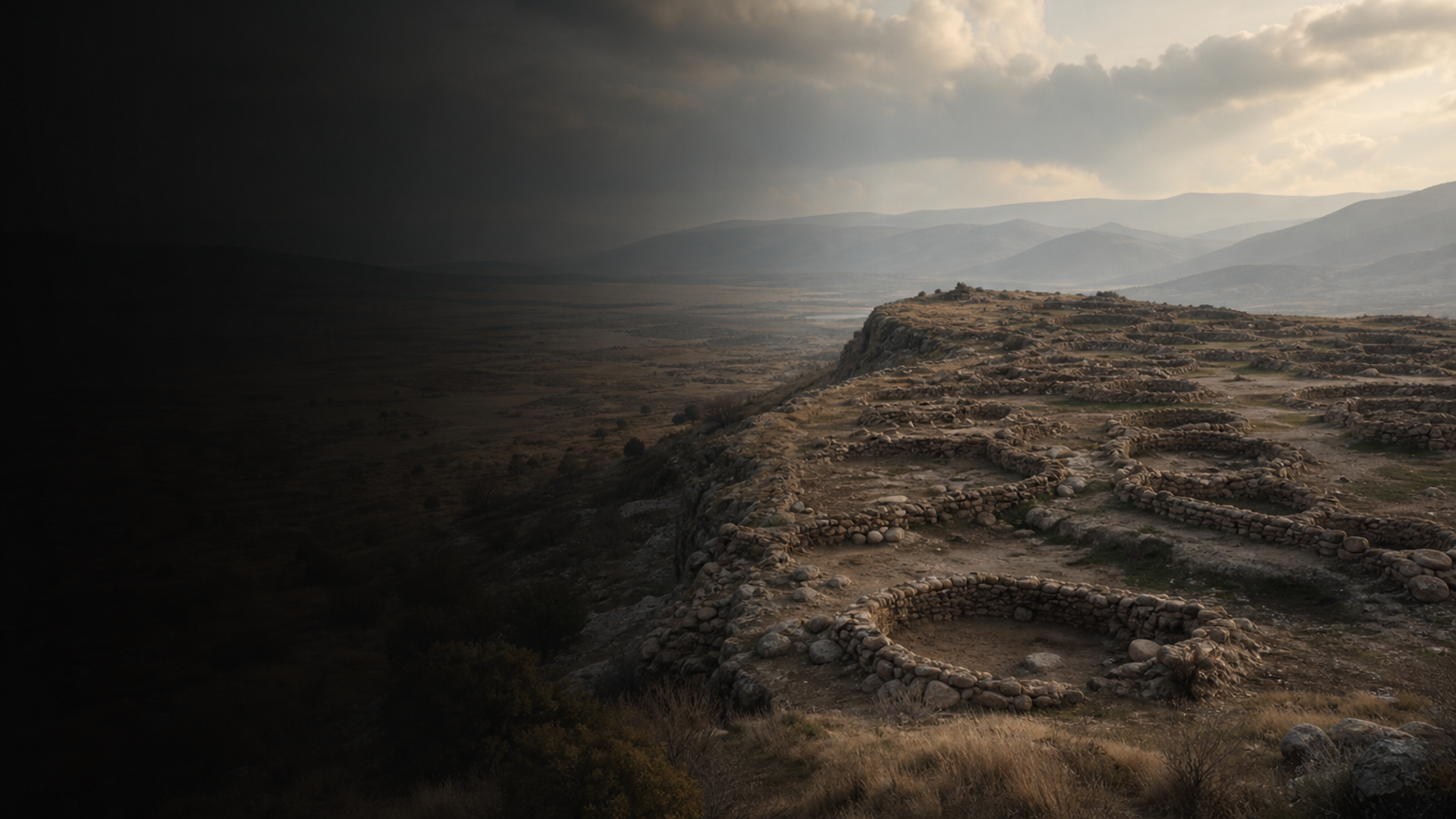
Against the rolling limestone and river valleys of central Bulgaria, the site of Krepost registers a human presence in the early 6th millennium BCE. Radiocarbon determinations bracket activity at the site to roughly 5723–5623 BCE, placing Krepost squarely in the Neolithic horizon when farming practices and new ceramic traditions swept the Balkans. Archaeological data indicates domestic architecture fragments, pottery sherds, and agricultural indicators typical of Neolithic communities across the region. These material traces align with broader patterns of Neolithic expansion from Anatolia into southeastern Europe, but local variation is pronounced: pottery styles and settlement footprints at Krepost suggest a community negotiating incoming technologies and existing landscapes.

Limited evidence from the site—both in terms of preserved material and contextual excavation—means interpretations remain cautious. The single genetic sample recovered offers a narrow glimpse of biological ancestry but does not capture the full demographic complexity of the community. Nevertheless, combining the archaeological record with even sparse DNA data invites a cinematic reconstruction: farmers tending newly sown fields, shaping clay vessels, and participating in networks of exchange that knit the Balkans into the early agricultural world.

  • Occupation dated ca. 5723–5623 BCE (early 6th millennium BCE)
  • Material culture consistent with Neolithic farming communities in the central Balkans
  • Interpretations are provisional due to limited excavation and sampling
Kapitel IV

Daily Life & Society

Daily life at Krepost can be imagined through the durable traces left behind: chipped stone, fired clay, and carbonized seeds. Archaeological data indicates a subsistence economy dominated by cereal cultivation and the management of domesticated animals—traits shared with contemporary Neolithic settlements across Bulgaria. Pottery, often plain or simply decorated, served as vessels for storage and cooking; hearths and postholes suggest small, possibly kin-based households clustered near arable land and water sources.

Social rhythms were tightly bound to seasonal cycles. Spring sowing and autumn harvest would have structured labor, while craft production—flint knapping, bone working, and pottery manufacture—provided daily focus. Exchange networks, visible in non-local raw materials and stylistic affinities in ceramics, hint at social ties beyond the immediate valley. Burial practices in the broader region point to growing distinctions in household identity, though direct cemetery evidence from Krepost itself is limited. In short, the life of Krepost’s inhabitants was intimate and embedded in landscape: hands in soil, clay on potter’s rims, and knowledge transmitted in small, repeated gestures that leave faint but telling marks in the archaeological record.

  • Economy centered on cereals and domesticated animals
  • Crafts and exchange link Krepost to wider Neolithic networks
Kapitel V

Genetic Profile

Ancient DNA from Krepost is extremely limited—a single individual dated to ca. 5723–5623 BCE whose mitochondrial genome belongs to haplogroup H5. Haplogroup H and its subclades are widespread in European prehistory and later periods; H5 has been observed in various Neolithic and later contexts in Europe. The presence of H5 at Krepost therefore fits expectations that Neolithic maternal lineages in the Balkans often derive from or reflect connections with early farming populations that dispersed from Anatolia and mixed with local hunter-gatherer groups.

However, with only one sample, any population-level inference would be provisional. No Y-chromosome data are reported for this individual, so paternal lineages and male-mediated demographic processes remain unknown at Krepost. Archaeogenetic studies in the broader Balkans typically reveal a predominant Anatolian Neolithic farmer ancestry component mixed to varying degrees with West Eurasian hunter-gatherer (WHG) ancestry; it is plausible that the Krepost individual reflects a similar admixture profile, but this remains hypothetical without genome-wide data. In sum, the mtDNA H5 finding is a valuable, evocative clue—an intimate maternal thread—that must be woven into a larger tapestry built from more samples and broader genomic coverage.

  • mtDNA H5 identified in the single sampled individual
  • No Y-DNA reported; genome-wide ancestry unknown—conclusions are preliminary
Kapitel VI

Legacy & Modern Connections

Krepost’s archaeological and genetic whispers speak to themes that shaped Europe: the spread of agriculture, the blending of peoples, and the long persistence of maternal lineages such as H5. Modern populations in the Balkans and across Europe carry mitochondrial diversity that partly reflects these deep Neolithic roots, but direct lines of descent are complex. The single H5 at Krepost may represent a maternal lineage that persisted locally, entered later gene pools, or remained rare—current data cannot distinguish among these possibilities.

Culturally, the legacy is clearer: early farmers like those at Krepost transformed landscapes, introducing new crops, animal husbandry, and ceramic traditions that set the stage for millennia of social change. Each new excavation and genetic sample will refine our view, turning the solitary voice from Krepost into part of a fuller chorus that tells how prehistoric lives in Bulgaria contributed to Europe's deep human story.

  • Maternal lineage H5 links Krepost to broader Neolithic maternal diversity
  • Cultural legacy: adoption of farming and ceramic traditions in the central Balkans
KI-gestützt

KI-Assistent

Stellen Sie Fragen zur Krepost Neolithic Echoes-Kultur

KI-Assistent von DNAGENICS

Funktion freischalten
Stellen Sie Fragen zur Kultur Krepost Neolithic Echoes. Unser KI-Assistent kann genetische Befunde, historischen Kontext, archäologische Belege und moderne Verbindungen erläutern.
Beispiel einer KI-Analyse

Die Krepost Neolithic Echoes-Kultur ist ein faszinierendes Kapitel der Menschheitsgeschichte...

Genetische Analysen zeigen Übereinstimmungen mit früheren Populationen und Hinweise auf besondere Anpassungen und kulturelle Innovationen. Alte DNA-Proben liefern Einblicke in Migrationsmuster, soziale Strukturen und genetische Verbindungen zwischen Populationen.

Dies ist eine Vorschau der KI-Analyse. Schalten Sie den vollständigen KI-Assistenten frei, um detaillierte Einblicke zu erkunden:

  • Genetische Zusammensetzung und genetische Ähnlichkeit
  • Migrationsmuster und Ursprünge
  • Alltag und kulturelle Praktiken
  • Genetischer Bezug zu heutigen Populationen

Weitere antike Kulturen erkunden

Geschichten von Zivilisationen aus der antiken Welt entdecken

Use code for 30% off • Expires Nov 08