Kudruküla Comb Ceramic of Estonia

Download PDF creates a visual, rasterized copy. Use Print for selectable text and better assistive-technology support.

Bericht wird vorbereitet

Verfügbare Informationen und Referenzen werden geladen

Verbindung mit dem archäologischen Quellenbestand...

Alte Quellen werden zusammengestellt

Zum Hauptinhalt springen
Kudruküla Comb Ceramic of Estonia
Zivilisations-Spotlight

Kudruküla Comb Ceramic of Estonia

Neolithic coastal communities at Narva-Jõesuu seen through pottery, stone, and DNA

3785 CE - 3376 BCE
Kudruküla, Ida‑Viru (Narva‑Jõesuu), Estonia
Scrollen zum Start
Kapitel I

Die Geschichte

Die Kudruküla Comb Ceramic of Estonia-Kultur verstehen

Archaeological and ancient DNA evidence from Kudruküla (Ida‑Viru, Estonia) links Comb Ceramic lifeways (c. 3785–3376 BCE) to hunter‑gatherer maternal lineages (mtDNA U/U4a) and a single Y‑haplogroup R. Small sample sizes make conclusions provisional.

Time Period

3785–3376 BCE

Region

Kudruküla, Ida‑Viru (Narva‑Jõesuu), Estonia

Common Y-DNA

R (n=1; limited sample)

Common mtDNA

U4a, U (n=2; limited sample)

Kapitel II

Zeitleiste

Zentrale Momente in der Geschichte dieser Kultur

3785 BCE

Comb Ceramic occupation at Kudruküla

Radiocarbon‑dated activity at Kudruküla marks Comb Ceramic presence on the northeastern Estonian coast; pottery and tools indicate seasonal coastal lifeways.

Kapitel III

Origins & Emergence

A shoreline people forged from ancient foragers

Wind and water shaped the first Comb Ceramic enclaves along the northeastern Baltic. Archaeological data from Kudruküla (Ida‑Viru County; Narva‑Jõesuu Municipality) place human activity here between ca. 3785 and 3376 BCE, squarely within the wider Neolithic Comb Ceramic tradition that spread across Finland, the eastern Baltic, and parts of northwestern Russia.

Material culture—thin, organic‑tempered pottery imprinted with comb impressions, microlithic stone tools and evidence of seasonal camps—speaks to long familiarity with coastal and riverine resources. Radiocarbon and stratigraphic work at this and comparable sites indicate repeated occupation rather than a single settlement episode.

Limited evidence suggests the local manifestation at Kudruküla represents a continuation of Mesolithic subsistence adapted to Neolithic technologies rather than a wholesale replacement by incoming farming communities. The archaeological picture is fragmentary but evocative: hearths near the shore, pottery fragments rubbed smooth by use, and discarded fish and elk bones hint at a resilient, mobile lifeway anchored to the sea and river.

Bulleted signals from the field:

  • Comb‑impressed pottery and microliths define the cultural horizon.
  • Coastal location indicates a mixed economy centered on fishing and foraging.
  • Radiocarbon range 3785–3376 BCE ties the local site to the broader Comb Ceramic phenomenon.

  • Comb‑impressed pottery and microliths define the cultural horizon.
  • Coastal location indicates a mixed economy centered on fishing and foraging.
  • Radiocarbon range 3785–3376 BCE ties Kudruküla to the regional Comb Ceramic phenomenon.
Kapitel IV

Daily Life & Society

Daily rhythms where river meets sea

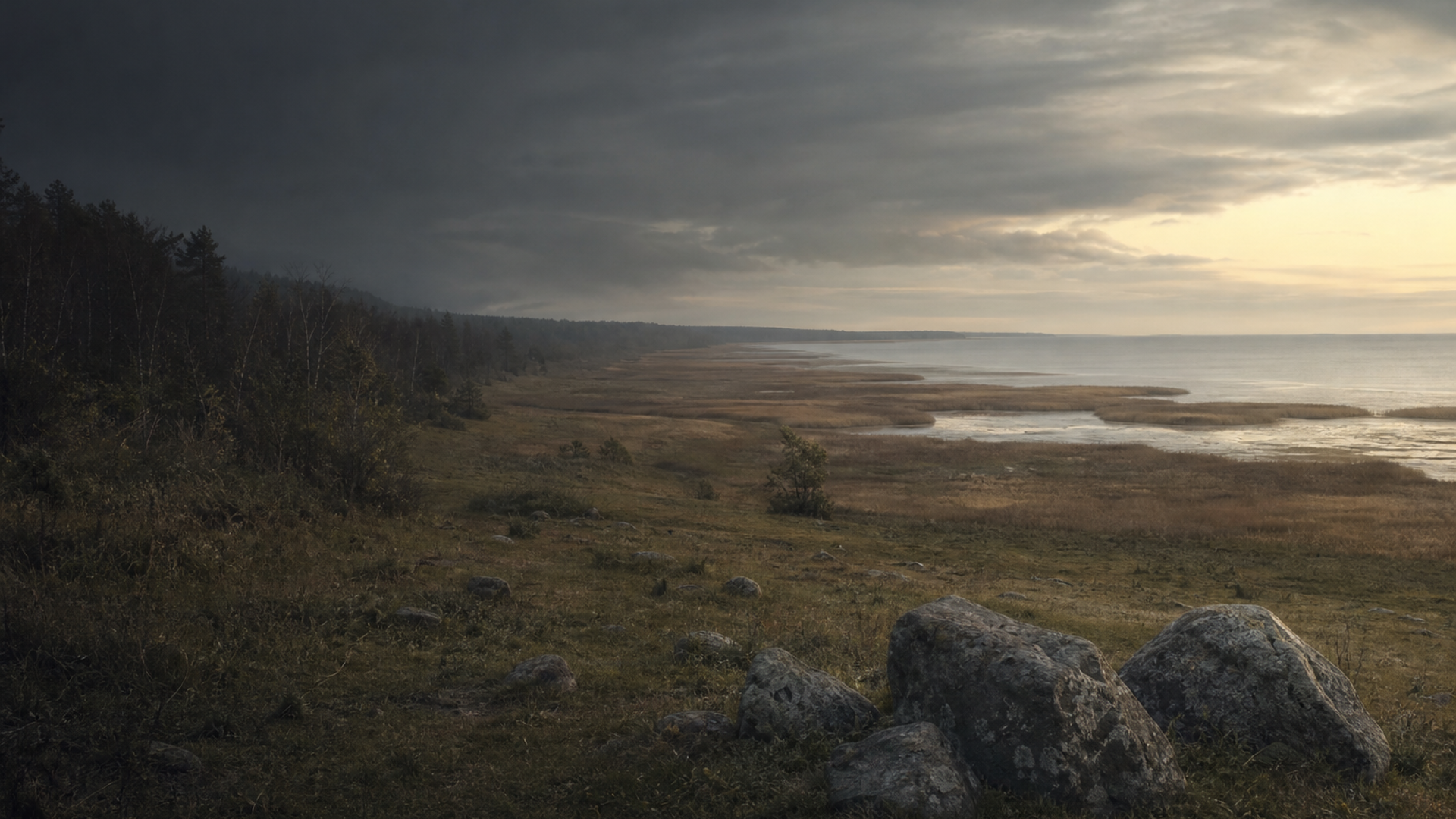
At Kudruküla the archaeological record paints a portrait of small, flexible communities whose calendar revolved around seasonal abundance. Fish bones, burnt sea‑mammal and terrestrial game remains, and specialized bone and antler tools indicate expertise in marine and littoral subsistence. Comb‑impressed pottery—often coarse and thin—was likely used for storage, cooking, and processing fish oils and plant foods.

Stone tool assemblages show continuity with Late Mesolithic technologies: carefully flaked microliths and scrapers suited to hide processing and woodworking. Settlement traces appear ephemeral in places, suggesting repeated short‑term camps or seasonal aggregations rather than large, permanent villages. The presence of hearths and specialized waste areas implies organized domestic spaces with routine craft activities.

Social life can only be inferred indirectly: the material economy points to small kin networks with mobility, partnership ties along waterways, and shared knowledge of coastal resources. Burial evidence for this specific locality is sparse, so mortuary practices and social ranking remain largely unknown.
Bulleted takeaways:

  • Economy centered on fishing, hunting, and foraging with specialized bone tools.

  • Mobility and seasonal aggregation likely structured social life; burial data are limited.
  • Economy centered on fishing, hunting, and foraging with specialized bone tools.
  • Mobility and seasonal aggregation likely structured social life; burial data are limited.
Kapitel V

Genetic Profile

DNA threads connecting shorelines and deep time

Ancient DNA from four individuals recovered at Kudruküla offers a tantalizing but preliminary glimpse into the genetic makeup of Comb Ceramic inhabitants in northeastern Estonia (dated 3785–3376 BCE). Among these four samples, mitochondrial lineages include U4a and a broader U lineage—both of which are commonly associated with Mesolithic and Neolithic hunter‑gatherer groups across northern and eastern Europe. A single male carries a Y‑chromosome haplogroup assigned to R.

These markers align qualitatively with broader patterns seen in Baltic and northeastern European Mesolithic/Neolithic contexts: enduring hunter‑gatherer maternal lineages (mtDNA U subclades) and a more variable picture for paternal lineages. The presence of Y‑haplogroup R in a single individual could indicate local continuity, contact, or incoming male‑mediated gene flow; however, R is a broad haplogroup with many sublineages, and the exact phylogeographic interpretation requires denser sampling.

Crucially, the small sample count (n=4) demands caution: statistical inference is limited and susceptible to sampling bias. Archaeological data combined with these genetic signals suggest a community rooted in hunter‑gatherer traditions but participating in wider regional networks. Larger sample sets would be required to resolve ancestry proportions, sex‑biased admixture, and continuity with later Baltic populations.

Key genetic points:

  • mtDNA U/U4a present, consistent with hunter‑gatherer maternal ancestry.
  • Y‑haplogroup R found in one male; interpretation is tentative given tiny sample size.
  • mtDNA U/U4a present, consistent with hunter‑gatherer maternal ancestry.
  • Y‑haplogroup R found in one male; interpretation is tentative given tiny sample size.
Kapitel VI

Legacy & Modern Connections

Echoes in the Baltic landscape

Archaeological and genetic traces from Kudruküla contribute to a larger story of the Baltic Neolithic: communities anchored to coasts and rivers who maintained hunter‑gatherer lifeways even as new technologies and contacts circulated across northern Europe. The mtDNA U lineages observed here resonate with a pattern of deep maternal continuity in the region, while the single Y‑R signal hints at more complex demographic interactions.

Over millennia, later migrations—Bronze Age movements, metalworking societies, and historical population shifts—reshaped the genetic tapestry of Estonia. Nevertheless, elements of Comb Ceramic lifeways endure in regional archaeology: pottery motifs, coastal economies, and a cultural memory of littoral subsistence. From a genetic perspective, the Kudruküla samples suggest that components of hunter‑gatherer ancestry likely contributed to the ancestral pool of later Baltic populations, but the magnitude of that contribution remains unresolved until more samples are analyzed.

Legacy bullets:

  • Genetic signals suggest contribution of hunter‑gatherer maternal lineages to later regional ancestry.
  • Cultural traditions (comb pottery, coastal subsistence) persist in the archaeological record, informing modern understandings of Baltic prehistory.
  • Genetic signals suggest contribution of hunter‑gatherer maternal lineages to later regional ancestry.
  • Cultural traditions (comb pottery, coastal subsistence) persist in the archaeological record.
KI-gestützt

KI-Assistent

Stellen Sie Fragen zur Kudruküla Comb Ceramic of Estonia-Kultur

KI-Assistent von DNAGENICS

Funktion freischalten
Stellen Sie Fragen zur Kultur Kudruküla Comb Ceramic of Estonia. Unser KI-Assistent kann genetische Befunde, historischen Kontext, archäologische Belege und moderne Verbindungen erläutern.
Beispiel einer KI-Analyse

Die Kudruküla Comb Ceramic of Estonia-Kultur ist ein faszinierendes Kapitel der Menschheitsgeschichte...

Genetische Analysen zeigen Übereinstimmungen mit früheren Populationen und Hinweise auf besondere Anpassungen und kulturelle Innovationen. Alte DNA-Proben liefern Einblicke in Migrationsmuster, soziale Strukturen und genetische Verbindungen zwischen Populationen.

Dies ist eine Vorschau der KI-Analyse. Schalten Sie den vollständigen KI-Assistenten frei, um detaillierte Einblicke zu erkunden:

  • Genetische Zusammensetzung und genetische Ähnlichkeit
  • Migrationsmuster und Ursprünge
  • Alltag und kulturelle Praktiken
  • Genetischer Bezug zu heutigen Populationen

Weitere antike Kulturen erkunden

Geschichten von Zivilisationen aus der antiken Welt entdecken

Use code for 35% off • Expires Nov 09




