Lambayeque of El Brujo

Download PDF creates a visual, rasterized copy. Use Print for selectable text and better assistive-technology support.

Bericht wird vorbereitet

Verfügbare Informationen und Referenzen werden geladen

Verbindung mit dem archäologischen Quellenbestand...

Alte Quellen werden zusammengestellt

Zum Hauptinhalt springen
Lambayeque of El Brujo
Zivilisations-Spotlight

Lambayeque of El Brujo

Coastal powerhouses of northern Peru — archaeology and DNA from 750–1300 CE

750 CE - 1300 CE
El Brujo, Lambayeque coast, Peru
Scrollen zum Start
Kapitel I

Die Geschichte

Die Lambayeque of El Brujo-Kultur verstehen

Archaeological evidence from El Brujo (Lambayeque region) dated 750–1300 CE shows coastal complex societies with monumental adobe architecture. Ancient DNA (3 samples) yields primarily Y‑haplogroup Q and Native American mtDNA lineages, but small sample size makes conclusions preliminary.

Time Period

750–1300 CE (Middle Horizon → Late Intermediate)

Region

El Brujo, Lambayeque coast, Peru

Common Y-DNA

Q (2 of 3 samples)

Common mtDNA

C1c (1), A2 (1), C1b (1)

Kapitel II

Zeitleiste

Zentrale Momente in der Geschichte dieser Kultur

750 CE

Emergence of Lambayeque‑associated contexts at El Brujo

Local archaeological strata show growing monumentality and complex burials, marking regional reorganization after Middle Horizon influences.

Kapitel III

Origins & Emergence

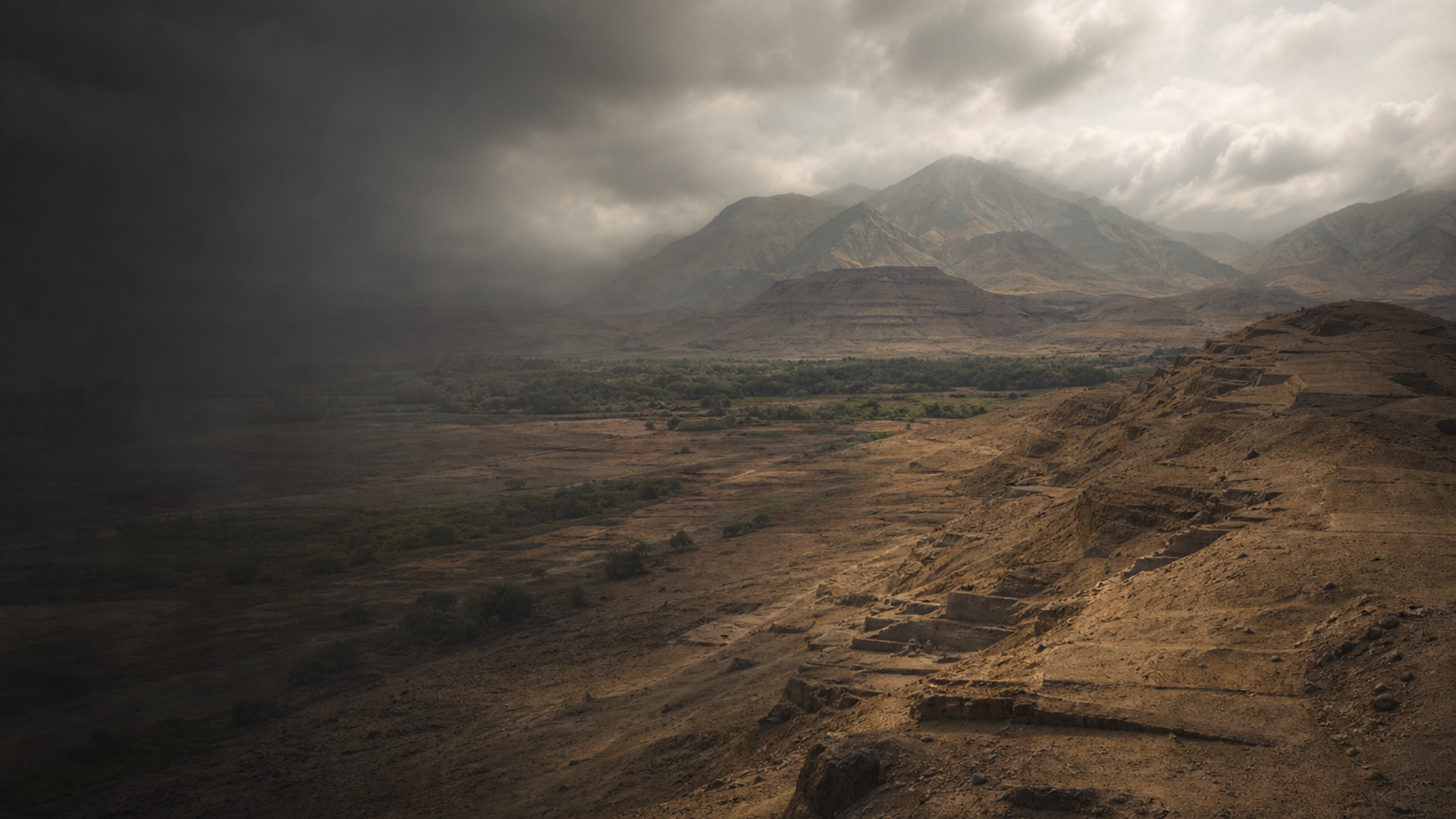
Along the arid northern coast of Peru, the cultural horizon broadly labeled “Lambayeque” (often associated with the Sicán tradition) emerges in the centuries after the Middle Horizon. Archaeological strata at El Brujo — a multi‑huaca complex in the Lambayeque valley — preserve adobe pyramids, painted friezes, and rich burial deposits that testify to growing social complexity between roughly 750 and 1300 CE. Environmental reconstructions and irrigation features indicate intensified agriculture and control of coastal wetlands that supported population aggregation and craft specialization.

Archaeological data indicates continuity with earlier coastland traditions in ceramic style and monumentality, yet regional reorganization after the Middle Horizon created new local polities and elites. Limited evidence suggests ritualized display of wealth and maritime resource exploitation played roles in elite identity. Mortuary contexts and grave goods point to ranked social structures, but settlement evidence is still incomplete: many Lambayeque-era coastal sites remain only partially excavated.

Because the genomic sample set from this cultural label is small, inferences about origins and population movement must be tentative. Genetic signals consistent with long‑standing Andean and coastal lineages support the archaeological picture of local development with possible links to broader Andean networks.

  • El Brujo complex in northern Peru preserves Lambayeque-era adobe pyramids and murals
  • Dates span c. 750–1300 CE, a transition from Middle Horizon influence to Late Intermediate regionalism
  • Evidence points to irrigation agriculture, craft specialization, and emerging elite control
Kapitel IV

Daily Life & Society

Life along the Lambayeque coast would have been shaped by a dramatic, cinematic juxtaposition of oceans, deserts, and irrigated green strips of fields. Communities clustered around canal-fed agriculture where maize, beans, squash, and cotton were staples; cotton supported textile production, and marine resources supplemented diets. Archaeological excavation at El Brujo documents craft workshops, ceramic production areas, and storage facilities that indicate organized production beyond household subsistence.

Monumental mounds (huacas) dominated the visual landscape and served as centers for ritual performance, elite burial, and possibly redistribution. Burials exhibit variability — from modest interments to richly furnished tombs — suggesting social differentiation. Iconography on ceramics and murals depicts animals, maritime scenes, and abstract motifs that likely signaled lineage, office, or religious affiliation. Funerary offerings and metal objects point to long‑distance exchange and skilled metallurgy in Lambayeque contexts.

However, direct evidence for household organization, daily diets at individual sites, and the extent of regional trade corridors remains uneven. Continued excavation and integration with isotopic and genetic studies will refine reconstructions of daily life.

  • Irrigated agriculture and marine resources underpinned coastal livelihoods
  • Huacas functioned as ritual, political, and economic centers with evidence of craft workshops
Kapitel V

Genetic Profile

Three ancient individuals from El Brujo dated between 750 and 1300 CE provide a preliminary window into the Lambayeque genetic landscape. Two of the three male-associated samples carry Y‑chromosome haplogroup Q, a lineage widely observed among Indigenous populations of the Americas and consistent with deep paternal continuity on the continent. Maternal lineages in the set include mtDNA haplogroups C1c, A2, and C1b — clades common across Andean and coastal populations.

These results align with archaeological expectations for long‑standing local ancestry rather than large‑scale recent population replacement. Nevertheless, the sample count is very small (<10), so patterns of kinship, social selection of burial individuals, and regional heterogeneity cannot be robustly established. For example, elite burials may be non‑representative of population averages; genetic signals from three individuals cannot resolve subtle admixture events or demographic shifts.

Future work integrating larger ancient DNA datasets from neighboring Lambayeque, Moche, and highland sites, together with isotopic mobility studies and radiocarbon dating, will be essential to test hypotheses about coastal–highland interaction, patrilineal descent, and the genetic footprint of Late Intermediate Period political change. Presently, the DNA evidence supports continuity with broader Native American paternal and maternal lineages while cautioning that conclusions are provisional.

  • Y haplogroup Q dominant in the small sample set (2 of 3), consistent with Native American paternal lineages
  • mtDNA diversity (C1c, A2, C1b) matches common Andean/coastal maternal lineages; sample size limits firm conclusions
Kapitel VI

Legacy & Modern Connections

Material and genetic traces of the Lambayeque world persist in the cultural memory and genomes of contemporary northern Peruvian populations. Many modern communities along the Lambayeque and La Libertad coasts maintain agricultural practices and textile motifs that echo ancient traditions. The genetic markers identified in these three ancient individuals — haplogroup Q and Native American mtDNA clades — are also observed in living Indigenous and mestizo populations, emphasizing continuity across centuries.

Archaeological conservation at El Brujo and related sites provides tangible links between past and present, but researchers stress that cultural continuity is complex and mediated by migration, colonial disruption, and social change. Given the limited number of ancient genomes available, claims about direct ancestry to specific modern groups must be made cautiously and in collaboration with descendant communities. Ongoing collaborative research that combines archaeology, aDNA, and community knowledge offers the most reliable pathway to understanding how the Lambayeque past shapes contemporary identities.

  • Genetic continuity with common Native American lineages suggests long-term ancestry ties
  • Archaeological motifs, agricultural systems, and craft traditions have echoes in regional cultural practices
KI-gestützt

KI-Assistent

Stellen Sie Fragen zur Lambayeque of El Brujo-Kultur

KI-Assistent von DNAGENICS

Funktion freischalten
Stellen Sie Fragen zur Kultur Lambayeque of El Brujo. Unser KI-Assistent kann genetische Befunde, historischen Kontext, archäologische Belege und moderne Verbindungen erläutern.
Beispiel einer KI-Analyse

Die Lambayeque of El Brujo-Kultur ist ein faszinierendes Kapitel der Menschheitsgeschichte...

Genetische Analysen zeigen Übereinstimmungen mit früheren Populationen und Hinweise auf besondere Anpassungen und kulturelle Innovationen. Alte DNA-Proben liefern Einblicke in Migrationsmuster, soziale Strukturen und genetische Verbindungen zwischen Populationen.

Dies ist eine Vorschau der KI-Analyse. Schalten Sie den vollständigen KI-Assistenten frei, um detaillierte Einblicke zu erkunden:

  • Genetische Zusammensetzung und genetische Ähnlichkeit
  • Migrationsmuster und Ursprünge
  • Alltag und kulturelle Praktiken
  • Genetischer Bezug zu heutigen Populationen

Weitere antike Kulturen erkunden

Geschichten von Zivilisationen aus der antiken Welt entdecken

Use code for 30% off • Expires Nov 08




