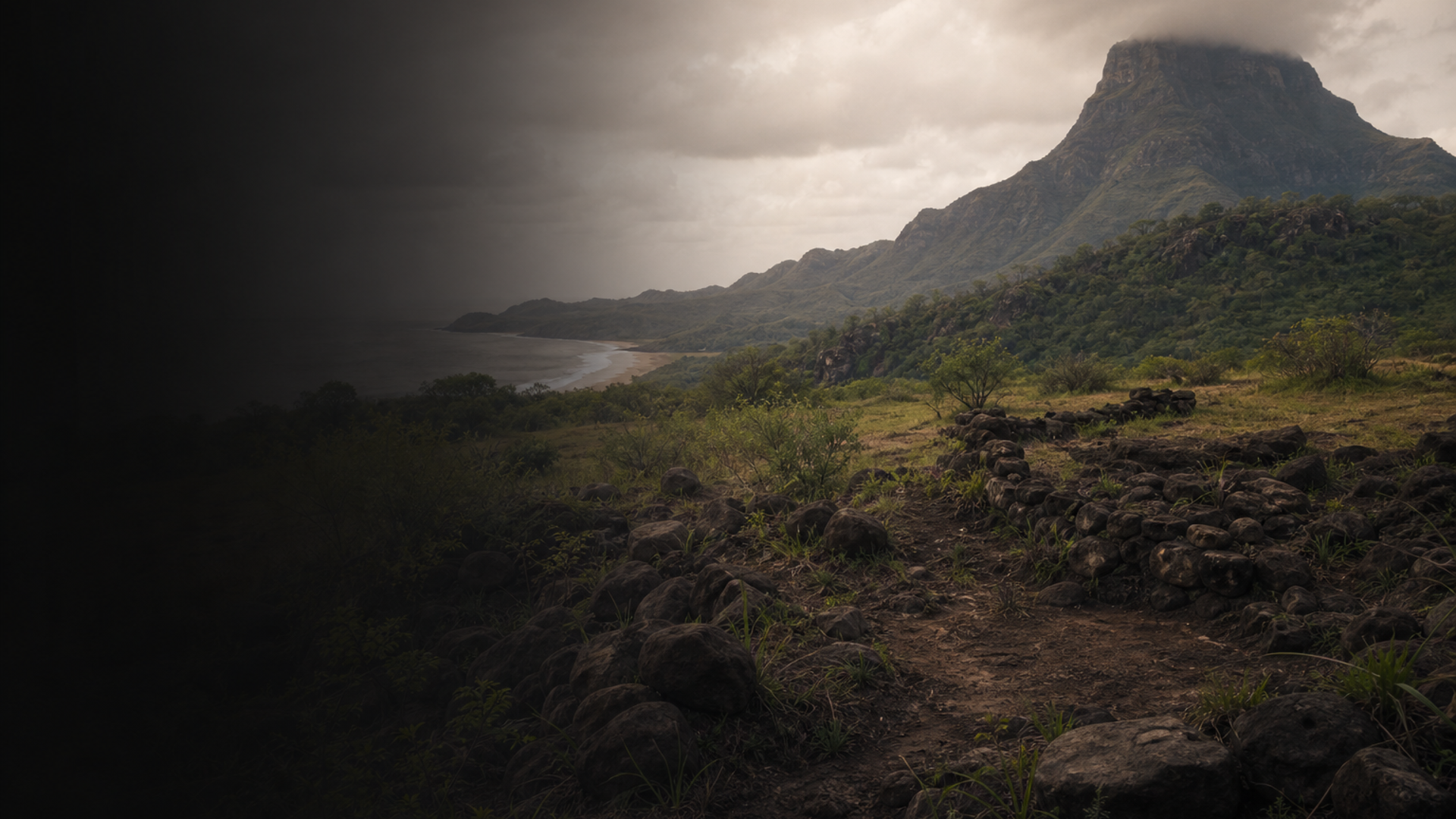
Lavoutte Ceramic People of St. Lucia

Download PDF creates a visual, rasterized copy. Use Print for selectable text and better assistive-technology support.

Bericht wird vorbereitet

Verfügbare Informationen und Referenzen werden geladen

Verbindung mit dem archäologischen Quellenbestand...

Alte Quellen werden zusammengestellt

Zum Hauptinhalt springen
Lavoutte Ceramic People of St. Lucia
Zivilisations-Spotlight

Lavoutte Ceramic People of St. Lucia

Coastal potters and mariners of Cas-en-Bas, 1000–1450 CE — where pots meet DNA

1000 CE - 1450 CE
St. Lucia (Cas-en-Bas, Lavoutte site)
Scrollen zum Start
Kapitel I

Die Geschichte

Die Lavoutte Ceramic People of St. Lucia-Kultur verstehen

Archaeological and genetic evidence from the Lavoutte site (Cas-en-Bas, St. Lucia) illuminates a Ceramic Period community (1000–1450 CE). DNA shows Indigenous American paternal lineage Q and diverse maternal A2/B2/D1/C lineages, offering insights into migration and social structure.

Time Period

1000–1450 CE

Region

St. Lucia (Cas-en-Bas, Lavoutte site)

Common Y-DNA

Q (observed in 6 samples)

Common mtDNA

A2 (3), B2e (3), D1 (2), C (2), C1c (1)

Kapitel II

Zeitleiste

Zentrale Momente in der Geschichte dieser Kultur

1000 CE

Ceramic occupation begins

Archaeological contexts at Lavoutte mark the start of sustained Ceramic Period occupation in Cas-en-Bas (circa 1000 CE).

1200 CE

Community activity and exchange

Material parallels suggest active exchange networks with neighboring islands during the 12th–13th centuries CE.

1450 CE

Later Ceramic transformations

By 1450 CE, archaeological layers indicate shifts in material culture leading into the late pre-contact period.

Kapitel III

Origins & Emergence

The Lavoutte assemblage at Cas-en-Bas sits within the Ceramic Period of St. Lucia (ca. 1000–1450 CE), a time when pottery-bearing peoples expanded across the Lesser Antilles. Archaeological data indicates distinct ceramic styles and coastal occupation layers at the Lavoutte site, consistent with a maritime-adapted lifeway. Radiocarbon determinations from associated contexts place human activity firmly in the late first and second millennia CE, although site-phase resolution remains limited.

Genetically, the samples (n = 12) recovered from Lavoutte reveal patterns typical of Indigenous American populations. Y-chromosome lineage Q appears in six individuals, a signature often linked to pre-contact Native American paternal ancestry across the Americas. Maternal lineages are diverse — A2, B2e, D1 and C/C1c occur among the tested individuals — echoing widespread continental founder lineages that reached the Caribbean via South American trajectories. Together, the archaeological and genetic signatures support a narrative of south-to-north dispersals of ceramic-using peoples, adaptation to island environments, and localized population differentiation.

Caveats: the sample set is modest and localized to Cas-en-Bas; therefore hypotheses about island-wide origins, timing of arrival, and the full spectrum of cultural interaction should be treated cautiously pending broader regional sampling.

  • Lavoutte occupation dated ca. 1000–1450 CE (Ceramic Period).
  • Ceramic assemblages and coastal deposits indicate maritime subsistence.
  • Genetic and archaeological evidence point to South American-rooted dispersal.
Kapitel IV

Daily Life & Society

Archaeological evidence from the Lavoutte site paints a vivid, coastal picture: households organized around pottery production and shoreline resource use. Ceramic forms typical of the Ceramic Period—bowls, cooking pots, and decorated sherds—suggest a reliance on processed and boiled foods, while coastal shell middens and fish remains (reported in regional Ceramic contexts) imply fishing and shellfish gathering as dietary cornerstones. Spatial patterns at Cas-en-Bas indicate discrete activity zones: areas for pot-making and repair, hearths for cooking, and loci of discard where middens accumulated.

Socially, island communities in this era likely maintained small, kin-based settlements with fluid ties to neighboring islands. Trade and exchange of raw materials and finished ceramics are archaeologically plausible: stylistic parallels across nearby islands suggest networks of interaction. Burial practices in the wider Ceramic Period hint at varied mortuary expressions, but direct funerary evidence from Lavoutte itself is limited, so interpretations about social hierarchy or ritual must remain tentative. Material culture and coastal ecology combined yield a cinematic image of daily life — hands shaping clay at dawn, canoes pushing out to reef and sea, and community tables sharing stews and roasted fish under open skies.

  • Pottery production and coastal resource use dominated economy.
  • Small, kin-based settlements with inter-island connections likely.
Kapitel V

Genetic Profile

Ancient DNA from 12 individuals at Lavoutte provides a rare genetic window into St. Lucia's Ceramic Period inhabitants. Y-DNA haplogroup Q is present in six tested individuals — a lineage widely detected among Indigenous peoples across North, Central, and South America and commonly interpreted as a marker of pre-contact paternal ancestry in the Caribbean. The observed concentration of Q suggests a continuity of male-line ancestry linked to broader Americas dispersals, though the absence of other Y-lineages may reflect small sample size or male-biased sampling.

Mitochondrial DNA among the assemblage exhibits maternal diversity: A2 (3 individuals), B2e (3), D1 (2), C (2), and C1c (1). These haplogroups are foundational Native American maternal lineages and are consistent with origins traced to northern South America or adjacent mainland regions that supplied migrants to the islands. Notably, the mtDNA counts account for 11 of 12 samples; one individual yielded either unassigned or low-coverage mitochondrial data, underscoring preservation limits. Population-level inferences — such as sex-biased migration, kin structure, or effective population size — remain preliminary given the modest and site-specific sample. Broader geographic sampling and higher-coverage genomes would better resolve migration routes, admixture events, and demographic shifts.

  • Y-DNA Q in 6 individuals suggests Indigenous American paternal continuity.
  • Maternal lineages (A2, B2e, D1, C/C1c) point to South American-derived roots.
Kapitel VI

Legacy & Modern Connections

The Lavoutte genetic and archaeological record ties the people of Cas-en-Bas to a long-lived Indigenous Caribbean story. Maternal and paternal markers align with lineages still recognized across Indigenous American populations, offering tangible genetic continuity between prehistoric islanders and broader Indigenous ancestries. For contemporary communities and descendants, such data can inform identity and cultural history, but must be integrated with respect for descendant communities and without overclaiming.

Archaeologically, Lavoutte contributes to island-scale reconstructions of settlement, subsistence, and exchange during the Ceramic Period. Genetic signals complement material culture, together illuminating migration arcs from mainland South America into the Lesser Antilles. However, given the localized scope (n = 12) and variable DNA preservation, conclusions remain provisional: additional sites and samples are required to map population dynamics across St. Lucia and neighboring islands with confidence.

  • Genetic lineages at Lavoutte connect to wider Indigenous American ancestry.
  • Broader sampling and community collaboration are needed for fuller narratives.
KI-gestützt

KI-Assistent

Stellen Sie Fragen zur Lavoutte Ceramic People of St. Lucia-Kultur

KI-Assistent von DNAGENICS

Funktion freischalten
Stellen Sie Fragen zur Kultur Lavoutte Ceramic People of St. Lucia. Unser KI-Assistent kann genetische Befunde, historischen Kontext, archäologische Belege und moderne Verbindungen erläutern.
Beispiel einer KI-Analyse

Die Lavoutte Ceramic People of St. Lucia-Kultur ist ein faszinierendes Kapitel der Menschheitsgeschichte...

Genetische Analysen zeigen Übereinstimmungen mit früheren Populationen und Hinweise auf besondere Anpassungen und kulturelle Innovationen. Alte DNA-Proben liefern Einblicke in Migrationsmuster, soziale Strukturen und genetische Verbindungen zwischen Populationen.

Dies ist eine Vorschau der KI-Analyse. Schalten Sie den vollständigen KI-Assistenten frei, um detaillierte Einblicke zu erkunden:

  • Genetische Zusammensetzung und genetische Ähnlichkeit
  • Migrationsmuster und Ursprünge
  • Alltag und kulturelle Praktiken
  • Genetischer Bezug zu heutigen Populationen

Weitere antike Kulturen erkunden

Geschichten von Zivilisationen aus der antiken Welt entdecken

Use code for 35% off • Expires Nov 09