Megalithic Ireland: Primrose Grange & Carrowmore

Download PDF creates a visual, rasterized copy. Use Print for selectable text and better assistive-technology support.

Bericht wird vorbereitet

Verfügbare Informationen und Referenzen werden geladen

Verbindung mit dem archäologischen Quellenbestand...

Alte Quellen werden zusammengestellt

Zum Hauptinhalt springen
Megalithic Ireland: Primrose Grange & Carrowmore
Zivilisations-Spotlight

Megalithic Ireland: Primrose Grange & Carrowmore

Early passage-tomb builders on Ireland's coasts, 3785–3359 BCE

3785 CE - 3359 BCE
Ireland (Primrose Grange, Carrowmore)
Scrollen zum Start
Kapitel I

Die Geschichte

Die Megalithic Ireland: Primrose Grange & Carrowmore-Kultur verstehen

Archaeological and genetic glimpses into Ireland's megalith builders (3785–3359 BCE). Eleven samples from Primrose Grange and Carrowmore show a predominance of farmer-associated mtDNA (K, T) and highlight the need for more data to resolve male-line ancestry and population dynamics.

Time Period

3785–3359 BCE

Region

Ireland (Primrose Grange, Carrowmore)

Common Y-DNA

Not reported / low coverage in this set

Common mtDNA

K (5), T (2), H (1), U (1), W1 (1)

Schlagwörter
Kapitel II

Zeitleiste

Zentrale Momente in der Geschichte dieser Kultur

2500 BCE

Enduring Megalithic Landscape

By 2500 BCE the megalithic tombs of Ireland had become long-standing ritual landmarks, reused and remembered across generations.

Kapitel III

Origins & Emergence

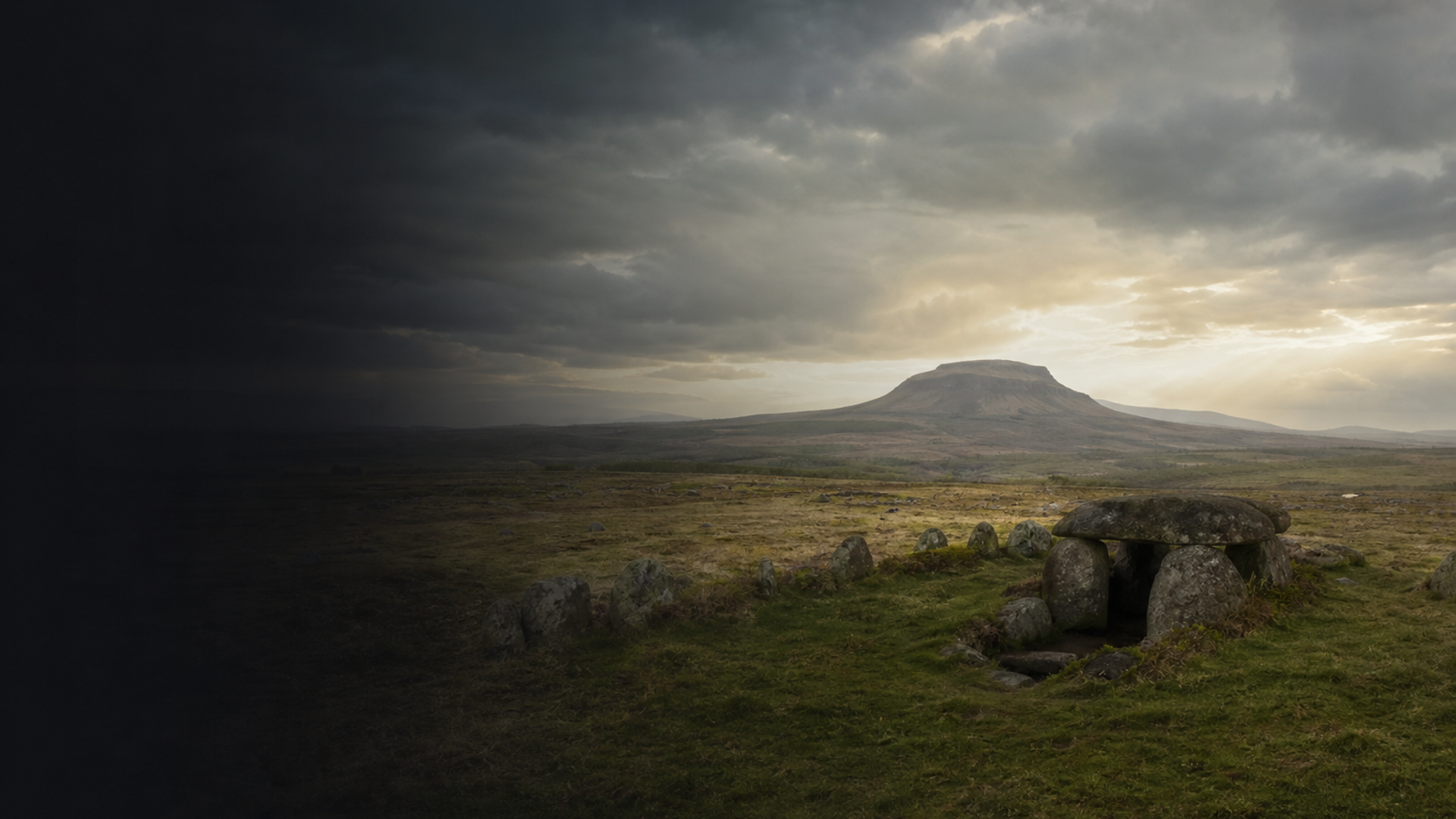
Across windswept headlands and low drumlins, the first great tombs of Ireland rose as communal statements. Archaeological data indicates that the mortuary tradition represented by Primrose Grange (County Louth) and the Carrowmore complex (County Sligo) belongs to the wider Atlantic Neolithic megalithic phenomenon. Radiocarbon dates for the sampled individuals fall between 3785 and 3359 BCE, placing them within the millennium when passage graves and court tombs formed focal points of ritual and memory.

Excavations reveal collective burial chambers, carefully worked stones and repeated reuse—material traces of long-term place-making. Pottery styles, stone tools and the architecture of tombs link these Irish monuments to networks of exchange and shared ritual practice extending along the Atlantic façade. Archaeological evidence suggests coordinated community labor and specialized knowledge of stone-working and landscape alignment.

Limited genetic sampling here (11 individuals) offers tantalizing but provisional windows into origins. Combined archaeological and genetic perspectives favor a strong role for Neolithic farming communities (Anatolian-derived migrants and their descendants) in building these monuments, but local Mesolithic lineages may persist in variable ways. Where evidence is thin, conclusions are framed as hypotheses awaiting larger datasets.

  • Passage tombs and court tombs prominent at Carrowmore and Primrose Grange
  • Radiocarbon-dated individuals: 3785–3359 BCE
  • Monuments reflect long-term communal construction and ritual reuse
Kapitel IV

Daily Life & Society

Behind the stones of tombs lived communities practicing mixed farming, crafting stone and bone tools, and exploiting coastal and freshwater resources. Archaeological assemblages from megalithic contexts in Ireland show pottery, polished axes and domestic debris indicating cereal cultivation, sheep and cattle herding, and fishing—an economy adapted to both inland fields and maritime margins.

Burial practice emphasizes collective identity: chambers receiving multiple interments, curated skull fragments, and structured deposition suggest complex social memories rather than simple nuclear-family burials. Monument building implies social coordination—seasonal gatherings to mobilize labor and exchange goods—producing landscape landmarks visible for generations.

Material culture also hints at connections: lithic raw material movement and stylistic parallels link Irish tombs to Atlantic networks. Yet everyday life likely combined local resilience with long-distance ties, where ritual landscapes anchored community identity even as small-scale migration and marriages connected distant groups.

  • Mixed farming economy with coastal resource use
  • Collective burial practices implying communal identities
Kapitel V

Genetic Profile

The genetic snapshot from 11 individuals dated 3785–3359 BCE offers a focused but limited view. Mitochondrial haplogroups are dominated by K (5 individuals) with smaller counts of T (2), H (1), U (1) and W1 (1). Haplogroups K and T are commonly associated in the literature with early European farmers deriving ancestry from Anatolian Neolithic populations; their prevalence here is consistent with an agricultural donor population shaping maternal lineages.

The presence of U and H lineages—H widespread later in Europe and U frequently seen in Mesolithic hunter-gatherers—suggests some continuity or assimilation of earlier lineages, but small counts (especially singletons) require caution. Notably, Y-chromosome haplogroups are not reliably reported in this set, so male-line patterns remain unresolved. Without robust autosomal and Y-chromosome coverage, it is premature to infer proportions of Anatolian farmer, local Mesolithic, or later Steppe-related ancestry in these individuals.

Archaeogenetic context: given the date range (mid 4th millennium BCE) and regional trajectories, a predominantly Neolithic farmer-derived autosomal profile is plausible, with variable local hunter-gatherer contribution. Large-scale shifts associated with Steppe-related ancestry appear later in northwest Europe (~3rd millennium BCE), so these megalithic individuals are crucial for understanding pre-Steppe population structure. Because sample count is modest (n=11), all genetic interpretations should be treated as preliminary and testable with expanded datasets.

  • mtDNA dominated by K (5) and T (2), consistent with Neolithic farmer maternal lines
  • Y-DNA not reported here; male-line ancestry remains unresolved
Kapitel VI

Legacy & Modern Connections

The great stone tombs remain anchors of Irish cultural memory and archaeology; they continue to shape landscapes, tourism and identity. Genetically, some maternal lineages observed in these Neolithic individuals—especially haplogroup K—persist at low frequencies in modern European populations, hinting at threads of biological continuity across millennia.

However, genetic continuity is complex: later migrations and demographic events (including Bronze Age movements) remodeled ancestry in the British Isles. While these megalith builders contributed to the gene pool and cultural foundations of later populations, direct lines of descent from an individual in a Neolithic tomb to a modern person are probabilistic and often diffuse. Archaeology and ancient DNA together offer a cinematic but cautious narrative: stones and genomes preserve fragments of human lives, informing our sense of deep-time connection without simplifying the many migrations and admixtures that followed.

  • Megalithic monuments remain central to Irish heritage and landscape
  • Some maternal haplogroups (e.g., K) show long-term presence but modern ancestry is mixed
KI-gestützt

KI-Assistent

Stellen Sie Fragen zur Megalithic Ireland: Primrose Grange & Carrowmore-Kultur

KI-Assistent von DNAGENICS

Funktion freischalten
Stellen Sie Fragen zur Kultur Megalithic Ireland: Primrose Grange & Carrowmore. Unser KI-Assistent kann genetische Befunde, historischen Kontext, archäologische Belege und moderne Verbindungen erläutern.
Beispiel einer KI-Analyse

Die Megalithic Ireland: Primrose Grange & Carrowmore-Kultur ist ein faszinierendes Kapitel der Menschheitsgeschichte...

Genetische Analysen zeigen Übereinstimmungen mit früheren Populationen und Hinweise auf besondere Anpassungen und kulturelle Innovationen. Alte DNA-Proben liefern Einblicke in Migrationsmuster, soziale Strukturen und genetische Verbindungen zwischen Populationen.

Dies ist eine Vorschau der KI-Analyse. Schalten Sie den vollständigen KI-Assistenten frei, um detaillierte Einblicke zu erkunden:

  • Genetische Zusammensetzung und genetische Ähnlichkeit
  • Migrationsmuster und Ursprünge
  • Alltag und kulturelle Praktiken
  • Genetischer Bezug zu heutigen Populationen

Weitere antike Kulturen erkunden

Geschichten von Zivilisationen aus der antiken Welt entdecken

Use code for 30% off • Expires Nov 08




