North Caucasus, Middle Bronze Age

Download PDF creates a visual, rasterized copy. Use Print for selectable text and better assistive-technology support.

Zum Hauptinhalt springen
Zivilisations-Spotlight

North Caucasus, Middle Bronze Age

Mountain peoples at the crossroads of steppe and Caucasus, 2197–1700 BCE

2197 CE - 1700 BCE
North Caucasus, Russia

Die Geschichte

Archaeological and genetic traces from Kabardinka and Kudachurt (2197–1700 BCE) reveal a small Middle Bronze Age North Caucasus sample. Limited remains hint at a mosaic of steppe and Caucasus ancestries; conclusions are preliminary due to only four genomes.

Time Period

2197–1700 BCE

Region

North Caucasus, Russia

Common Y-DNA

R, J

Common mtDNA

I4a, W1, X, HV

Zeitleiste

2197 BCE

Earliest sampled individuals

Genome-bearing remains dated to c.2197 BCE recovered from Kabardinka and Kudachurt mark the start of the sampled Middle Bronze Age span.

Origins & Emergence

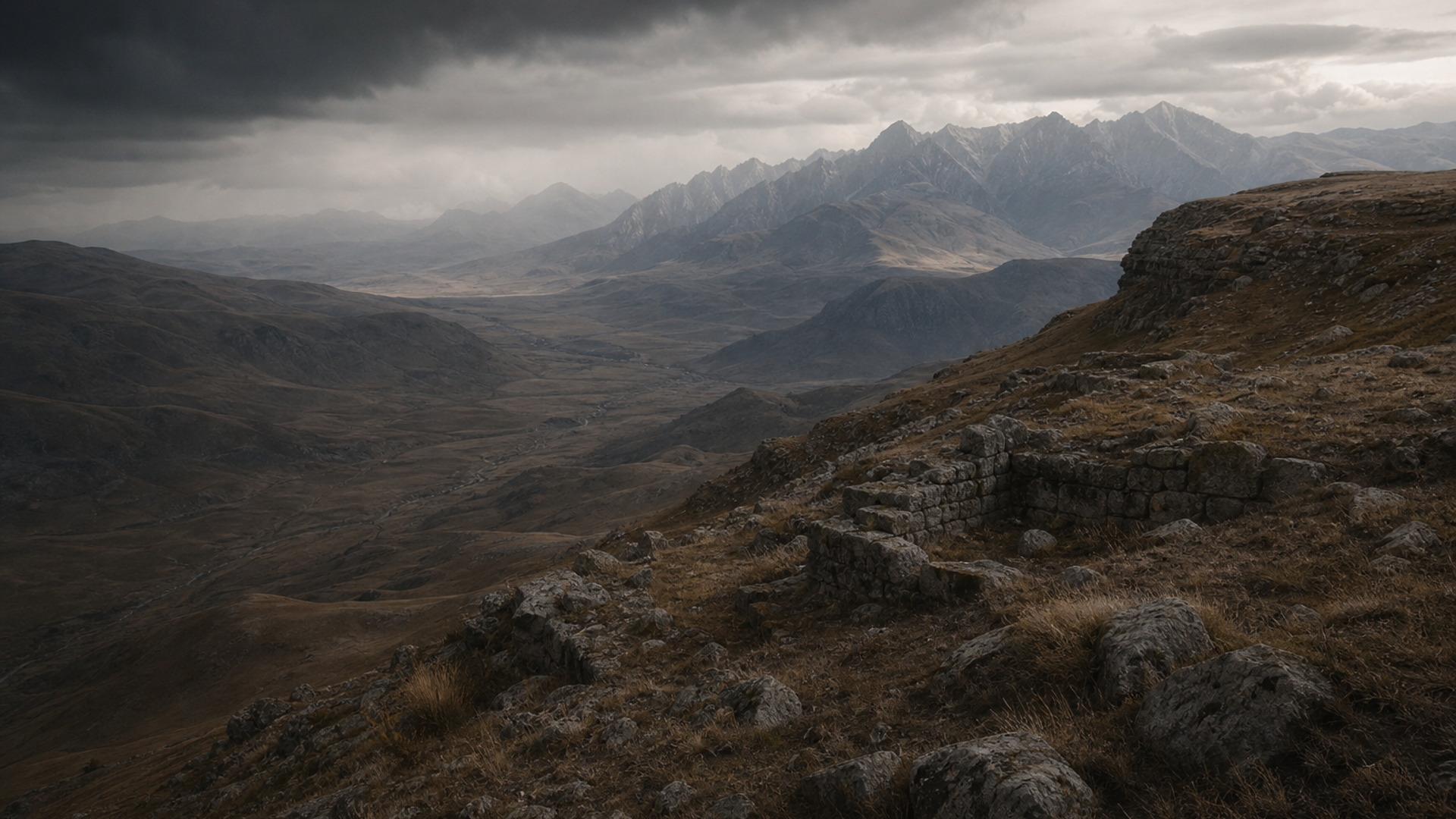
The Middle Bronze Age foothills and high valleys of the North Caucasus were a stage where mountains met the open steppe. Archaeological data from Kabardinka and Kudachurt (modern Russia) indicate human groups occupied piedmont settings and mountain niches between approximately 2197 and 1700 BCE. Material culture and settlement traces point to mobile pastoral lifeways combined with local traditions preserved in pottery styles and funerary practices.

Genetic evidence, though limited to four individuals, suggests these communities belonged to a dynamic frontier where populations carrying steppe-associated ancestry interacted with groups bearing signals typical of the Caucasus corridor. The presence of Y-haplogroups R and J among these samples hints at diverse paternal lineages; maternally, I4a, W1, X, and HV appear. These haplogroups individually occur across Eurasia, and in this region they may reflect both local continuity and incoming lineages.

Limited evidence suggests this was not a single homogeneous population but a mosaic created by movement, exchange, and adaptation to rugged terrain. Because the sample count is small (<10), reconstructions of origin and demographic change must remain tentative; future sampling across more sites and contexts is required to resolve the full story.

  • Occupied piedmont and mountain zones (Kabardinka, Kudachurt)
  • Dates span 2197–1700 BCE
  • Small genetic sample implies preliminary conclusions

Daily Life & Society

Archaeological finds from Middle Bronze Age North Caucasus sites evoke a life shaped by altitude and horizon. Herding of sheep, goats, and cattle likely dominated subsistence, with seasonal movement between lower pastures and upland grazing. Persisting archaeological traces—stone foundations, hearths, and scattered pottery fragments—suggest small hamlets and temporary encampments rather than dense urban centers.

Grave assemblages from the region, where preserved, provide intimate glimpses: personal ornaments, simple metal objects, and pottery accompany burials, implying social identities encoded through dress and grave furnishing. Landscape use favored passes and river valleys for communication; exchange networks probably carried metals, crafted goods, and stylistic motifs from both the steppe and southern Caucasus.

The material record hints at social flexibility. Kin groups may have organized pasture rights and reciprocal exchange, while leaders or lineages negotiated access to routes linking the plains with mountain pastures. However, the archaeological record in Kabardinka and Kudachurt is fragmentary. Limited excavation and poor preservation in some contexts mean many aspects of household organization, ritual practice, and economy remain shadowed, awaiting more systematic study.

  • Pastoral economy with seasonal mobility
  • Burials show personal ornaments and simple metalwork

Genetic Profile

Four Middle Bronze Age genomes from the North Caucasus (Kabardinka, Kudachurt) provide a cautious window into regional ancestry. Y-chromosome lineages include R and J (one individual each), while mitochondrial lineages are I4a, W1, X, and HV. Each haplogroup has a broad Eurasian distribution; their presence here is consistent with a contact zone between steppe herders and Caucasus populations.

In broader datasets, Y-haplogroup R (including R1a/R1b subclades in other contexts) often tracks with steppe-derived paternal ancestry, whereas haplogroup J is frequent in Near Eastern and Caucasus-linked populations. The mtDNA diversity observed—four different haplogroups among four individuals—suggests varied maternal ancestries, possibly reflecting exogamy, mobility, or small-scale migration.

Genome-wide patterns in neighboring regions commonly reveal mixtures of "steppe-related" and "Caucasus-related" ancestry during the Bronze Age. Limited evidence from these four samples is compatible with such admixture but cannot quantify proportions reliably. Given the very small sample size (<10), statements about sex-biased migration, demographic turnover, or continuity should be considered provisional. More genomes across time and sites are needed to connect genetic shifts to archaeological transformations in the North Caucasus.

  • Y lineages: R and J present, reflecting diverse paternal roots
  • mtDNA diversity (I4a, W1, X, HV) indicates varied maternal ancestries

Legacy & Modern Connections

The North Caucasus Middle Bronze Age sits in the deep backstory of a region that remains genetically and culturally diverse today. Archaeogenetic patterns hint at long-standing connections along the mountain corridor that channelled people and ideas between the Eurasian steppe and the Near East. Modern populations of the Caucasus inherit layers of this ancient mosaic, but direct ancestral links cannot be asserted from four genomes alone.

Cautious interpretation suggests that continuing exchange across mountain passes contributed to the genetic and linguistic patchwork of the later first millennia BCE and beyond. The observed mixture of paternal and maternal lineages in these samples aligns with a picture of mobility, marriage ties across regions, and sustained contact. Ultimately, the legacy of the Middle Bronze Age North Caucasus is best read as a fragment of a complex tapestry—beautiful, partially visible, and awaiting more threads from future archaeological and genetic work.

  • Contributes to long-term genetic mosaic of the Caucasus
  • Modern connections plausible but not provable from four samples

KI-Assistent

KI-Assistent von DNAGENICS

Funktion freischalten
Stellen Sie Fragen zur Kultur North Caucasus, Middle Bronze Age. Unser KI-Assistent kann genetische Befunde, historischen Kontext, archäologische Belege und moderne Verbindungen erläutern.
Beispiel einer KI-Analyse

Die North Caucasus, Middle Bronze Age-Kultur ist ein faszinierendes Kapitel der Menschheitsgeschichte...

Genetische Analysen zeigen Übereinstimmungen mit früheren Populationen und Hinweise auf besondere Anpassungen und kulturelle Innovationen. Alte DNA-Proben liefern Einblicke in Migrationsmuster, soziale Strukturen und genetische Verbindungen zwischen Populationen.

Dies ist eine Vorschau der KI-Analyse. Schalten Sie den vollständigen KI-Assistenten frei, um detaillierte Einblicke zu erkunden:

  • Genetische Zusammensetzung und genetische Ähnlichkeit
  • Migrationsmuster und Ursprünge
  • Alltag und kulturelle Praktiken
  • Genetischer Bezug zu heutigen Populationen
Use code for 30% off • Expires Nov 14




