Polizzello Voices: Iron Age Sicily

Download PDF creates a visual, rasterized copy. Use Print for selectable text and better assistive-technology support.

Bericht wird vorbereitet

Verfügbare Informationen und Referenzen werden geladen

Verbindung mit dem archäologischen Quellenbestand...

Alte Quellen werden zusammengestellt

Zum Hauptinhalt springen
Polizzello Voices: Iron Age Sicily
Zivilisations-Spotlight

Polizzello Voices: Iron Age Sicily

A hilltop community where stones, pottery and DNA speak of Mediterranean ties

850 CE - 541 BCE
Polizzello, Caltanissetta, Sicily (Italy)
Scrollen zum Start
Kapitel I

Die Geschichte

Die Polizzello Voices: Iron Age Sicily-Kultur verstehen

Archaeological and genetic evidence from Polizzello (Caltanissetta, Sicily) illuminates Iron Age lifeways (850–541 BCE). Nineteen ancient genomes reveal predominant Y haplogroup G and maternal H lineages, suggesting local continuity with Mediterranean contacts during Greek and Phoenician expansion.

Time Period

850–541 BCE

Region

Polizzello, Caltanissetta, Sicily (Italy)

Common Y-DNA

G (predominant among samples)

Common mtDNA

H, T, J, U (H most frequent)

Kapitel II

Zeitleiste

Zentrale Momente in der Geschichte dieser Kultur

850 BCE

Early Iron Age occupation at Polizzello

Archaeological layers at Polizzello begin to show dense habitation and funerary activity marking an emergent Iron Age community in central Sicily.

750 BCE

Mediterranean contacts intensify

Material culture at Polizzello records increased exchange—imported pottery and metalwork—consistent with broader Phoenician and Greek maritime expansion.

541 BCE

Terminal Iron Age horizon for sampled individuals

The latest directly dated individuals in the Polizzello series fall around the mid-6th century BCE, closing the sampled window at 541 BCE.

Kapitel III

Origins & Emergence

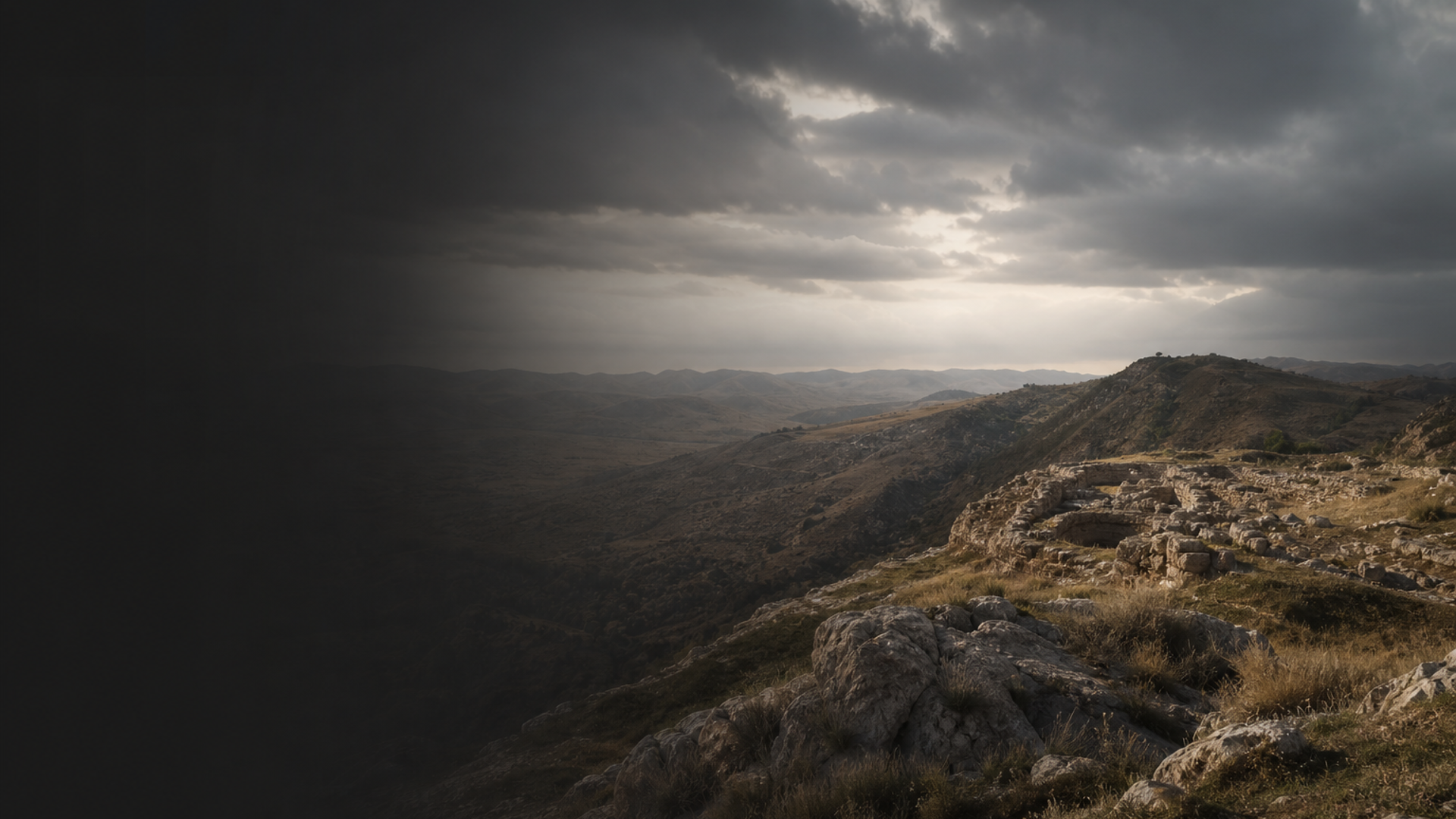
Perched on a limestone ridge near modern Caltanissetta, the settlement of Polizzello unfolds like a stratified storybook of Iron Age Sicily. Archaeological layers record occupation and funerary activity between the 9th and 6th centuries BCE (c. 850–541 BCE). Excavations have revealed hut foundations, terraced enclosures, and necropoleis containing richly furnished graves with local ceramics and imported Mediterranean wares. These material traces point to a community rooted in earlier Bronze Age traditions but increasingly tied into wider maritime networks.

Archaeological data indicates cultural exchange with both Phoenician and Greek seafarers during the 8th–6th centuries BCE: imported amphorae and styles appear alongside local pottery traditions, producing hybrid material culture. The 19 ancient individuals sampled from Polizzello provide a genetic dimension to this picture. Their uniparental markers suggest continuity of local maternal lineages combined with paternal lineages that are also present elsewhere in the central Mediterranean. Limited evidence suggests this was not simply replacement by newcomers but rather a complex process of contact, exchange, and selective influx.

Uncertainties remain: pottery and objects document contact, but uniparental DNA offers only part of the ancestry story. Genome-wide analyses, where available, would better resolve timing and directionality of gene flow. For now, Polizzello stands as a place where local endurance met Mediterranean movement.

  • Hilltop settlement with necropoleis at Polizzello, Caltanissetta
  • Material culture shows local traditions plus imported Mediterranean goods
  • 19 ancient individuals sampled, dating 850–541 BCE
Kapitel IV

Daily Life & Society

Imagine dawn on the ridge above the plain: smoke rises from hearths, and artisans shape pottery that carries both local patterns and foreign motifs. Archaeological evidence from house floors, kilns, and workshops at Polizzello suggests a mixed economy of dry farming, herding, and specialized craft production. Metalworking debris and ornament fragments imply access to bronze smithing and the circulation of prestige goods.

Burial evidence speaks to social differentiation. Some graves contain richer assemblages—bronze fibulae, decorated ceramics, and imported items—while others are simpler, hinting at status hierarchies. Funerary architecture and the placement of tombs on the slopes imply communal memory tied to the landscape, with ancestors anchoring claims to land and resources.

Polizzello’s role in regional exchange is visible in amphora fragments and nonlocal raw materials: merchants and seafarers calling at Sicilian coasts likely brought ideas and objects inland. Yet archaeological data also shows strong continuity in local craft traditions, suggesting that foreign goods were integrated into existing social frameworks rather than fully displacing them. Daily life, then, balanced rooted agricultural rhythms with intermittent pulses of long-distance exchange.

Many details of household economy remain open questions; continued excavation and biomolecular analyses (pollen, residues, isotopes) will refine this lived portrait.

  • Mixed economy: agriculture, herding, local crafts
  • Burials reflect social variation and Mediterranean trade connections
Kapitel V

Genetic Profile

The genetic snapshot from Polizzello comprises 19 individuals dated to 850–541 BCE. Uniparental markers are informative though partial: Y-chromosome haplogroup G appears in seven sampled males, while mitochondrial lineages are dominated by H (6), with smaller counts of T (2), J (2), U (2), and one labelled H+.

Archaeological DNA patterns like these are consistent with a picture of local continuity blended with Mediterranean contact. Haplogroup G has a long presence in parts of Europe and the Near East and is often associated in European contexts with descendants of early farmers and later regional groups; its prominence here suggests a substantial paternal lineage within the community. The predominance of mtDNA H mirrors a widespread European maternal heritage from the Neolithic onward. The presence of J, T and U maternal haplogroups points to diverse maternal ancestries compatible with both local and wider Mediterranean gene pools.

Caution is essential: uniparental markers reflect only a fraction of ancestry and can be skewed by drift or social practices (e.g., patrilocality). With 19 genomes, conclusions are moderate in confidence — adequate to detect notable trends but not to resolve detailed admixture histories. Genome-wide data and larger sample series would better quantify contributions from Greek colonists, Phoenician traders, and residual Bronze Age inhabitants. For now, the genetic record from Polizzello suggests a community rooted in local lineages while participating in Mediterranean biological and cultural exchanges.

  • Y haplogroup G found in 7 individuals — notable paternal signal
  • mtDNA dominated by H, with T, J, U also present — mixed maternal ancestry
Kapitel VI

Legacy & Modern Connections

Polizzello’s stones and genomes together illuminate a formative chapter in Sicily’s story. The material culture documents how local groups engaged with newcomers — adopting, adapting, and integrating foreign goods and ideas. The genetic signals reinforce this blended history: continuity of local lineages alongside evidence for Mediterranean connections.

Modern Sicilians are the product of many such episodes. These Iron Age genomes provide an intermediate snapshot between Bronze Age inhabitants and later classical populations, helping to map long-term genetic trajectories in the central Mediterranean. However, direct ancestry claims should be cautious: centuries of subsequent migration and admixture have further reshaped Sicilian genomes. Nonetheless, Polizzello reminds us that connectivity and rootedness have long coexisted on this island, a legacy visible in both artifacts and DNA.

  • Provides a genetic intermediary between Bronze Age and later populations
  • Highlights long-standing mixture of local continuity and Mediterranean contacts
KI-gestützt

KI-Assistent

Stellen Sie Fragen zur Polizzello Voices: Iron Age Sicily-Kultur

KI-Assistent von DNAGENICS

Funktion freischalten
Stellen Sie Fragen zur Kultur Polizzello Voices: Iron Age Sicily. Unser KI-Assistent kann genetische Befunde, historischen Kontext, archäologische Belege und moderne Verbindungen erläutern.
Beispiel einer KI-Analyse

Die Polizzello Voices: Iron Age Sicily-Kultur ist ein faszinierendes Kapitel der Menschheitsgeschichte...

Genetische Analysen zeigen Übereinstimmungen mit früheren Populationen und Hinweise auf besondere Anpassungen und kulturelle Innovationen. Alte DNA-Proben liefern Einblicke in Migrationsmuster, soziale Strukturen und genetische Verbindungen zwischen Populationen.

Dies ist eine Vorschau der KI-Analyse. Schalten Sie den vollständigen KI-Assistenten frei, um detaillierte Einblicke zu erkunden:

  • Genetische Zusammensetzung und genetische Ähnlichkeit
  • Migrationsmuster und Ursprünge
  • Alltag und kulturelle Praktiken
  • Genetischer Bezug zu heutigen Populationen

Weitere antike Kulturen erkunden

Geschichten von Zivilisationen aus der antiken Welt entdecken

Use code for 30% off • Expires Nov 08




