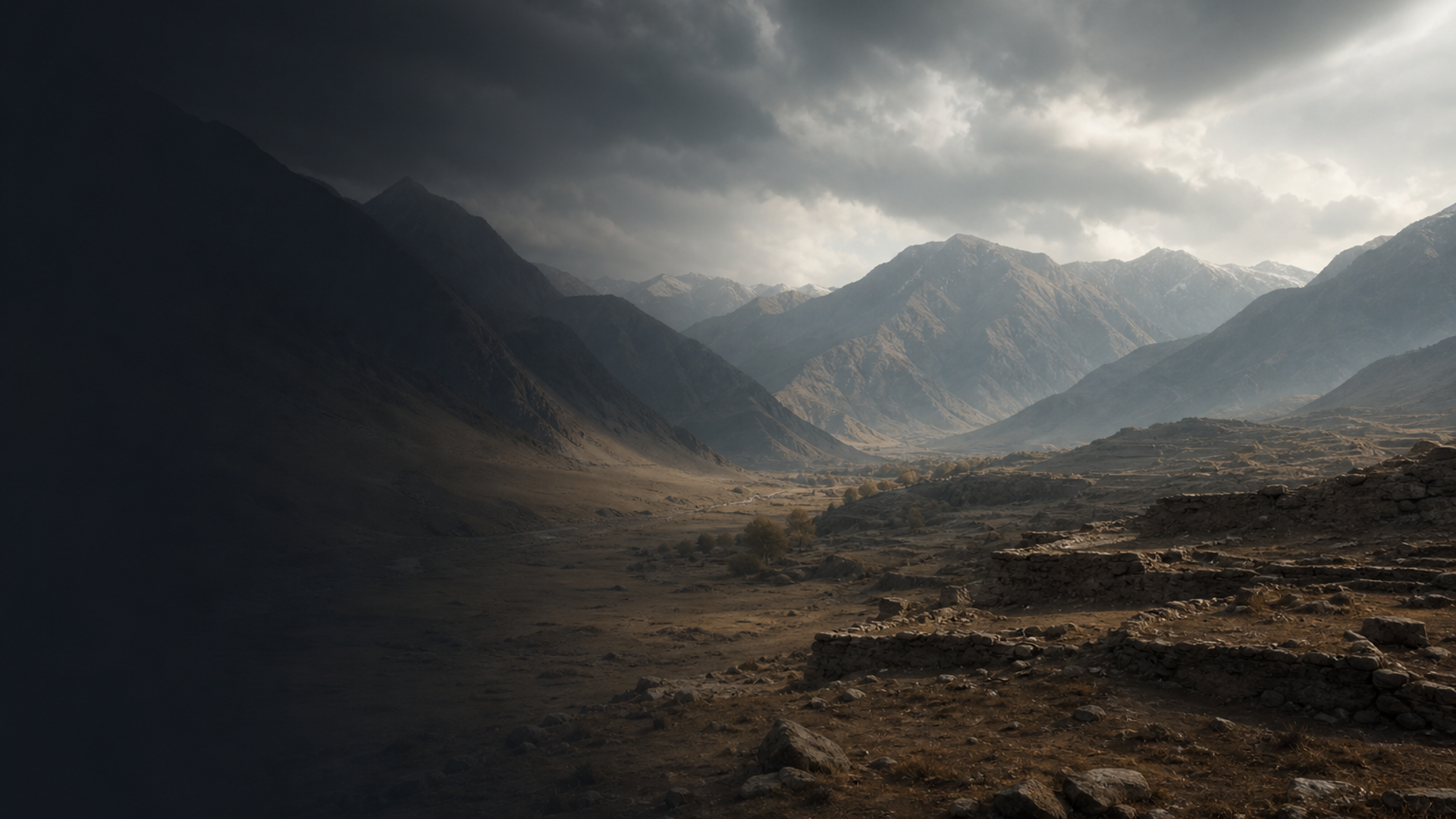
Saidu Sharif: Swat Valley Iron Age

Download PDF creates a visual, rasterized copy. Use Print for selectable text and better assistive-technology support.

Bericht wird vorbereitet

Verfügbare Informationen und Referenzen werden geladen

Verbindung mit dem archäologischen Quellenbestand...

Alte Quellen werden zusammengestellt

Zum Hauptinhalt springen
Saidu Sharif: Swat Valley Iron Age
Zivilisations-Spotlight

Saidu Sharif: Swat Valley Iron Age

Archaeology and ancient DNA (406–174 BCE) reveal layered ancestries in the Swat Valley

406 CE - 174 BCE
Swat Valley, Pakistan
Scrollen zum Start
Kapitel I

Die Geschichte

Die Saidu Sharif: Swat Valley Iron Age-Kultur verstehen

Archaeological and genetic data from 12 individuals at Saidu Sharif (Swat Valley, Pakistan; 406–174 BCE) link the Saidu Sharif Iron Age Complex to a mixed genetic heritage, showing both West Eurasian and South/South-Central Asian maternal and paternal lineages.

Time Period

406–174 BCE

Region

Swat Valley, Pakistan

Common Y-DNA

R (2), Q (1), L (1)

Common mtDNA

H (2), M (2), H2 (1), M30 (1), K (1)

Kapitel II

Zeitleiste

Zentrale Momente in der Geschichte dieser Kultur

406 BCE

Earliest dated samples from Saidu Sharif

Radiocarbon and stratigraphic data anchor human remains at Saidu Sharif to around 406 BCE, opening a genetic window onto the Swat Valley Iron Age.

Kapitel III

Origins & Emergence

The Saidu Sharif assemblage sits at the crossroads of mountain and plain, where the Swat Valley channels trade, ideas, and people between Central Asia and the Indo-Gangetic world. Archaeological data indicates an Iron Age horizon in Saidu Sharif characterized by settled villages, local craft traditions, and material ties across the Gandhara region. Radiocarbon and stratigraphic evidence anchor the sampled individuals to a span from 406 to 174 BCE, a period of political flux after the decline of Achaemenid influence and during the rise of regional polities.

Culturally, the Saidu Sharif Iron Age Complex shows continuity with earlier Swat Valley occupations while also reflecting new influences in ceramics, metallurgy, and burial practice. Limited direct evidence ties specific artifacts to individual skeletons, so interpretations of cultural identity are cautious: archaeological contexts suggest a population engaged in agro-pastoralism, regional exchange, and local craft specialization. The cinematic sweep of river terraces and terraced fields frames a landscape where communities adapted to seasonal rhythms and long-distance contacts.

Taken together, the material record and the dated human remains portray a community neither isolated nor homogenous, but one shaped by both enduring local traditions and incoming networks of goods, styles, and peoples.

  • Sited in the Swat Valley, Saidu Sharif samples date 406–174 BCE
  • Material culture shows local continuity with regional Gandhara links
  • Evidence points to agro-pastoral lifeways and craft specialization
Kapitel IV

Daily Life & Society

The people of Saidu Sharif inhabited a landscape of steep terraces, riverine corridors, and upland pastures. Archaeological traces—house plans, hearths, and toolkits—indicate household economies organized around mixed farming, seasonal herding, and artisanal production. Objects recovered in the Swat Valley, including fragments of iron tools and locally made pottery, suggest everyday activities of cultivation, weaving, metalworking, and local exchange.

Burial contexts from the Saidu Sharif Iron Age Complex show variability: some interments are simple, others accompanied by personal ornaments or utilitarian objects. This variation hints at social differentiation, but preservation and sampling biases mean social reconstructions remain tentative. Inhabitants likely participated in wider networks: river routes and mountain passes connected them to markets and ideas across Gandhara and beyond, bringing exotic raw materials and stylistic influences that would animate local workshops.

Archaeology here often reads like a film of small domestic scenes—children playing at hearths, smiths hammering in shaded courtyards, traders arriving with new wares—set against a backdrop of shifting political boundaries. Yet many specifics of household composition, status markers, and ritual practice remain incompletely known and subject to ongoing fieldwork.

  • Mixed farming, seasonal herding, and local crafts dominated the economy
  • Burial variation suggests emerging social differentiation but is not fully understood
Kapitel V

Genetic Profile

Genetic analysis of 12 individuals from Saidu Sharif offers a rare biochemical lens into population dynamics in the Swat Valley during the late first millennium BCE. The paternal lineages include Y-haplogroups R (2 samples), Q (1), and L (1). Haplogroup R is widespread across Eurasia and can reflect West Eurasian or steppe-derived paternal ancestry in South Asia; haplogroup Q has ties to Central Asian and Siberian lineages but also appears in South and Central Asia; haplogroup L is typically associated with South Asian paternal backgrounds. These distributions point to a mixed male ancestry in the community, plausibly combining long-standing South Asian lineages with inputs from broader Eurasian networks.

Mitochondrial DNA shows maternal diversity: H (2), M (2), H2 (1), M30 (1), and K (1). Haplogroup H and K are often linked to West Eurasian maternal heritage, while M and its subclades (including M30) are widespread in South and South-Central Asia, suggesting enduring local female lineages. The combined signal is of bi-directional gene flow—both West Eurasian-affiliated and indigenous South Asian maternal components.

Interpretations should remain measured: with 12 genomes the sample is meaningful but not exhaustive. The genetic picture aligns with an archaeological narrative of interaction—Saidu Sharif appears genetically heterogeneous, reflecting migration, marriage networks, and long-distance contacts during the Iron Age transition.

  • Paternal mix: R (2), Q (1), L (1) — suggests both West Eurasian and South Asian inputs
  • Maternal diversity: H, K (West Eurasian) and M/M30 (South Asian) — indicates mixed maternal ancestry
Kapitel VI

Legacy & Modern Connections

The Saidu Sharif genetic and archaeological record contributes to a broader understanding of how the Swat Valley served as a contact zone in antiquity. Modern populations in northern Pakistan and adjoining regions still carry echoes of these ancestral mixtures: West Eurasian-associated haplogroups alongside deep South Asian lineages. Archaeogenetic data from Saidu Sharif thus helps trace threads of continuity and admixture that feed into later historic populations in Gandhara and the greater Himalaya foothills.

However, the snapshot offered by 12 individuals is limited: it illuminates patterns but cannot capture the full demographic complexity over centuries. Continued excavation, larger ancient DNA datasets, and integration with linguistic and historical studies will refine how Saidu Sharif contributed to the genetic and cultural tapestry of South Asia.

  • Reflects long-term admixture contributing to genetic diversity in northern Pakistan
  • Findings are informative but require larger datasets for definitive population histories
KI-gestützt

KI-Assistent

Stellen Sie Fragen zur Saidu Sharif: Swat Valley Iron Age-Kultur

KI-Assistent von DNAGENICS

Funktion freischalten
Stellen Sie Fragen zur Kultur Saidu Sharif: Swat Valley Iron Age. Unser KI-Assistent kann genetische Befunde, historischen Kontext, archäologische Belege und moderne Verbindungen erläutern.
Beispiel einer KI-Analyse

Die Saidu Sharif: Swat Valley Iron Age-Kultur ist ein faszinierendes Kapitel der Menschheitsgeschichte...

Genetische Analysen zeigen Übereinstimmungen mit früheren Populationen und Hinweise auf besondere Anpassungen und kulturelle Innovationen. Alte DNA-Proben liefern Einblicke in Migrationsmuster, soziale Strukturen und genetische Verbindungen zwischen Populationen.

Dies ist eine Vorschau der KI-Analyse. Schalten Sie den vollständigen KI-Assistenten frei, um detaillierte Einblicke zu erkunden:

  • Genetische Zusammensetzung und genetische Ähnlichkeit
  • Migrationsmuster und Ursprünge
  • Alltag und kulturelle Praktiken
  • Genetischer Bezug zu heutigen Populationen

Weitere antike Kulturen erkunden

Geschichten von Zivilisationen aus der antiken Welt entdecken

Use code for 30% off • Expires Nov 08