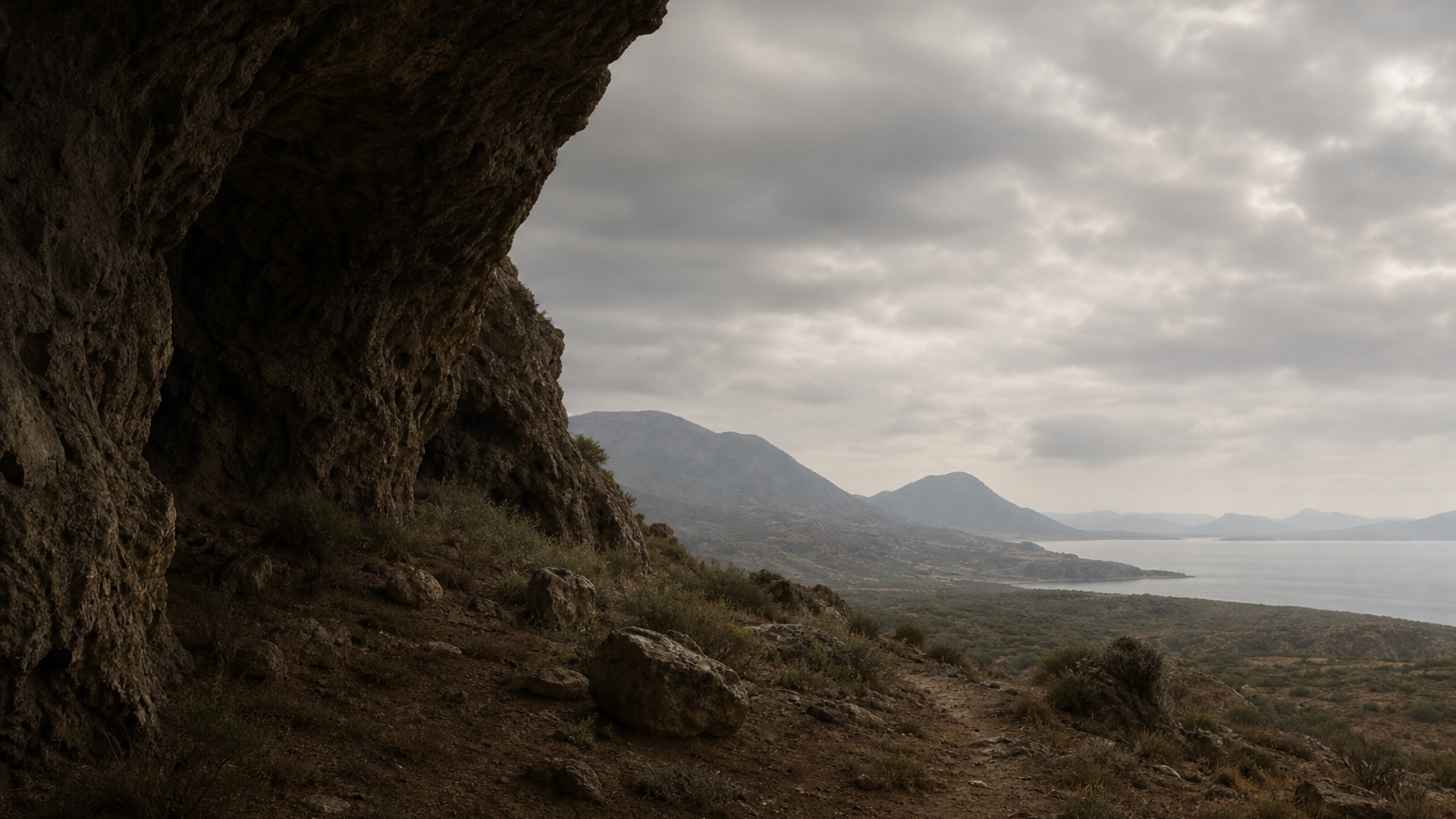
San Teodoro Epigravettian of Sicily

Download PDF creates a visual, rasterized copy. Use Print for selectable text and better assistive-technology support.

Bericht wird vorbereitet

Verfügbare Informationen und Referenzen werden geladen

Verbindung mit dem archäologischen Quellenbestand...

Alte Quellen werden zusammengestellt

Zum Hauptinhalt springen
San Teodoro Epigravettian of Sicily
Zivilisations-Spotlight

San Teodoro Epigravettian of Sicily

Late Palaeolithic hunter-gatherers on Sicily’s rugged northeastern shores, glimpsed through archaeology and DNA

17171 CE - 11397 BCE
San Teodoro, Messina, Sicily (Italy)
Scrollen zum Start
Kapitel I

Die Geschichte

Die San Teodoro Epigravettian of Sicily-Kultur verstehen

Epigravettian occupants of San Teodoro (Messina, Sicily) lived between ca. 17171–11397 BCE. Archaeology and three ancient mtDNA genomes (U) hint at Late Palaeolithic coastal foragers whose genetic signals link them to broader European hunter-gatherer networks—yet conclusions remain preliminary.

Time Period

17171–11397 BCE

Region

San Teodoro, Messina, Sicily (Italy)

Common Y-DNA

Unknown / not reported

Common mtDNA

U (3/3 samples)

Kapitel II

Zeitleiste

Zentrale Momente in der Geschichte dieser Kultur

17171 BCE

San Teodoro Epigravettian occupation

Radiocarbon-dated human remains and associated deposits record Epigravettian activity at San Teodoro cave in northeastern Sicily.

Kapitel III

Origins & Emergence

The Epigravettian occupants of San Teodoro emerged against the dramatic backdrop of a warming post-glacial world. Dated human remains and associated deposits from San Teodoro cave near Messina place people on northeastern Sicily between roughly 17,171 and 11,397 BCE. Archaeological data indicates adaptation to shifting coastlines and rich marine resources as sea levels rose after the Last Glacial Maximum. Lithic typologies attributed to the Epigravettian tradition—backed blades, microliths, and retouched tools—tie Sicilian groups into a wider southern European cultural horizon.

Limited evidence suggests these groups were part of regional networks of mobility rather than isolated island populations: similarities in tool styles and raw-material procurement hint at contacts with mainland southern Italy and the central Mediterranean. Yet the island setting also fostered local innovations in subsistence and settlement. While evocative rock shelters and hearth features survive at San Teodoro, the sparse sample count and taphonomic loss over millennia mean our picture is fragmentary. Archaeology indicates a resilient human presence that negotiated dramatic environmental change, leaving a material signature that only begins to align with early genetic snapshots.

  • Occupations dated ca. 17,171–11,397 BCE at San Teodoro cave (Messina, Sicily)
  • Epigravettian lithic industry links Sicily to broader southern European traditions
  • Post-LGM environmental shifts shaped coastal foraging and mobility
Kapitel IV

Daily Life & Society

Archaeological traces paint a cinematic, if partial, portrait of daily life: small bands moving seasonally along rocky coasts and inland valleys, exploiting fish, shellfish, and coastal game while hunting terrestrial herbivores inland. Hearths, tool scatters, and worked shell or pigment fragments recovered from Epigravettian contexts in Sicily indicate dense activity areas within caves like San Teodoro. Personal adornment and ochre use—common in Late Palaeolithic contexts—suggest identities shaped by social ties, mobility, and long-distance exchange.

Settlement patterns likely alternated between caves that provided shelter and open-air camps tied to resource patches. Social organization was probably flexible and kin-based, with group sizes adapted to resource availability and seasonality. Skilled flintknapping and composite tools enabled efficient hunting, while coastal resources buffered communities during climatic instability. However, the archaeological record in Sicily remains limited: preservation biases and a small number of well-dated sites mean many aspects of social complexity—ritual behavior, detailed seasonal calendars, and inter-group alliances—remain only partially resolved.

  • Coastal and cave-based lifeways exploiting marine and terrestrial resources
  • Skilled lithic production, personal ornaments, and ochre use indicate social complexity
Kapitel V

Genetic Profile

Three analyzed individuals from San Teodoro yield a clear maternal signal: all carry mitochondrial haplogroup U. Haplogroup U and its sublineages are common among Late Palaeolithic and Mesolithic hunter-gatherers across Europe, suggesting that the maternal lineages in Sicily fit within a broader continental pattern of post-glacial recolonization by hunter-gatherer populations. No consistent Y-chromosome haplogroup is reported for these samples, so paternal affinities remain unresolved.

Genetic data from these three individuals provide tantalizing but preliminary insights. With only three genomes, any inference about population structure, continuity, or admixture must be cautious. Archaeogenetic studies elsewhere have shown that Late Palaeolithic European hunter-gatherers often share affinities with clusters sometimes called Western Hunter-Gatherers or Villabruna-related groups; limited evidence suggests Sicilian Epigravettians may have connections to these broader gene pools, but firm conclusions require larger sample sizes and comparative analyses. Future sampling could reveal whether San Teodoro individuals represent island-endemic lineages, mainland-derived migrants, or a mixture shaped by maritime mobility. For now, mitochondrial uniformity (U) is a clear signal, while the deeper demographic story remains an open and compelling question.

  • All three sampled individuals carry mtDNA haplogroup U (3/3)
  • Y-DNA not reported; sample size (n=3) makes conclusions preliminary
Kapitel VI

Legacy & Modern Connections

The Epigravettian occupants of San Teodoro leave a legacy both tangible and genetic. Archaeologically, their tool traditions and coastal adaptations contributed to the cultural tapestry that would evolve through the Mesolithic into later Neolithic societies around the central Mediterranean. Genetically, the maternal U lineages tie these individuals into the deep female-rooted heritage of prehistoric Europe; whether this maternal heritage persisted locally or was transformed by later migrations remains unresolved.

By combining evocative material remains with ancient DNA, researchers can trace threads of continuity and replacement across millennia—but always with caution. The Sicilian Epigravettian snapshot is a window onto a dynamic post-glacial world: its people navigated changing seas and climates, and their fragments of bone and DNA remind us that modern Mediterranean diversity is the outcome of many such human dramas.

  • Material culture contributed to later Mesolithic adaptations in the central Mediterranean
  • mtDNA U links these individuals to broader Paleolithic maternal lineages in Europe
KI-gestützt

KI-Assistent

Stellen Sie Fragen zur San Teodoro Epigravettian of Sicily-Kultur

KI-Assistent von DNAGENICS

Funktion freischalten
Stellen Sie Fragen zur Kultur San Teodoro Epigravettian of Sicily. Unser KI-Assistent kann genetische Befunde, historischen Kontext, archäologische Belege und moderne Verbindungen erläutern.
Beispiel einer KI-Analyse

Die San Teodoro Epigravettian of Sicily-Kultur ist ein faszinierendes Kapitel der Menschheitsgeschichte...

Genetische Analysen zeigen Übereinstimmungen mit früheren Populationen und Hinweise auf besondere Anpassungen und kulturelle Innovationen. Alte DNA-Proben liefern Einblicke in Migrationsmuster, soziale Strukturen und genetische Verbindungen zwischen Populationen.

Dies ist eine Vorschau der KI-Analyse. Schalten Sie den vollständigen KI-Assistenten frei, um detaillierte Einblicke zu erkunden:

  • Genetische Zusammensetzung und genetische Ähnlichkeit
  • Migrationsmuster und Ursprünge
  • Alltag und kulturelle Praktiken
  • Genetischer Bezug zu heutigen Populationen

Weitere antike Kulturen erkunden

Geschichten von Zivilisationen aus der antiken Welt entdecken

Use code for 30% off • Expires Nov 08