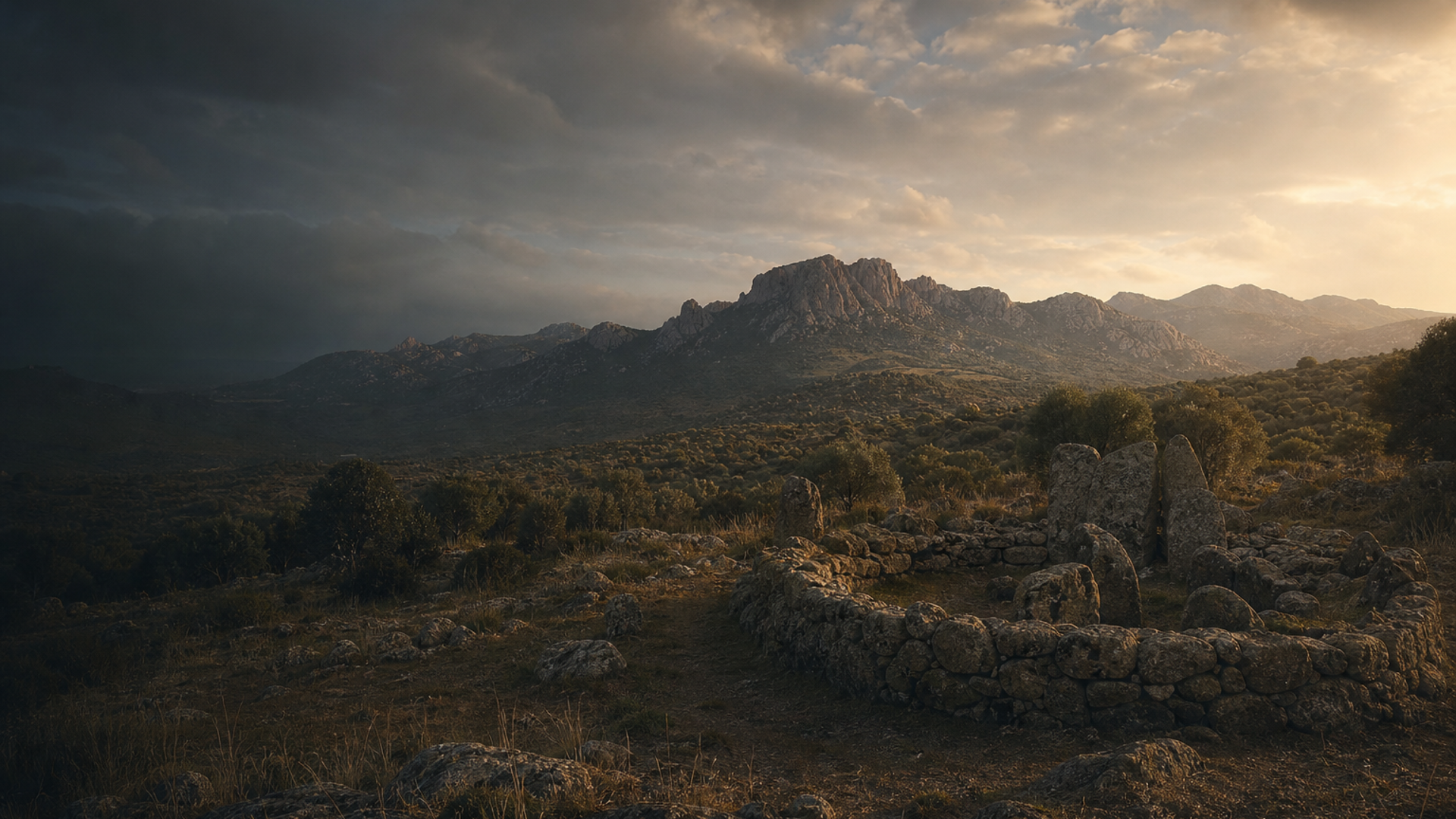
Sardinia: Late Bronze Age Echoes

Download PDF creates a visual, rasterized copy. Use Print for selectable text and better assistive-technology support.

Bericht wird vorbereitet

Verfügbare Informationen und Referenzen werden geladen

Verbindung mit dem archäologischen Quellenbestand...

Alte Quellen werden zusammengestellt

Zum Hauptinhalt springen
Sardinia: Late Bronze Age Echoes
Zivilisations-Spotlight

Sardinia: Late Bronze Age Echoes

Genetic and archaeological traces from Sardinia's Late Bronze Age, 1386–800 BCE

1386 CE - 800 BCE
Sardinia, Italy
Scrollen zum Start
Kapitel I

Die Geschichte

Die Sardinia: Late Bronze Age Echoes-Kultur verstehen

Seven Sardinian Late Bronze Age genomes (1386–800 BCE) link Nuragic landscapes and coastal sites (Alghero, Perdasdefogu, Persasdefogu, Anulù Seui) to mixed maternal and paternal lineages; conclusions are preliminary due to small sample size.

Time Period

1386–800 BCE

Region

Sardinia, Italy

Common Y-DNA

G (2), J (1), R (1) — small sample

Common mtDNA

J (3), T (2), V (1), HV (1)

Kapitel II

Zeitleiste

Zentrale Momente in der Geschichte dieser Kultur

1200 BCE

Heightened maritime contacts and local complexity

Around 1200 BCE, material culture and coastal finds suggest active exchange across the central Mediterranean while nuraghi continued shaping inland social life.

Kapitel III

Origins & Emergence

The Late Bronze Age in Sardinia unfolds like a weathered coastal panorama: inland stone towers (nuraghi), small settlements and coastal ports that threaded the island into Mediterranean exchange networks. Archaeological data indicates activity across both interior and littoral contexts between ca. 1500 and 800 BCE; the genomic samples here date specifically to 1386–800 BCE. Sites represented by the seven individuals include Alghero (northwest coast), Perdasdefogu and Persasdefogu (Ogliastra area), and Anulù Seui (inland mountainous terrain).

Material culture — pottery styles, funerary practices and the monumental nuraghi — shows continuity with earlier Bronze Age traditions while also registering new influences from maritime contacts. Limited evidence suggests increased interaction with central Mediterranean and Aegean spheres during the Late Bronze Age, but the intensity and directionality of those connections remain debated.

Genetic data from these individuals offers a tentative glimpse into the island's population composition at a time of cultural dynamism. Because the sample count is small (n=7), any reconstruction of demographic origins must be framed as preliminary: the genetic picture complements the archaeology but does not yet provide a definitive narrative of population change or migration across Sardinia in this era.

  • Samples dated 1386–800 BCE from Alghero, Perdasdefogu, Perdasdefogu, Anulù Seui
  • Nuraghi and coastal sites indicate mixed inland/coastal lifeways
  • Archaeological signals of external contact are present but uneven
Kapitel IV

Daily Life & Society

Archaeological remains paint a textured portrait of Late Bronze Age Sardinian lifeways: pastoralism and small-scale agriculture persisted in upland valleys, while coastal settlements engaged in fishing, craft production and exchange. The stone nuraghi — towering, drystone monuments scattered across the island — anchored local communities, acting as ceremonial, defensive and social focal points. Excavations at Ogliastra-region settlements (near Perdasdefogu and Persasdefogu) reveal domestic structures, storage pits and pottery that reflect everyday economies.

Bronze tools, local metallurgical debris and imported styles suggest artisan networks and occasional long-distance trade. Imported Aegean-style sherds and exotic materials at some coastal sites imply maritime connections, though archaeological data indicates such items were selective and localized rather than uniformly widespread. Burial practices vary across sites; tomb contexts associated with the genetic samples include both inhumations and complex depositional sequences, hinting at social differentiation.

Tactile traces — grinding stones, loom weights, and animal bones — evoke a society balancing inside-outside lives: stock, field, forge and harbor. Yet because our genetic window is narrow, linking these artifacts directly to the sampled individuals remains cautious work: skeletal associations and context must be carefully matched to avoid overreach.

  • Economy: mixed pastoralism, agriculture, coastal fishing and craft
  • Material culture shows local traditions with sporadic external imports
Kapitel V

Genetic Profile

The seven Late Bronze Age Sardinian genomes reveal a mosaic of paternal and maternal lineages that mirror Sardinia's complex prehistory. Y-chromosome markers among male individuals are G (2), J (1) and R (1). Haplogroup G is often associated with Neolithic farmer expansions in Europe and the Mediterranean; J can reflect connections to Anatolia and the Near East or later maritime links; the single R lineage is ambiguous without subclade resolution and should not be overinterpreted as definitively Steppe-associated.

Mitochondrial DNA is dominated by haplogroups J (3) and T (2), with single instances of V and HV. Maternal haplogroups J and T frequently appear in Neolithic and post-Neolithic Mediterranean contexts and may indicate continuity of maternal lines established during earlier agricultural expansions; V and HV are present in broader European maternal diversity.

Importantly, the small sample size (n=7) constrains statistical power: observed frequencies could shift with additional sampling. Archaeogenetic signals align with archaeological evidence of local continuity alongside intermittent external influence, suggesting a population anchored in Sardinian traditions but connected through maritime networks. Future analyses with larger samples and high-resolution Y-subclade data will be needed to clarify migration timing and sex-biased gene flow patterns.

  • Y-DNA: G (2), J (1), R (1) — limited sample, interpret cautiously
  • mtDNA: J (3), T (2), V (1), HV (1) indicating mixed maternal ancestries
Kapitel VI

Legacy & Modern Connections

The Late Bronze Age inhabitants of Sardinia contributed threads to the island's long genetic tapestry. Some maternal lineages (J, T) observed among these individuals echo broader Mediterranean maternal signatures that persist in later populations; paternal signals (notably G and J) also connect to deeper Neolithic and Near Eastern currents. However, archaeological continuity of the Nuragic culture and genetic continuity are not identical stories — gene flow, isolation and local resilience all shaped Sardinia's demographic destiny.

Modern Sardinian populations show unique genetic features partly rooted in prehistoric isolation, but linking modern genomes directly to these seven individuals requires caution. Because the sample set is small and regionally limited, conclusions about island-wide continuity are preliminary. Still, when combined with ongoing ancient DNA research, these Late Bronze Age genomes help illuminate how island communities negotiated isolation and connection across maritime Bronze Age networks.

  • Some maternal and paternal lineages resemble broader Mediterranean ancestries
  • Small sample size means links to modern Sardinians remain tentative
KI-gestützt

KI-Assistent

Stellen Sie Fragen zur Sardinia: Late Bronze Age Echoes-Kultur

KI-Assistent von DNAGENICS

Funktion freischalten
Stellen Sie Fragen zur Kultur Sardinia: Late Bronze Age Echoes. Unser KI-Assistent kann genetische Befunde, historischen Kontext, archäologische Belege und moderne Verbindungen erläutern.
Beispiel einer KI-Analyse

Die Sardinia: Late Bronze Age Echoes-Kultur ist ein faszinierendes Kapitel der Menschheitsgeschichte...

Genetische Analysen zeigen Übereinstimmungen mit früheren Populationen und Hinweise auf besondere Anpassungen und kulturelle Innovationen. Alte DNA-Proben liefern Einblicke in Migrationsmuster, soziale Strukturen und genetische Verbindungen zwischen Populationen.

Dies ist eine Vorschau der KI-Analyse. Schalten Sie den vollständigen KI-Assistenten frei, um detaillierte Einblicke zu erkunden:

  • Genetische Zusammensetzung und genetische Ähnlichkeit
  • Migrationsmuster und Ursprünge
  • Alltag und kulturelle Praktiken
  • Genetischer Bezug zu heutigen Populationen

Weitere antike Kulturen erkunden

Geschichten von Zivilisationen aus der antiken Welt entdecken

Use code for 35% off • Expires Nov 09