Shorelines and Highlands: Albania BA–IA

Download PDF creates a visual, rasterized copy. Use Print for selectable text and better assistive-technology support.

Zum Hauptinhalt springen
Zivilisations-Spotlight

Shorelines and Highlands: Albania BA–IA

A cinematic glimpse into communities across Albania from 2700 BCE to 1000 CE

2700 BCE - 1000 CE
Albania (SW Dukat; NE Çinamak, Kukes)

Die Geschichte

Archaeological remains from Dukat and Çinamak reveal long-lived coastal and highland communities in Albania (2700 BCE–1000 CE). Limited genetic data (11 samples) show mainly mtDNA H and T lineages, suggesting maternal ties to broader European populations amid local cultural change.

Time Period

2700 BCE – 1000 CE

Region

Albania (SW Dukat; NE Çinamak, Kukes)

Common Y-DNA

Not consistently reported / varied

Common mtDNA

H, T (predominant in dataset)

Zeitleiste

2500 BCE

Late Bronze Age communities established

Occupations at coastal Dukat and upland Çinamak reflect settled communities engaged in metallurgy, farming, and exchange across the central Balkans.

Origins & Emergence

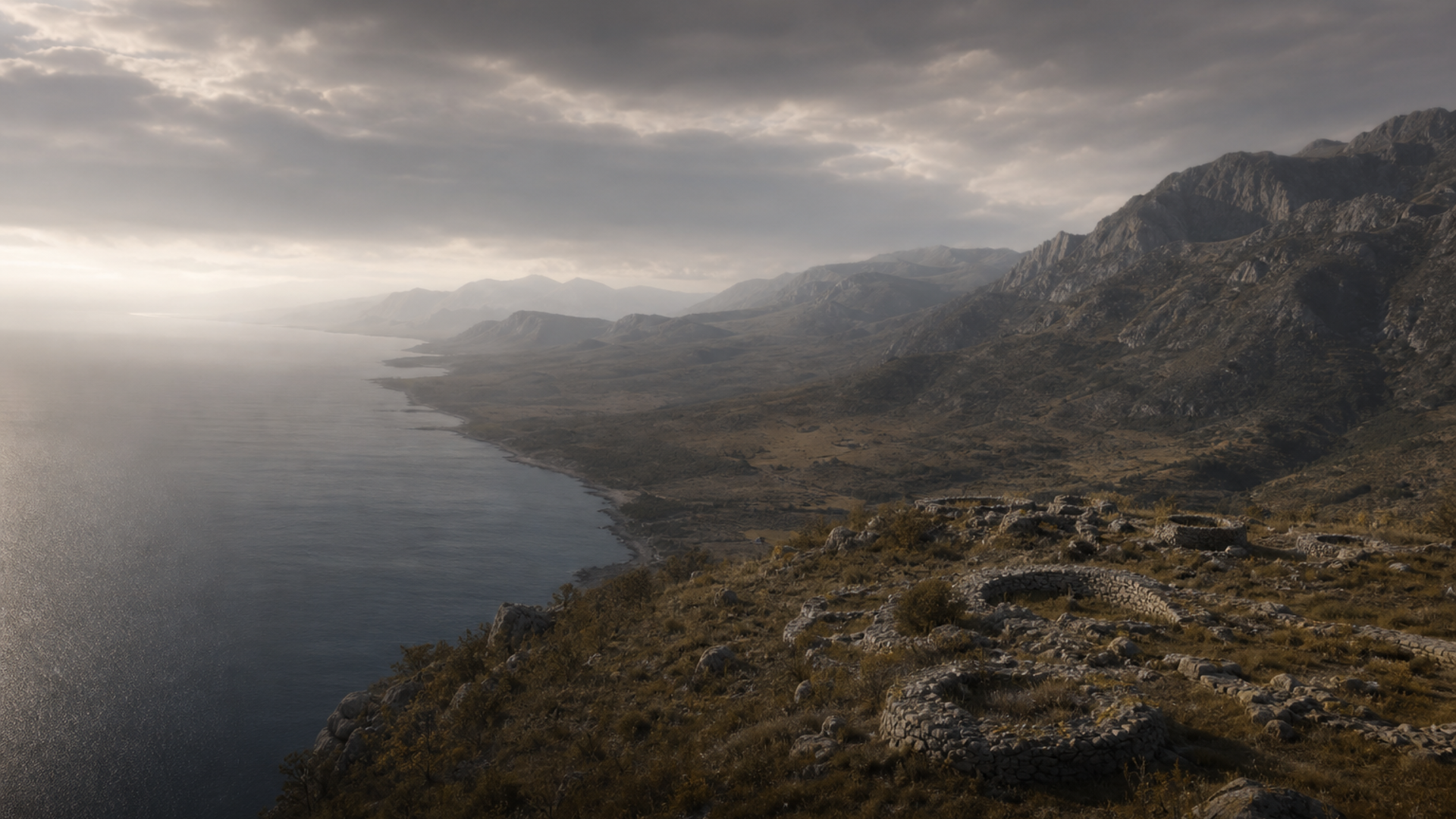
Across the exposed terraces of the Adriatic and the shadowed valleys of the Kukes uplands, the material traces assigned to Albania_BA_IA evoke a long arc of transformation. Archaeological data indicate occupation stretching from the late 3rd millennium BCE into the first millennium CE, a time when Bronze Age metallurgy matured and iron began to reshape tools, weapons, and social orders. Sites such as Dukat on the southwestern shore and Çinamak in the northeastern Kukes district preserve burials and settlement debris that reflect continuity and change: pottery styles and metalwork suggest connections across the central Balkans and the Ionian littoral, while local ceramic traditions point to regionally rooted identities.

Limited evidence suggests that these communities did not represent a single uniform polity; instead, they were a mosaic of coastal traders, upland pastoralists, and valley agriculturalists whose lifeways adapted through centuries of climatic fluctuation and shifting exchange networks. The temporal breadth of the dataset (2700 BCE–1000 CE) means archaeological phases overlap: Late Bronze Age horizons give way to Iron Age innovations, and later medieval reoccupation can complicate stratigraphy. Where genetic sampling is available, it provides a complementary lens on lineage continuity and mobility, but with only 11 samples the emerging picture remains provisional and must be integrated cautiously with material culture.

  • Occupation spans late Bronze Age into the early Medieval period (2700 BCE–1000 CE).
  • Key sites: Dukat (SW) and Çinamak (NE, Kukes District).
  • Evidence points to local traditions with broader Balkan and Adriatic links.

Daily Life & Society

Archaeology paints evocative snapshots: in coastal Dukat, people shaped marine resources and Mediterranean exchange; in the Kukes foothills, households tilled terraces, tended herds, and managed mountain pastures. Material assemblages recovered from these regions — pottery, loom weights, metal tools and fragments — imply mixed economies combining farming, herding, and specialized craft production. Burials reveal variation in funerary practice over time, hinting at shifting social hierarchies: some interments are accompanied by personal ornaments or metal objects, while others are modest, suggesting social differentiation rather than rigid caste.

Settlement patterns appear responsive to landscape: coastal sites emphasize access to maritime routes and raw materials, while upland sites show mobility tied to seasonal grazing. The gradual introduction of iron technology during the transition to the Iron Age likely altered daily tasks and social power, as iron tools and weapons became more widespread. Archaeobotanical and zooarchaeological data remain sparse for this specific dataset, so reconstructions of diet and seasonality are tentative. Taken together, the archaeological record suggests resilient communities negotiating local resources and long-distance connections in a changing technological and climatic world.

  • Mixed economies: agriculture, pastoralism, coastal resource use.
  • Burial variability indicates emerging social differentiation.

Genetic Profile

The genetic snapshot from Albania_BA_IA is modest but informative. Among 11 samples, mitochondrial haplogroups are dominated by H and T lineages (reported counts: T = 2; H+ = 2; T2b = 1; H1a = 1; H = 1). mtDNA H and T are widespread in Europe: H has deep roots reaching back to Late Glacial and Neolithic populations, while T and its subclades are common among Neolithic farmers and later communities. These maternal signals are consistent with a degree of continuity with broader European maternal lineages, suggesting that female-line ancestry in these sites reflects long-standing regional connections.

No consistent Y-DNA haplogroup emerges from the supplied dataset (either not reported or heterogeneous), so conclusions about male-line movements, patrilineal continuity, or steppe-associated influxes remain tentative. The temporal span of the samples (2700 BCE–1000 CE) increases the likelihood that genetic signals reflect multiple migration and admixture events across millennia rather than a single demographic episode. With only 11 individuals, statistical power is limited; patterns such as regional continuity, gene flow, or sex-biased migration should be considered provisional. Future sampling, especially paired autosomal data and more Y-chromosome profiles, will clarify how these maternal lineages relate to broader Balkan and Mediterranean population dynamics.

  • mtDNA dominated by H and T lineages, common in European maternal ancestry.
  • Y-DNA not consistently reported; male-line conclusions remain tentative.

Legacy & Modern Connections

The archaeological and genetic fragments from Albania_BA_IA form threads in a larger tapestry that ties ancient coastal harbors and mountain valleys to the present-day genetic landscape of the western Balkans. Archaeological continuity in material culture and the prevalence of widespread maternal haplogroups suggest that some ancestral components of local populations persisted through the Bronze-to-Iron Age transition and beyond. However, the long date range and limited sample count caution against overinterpreting direct ancestry claims.

For modern genetic ancestry research, these remains offer tantalizing but preliminary anchors: they help frame where lineages like mtDNA H and T were present locally and underscore the need for denser sampling across time and place. When integrated with archaeology, isotopes, and larger ancient DNA panels, these samples contribute to reconstructing mobility, kinship, and cultural change across Albania's rugged landscapes.

  • Maternal lineages suggest regional continuity but require larger samples to confirm.
  • Combining archaeology and DNA offers powerful, but preliminary, insights into ancestry.

KI-Assistent

KI-Assistent von DNAGENICS

Funktion freischalten
Stellen Sie Fragen zur Kultur Shorelines and Highlands: Albania BA–IA. Unser KI-Assistent kann genetische Befunde, historischen Kontext, archäologische Belege und moderne Verbindungen erläutern.
Beispiel einer KI-Analyse

Die Shorelines and Highlands: Albania BA–IA-Kultur ist ein faszinierendes Kapitel der Menschheitsgeschichte...

Genetische Analysen zeigen Übereinstimmungen mit früheren Populationen und Hinweise auf besondere Anpassungen und kulturelle Innovationen. Alte DNA-Proben liefern Einblicke in Migrationsmuster, soziale Strukturen und genetische Verbindungen zwischen Populationen.

Dies ist eine Vorschau der KI-Analyse. Schalten Sie den vollständigen KI-Assistenten frei, um detaillierte Einblicke zu erkunden:

  • Genetische Zusammensetzung und genetische Ähnlichkeit
  • Migrationsmuster und Ursprünge
  • Alltag und kulturelle Praktiken
  • Genetischer Bezug zu heutigen Populationen
Use code for 25% off • Expires Nov 13




