Southeast Karakhanid Voices

Download PDF creates a visual, rasterized copy. Use Print for selectable text and better assistive-technology support.

Bericht wird vorbereitet

Verfügbare Informationen und Referenzen werden geladen

Verbindung mit dem archäologischen Quellenbestand...

Alte Quellen werden zusammengestellt

Zum Hauptinhalt springen
Southeast Karakhanid Voices
Zivilisations-Spotlight

Southeast Karakhanid Voices

Three genomes from Butakty-1 revealing a frontier of Silk Road exchange

800 CE - 1100 CE
Southeast Kazakhstan (Almaty Region)
Scrollen zum Start
Kapitel I

Die Geschichte

Die Southeast Karakhanid Voices-Kultur verstehen

Archaeogenetic glimpses from Butakty-1 (Almaty Region) dated 800–1100 CE show a mixed male-line J signal and diverse maternal lineages (G, J1c, A+). Limited samples suggest contact between West Eurasian and East Asian ancestries during the Karakhanid era.

Time Period

800–1100 CE (Karakhanid era)

Region

Southeast Kazakhstan (Almaty Region)

Common Y-DNA

J (2 of 3 samples)

Common mtDNA

G, J1c, A+ (each observed)

Kapitel II

Zeitleiste

Zentrale Momente in der Geschichte dieser Kultur

840 CE

Rise of the Karakhanid Khanate

Turkic polities consolidate power in Transoxiana and adjacent regions, creating a political backdrop for increased trade and mobility across southeastern Kazakhstan.

Kapitel III

Origins & Emergence

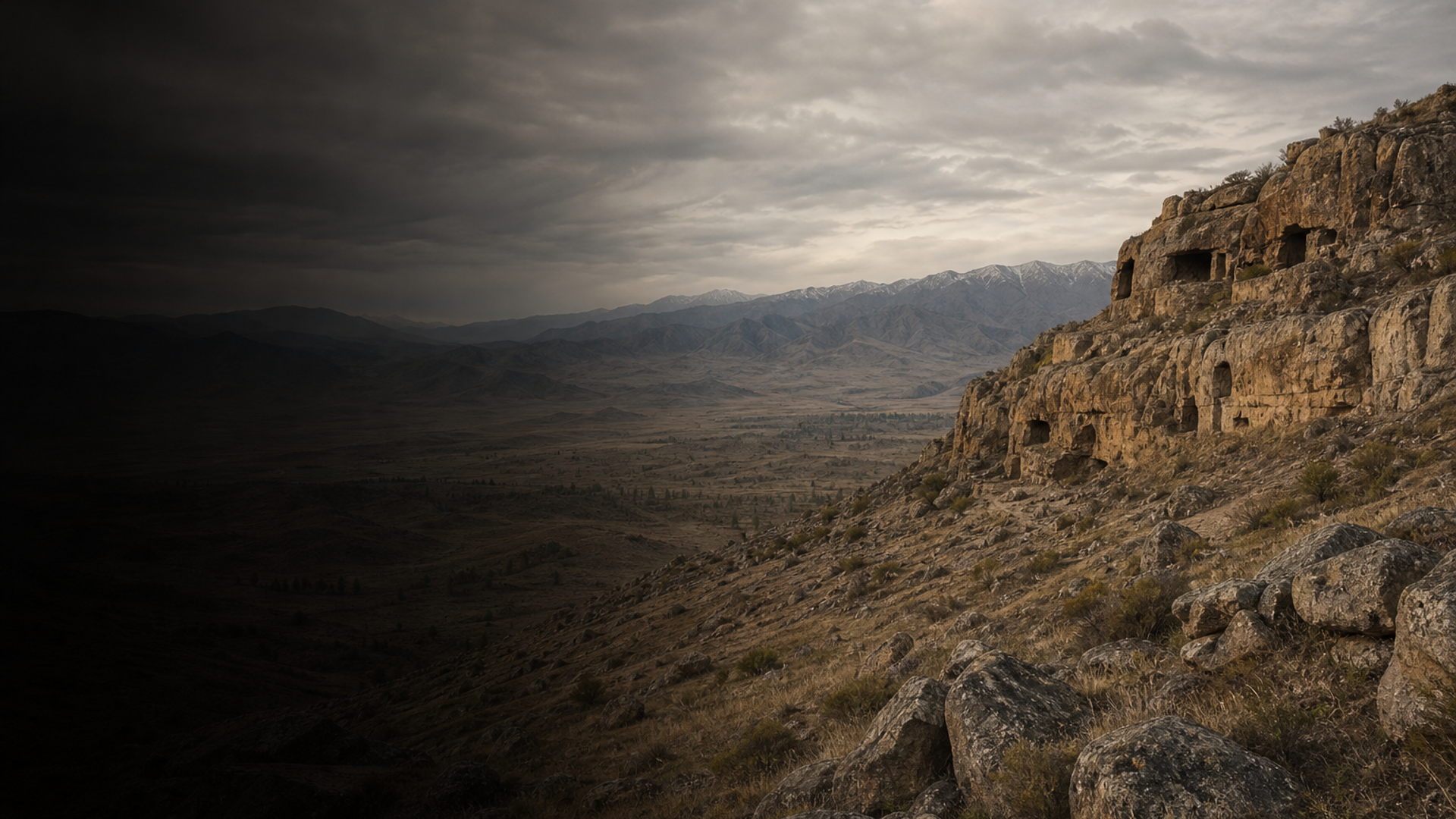
In the high, wind-swept foothills near Almaty, the Karakhanid world unfolded as a tapestry of caravan routes, pastoral encampments, and fortified towns. Archaeological data from the Butakty-1 cemetery (Medeu District) dated between 800 and 1100 CE places these burials squarely within the Karakhanid Khanate's ascendancy. Material remains in the broader region—ceramics with stylistic echoes of Central Asian workshops, iron tools, and occasional imported goods—point to a frontier where West Eurasian, Iranian, and eastern Eurasian influences converged.

Limited evidence suggests that communities here were neither isolated nomads nor static urbanites but participants in a dynamic Silk Road network. The appearance of male-line haplogroup J among two of three sampled individuals hints at continued ties to West Eurasian or Iranian-linked paternal ancestries during the medieval period. At the same time, maternal lineages including haplogroups G and A+ signal eastern Eurasian connections, consistent with mobility and intermarriage across cultural boundaries. Because only three genomes are available, any reconstruction of origins remains provisional; archaeological patterns, however, consistently depict this area as an intermediary landscape—a place of meeting, movement, and cultural blending.

  • Butakty-1 cemetery (Medeu District, Almaty) dated 800–1100 CE
  • Material culture indicates Silk Road connectivity
  • Preliminary genetic signals show both West and East Eurasian ancestries
Kapitel IV

Daily Life & Society

Archaeological traces from southeast Kazakhstan evoke a society adapted to mobility and exchange. Hearths, animal bones, and simple metal tools recovered in regional surveys suggest a mixed pastoral-agropastoral economy: flocks grazed the steppe while villagers cultivated valley gardens. Textile fragments and ornamental metalwork—sometimes bearing motifs shared across Central Asia—speak to aesthetic networks that moved along trade routes as readily as spices or silver.

Burial practices at Butakty-1 are modest but telling: grave orientations, goods of personal adornment, and patterns of interment suggest families and small kin groups anchored by seasonal movement rather than large, sedentary polities. The Karakhanid political framework likely reshaped local social landscapes, introducing administrative, religious, and commercial ties that intensified interaction. Archaeological data indicates that everyday life here was shaped by adaptability—responding to climatic variability, banded alliances, and the steady flow of peoples and ideas along the Silk Road corridors.

  • Mixed pastoral and local agricultural economy
  • Burials reflect kin-based groups and Silk Road material influences
Kapitel V

Genetic Profile

The genetic snapshot from Butakty-1 is small—three individuals—but cinematic in its implications. Two of the three males carry Y-chromosome haplogroup J, a lineage often associated with West Eurasian and Near Eastern paternal ancestries. This presence during the Karakhanid period may reflect continued male-mediated gene flow from western corridors (Iranian, Central Asian urban centers) into southeastern Kazakhstan.

Mitochondrial diversity in the trio is striking: haplogroups G and A+ are commonly linked to northeastern and eastern Eurasian maternal ancestries, while J1c is more frequent in west-to-central Eurasia. This pattern—West-linked paternal J alongside mixed maternal lineages—aligns with archaeological expectations for a contact zone: male-line continuity or migration from western networks coupled with local or eastern maternal inputs, perhaps through marriage or adoption into migratory groups. It is crucial to stress the preliminary nature of these conclusions: with only three samples any broader population portrait is tentative. Additional sampling could reveal whether the observed pattern reflects a localized household structure, a social practice (e.g., patrilocality), or wider demographic processes operating under the Karakhanid Khanate.

  • Two of three males carry Y-DNA haplogroup J — West Eurasian-linked signal
  • MtDNA includes G and A+ (East Eurasian) and J1c (West/Central Eurasian), indicating mixed maternal ancestry
Kapitel VI

Legacy & Modern Connections

The genetic echoes at Butakty-1 illuminate how medieval Central Asia was not a uniform sea of one people but a braided stream of ancestries. Today’s populations across southeastern Kazakhstan and neighboring regions retain layered genetic and cultural legacies from Turkic, Iranian, Mongolic, and indigenous steppe communities. Archaeological data indicates that the Karakhanid era intensified long-distance ties, helping shape local identities that would continue to evolve.

Because sample size is small, these genomes are best seen as tantalizing waypoints rather than definitive endpoints. They invite further study: expanded ancient DNA sampling, comparative analyses with urban Karakhanid centers, and integration with material culture studies. Together, these approaches can transform cinematic fragments—isolated graves, a handful of genomes—into a clearer picture of how people lived, moved, and connected across the medieval Silk Road.

  • Reflects layered ancestries still visible in Central Asian genetic mosaic
  • Findings are preliminary and motivate broader regional sampling
KI-gestützt

KI-Assistent

Stellen Sie Fragen zur Southeast Karakhanid Voices-Kultur

KI-Assistent von DNAGENICS

Funktion freischalten
Stellen Sie Fragen zur Kultur Southeast Karakhanid Voices. Unser KI-Assistent kann genetische Befunde, historischen Kontext, archäologische Belege und moderne Verbindungen erläutern.
Beispiel einer KI-Analyse

Die Southeast Karakhanid Voices-Kultur ist ein faszinierendes Kapitel der Menschheitsgeschichte...

Genetische Analysen zeigen Übereinstimmungen mit früheren Populationen und Hinweise auf besondere Anpassungen und kulturelle Innovationen. Alte DNA-Proben liefern Einblicke in Migrationsmuster, soziale Strukturen und genetische Verbindungen zwischen Populationen.

Dies ist eine Vorschau der KI-Analyse. Schalten Sie den vollständigen KI-Assistenten frei, um detaillierte Einblicke zu erkunden:

  • Genetische Zusammensetzung und genetische Ähnlichkeit
  • Migrationsmuster und Ursprünge
  • Alltag und kulturelle Praktiken
  • Genetischer Bezug zu heutigen Populationen

Weitere antike Kulturen erkunden

Geschichten von Zivilisationen aus der antiken Welt entdecken

Use code for 30% off • Expires Nov 08