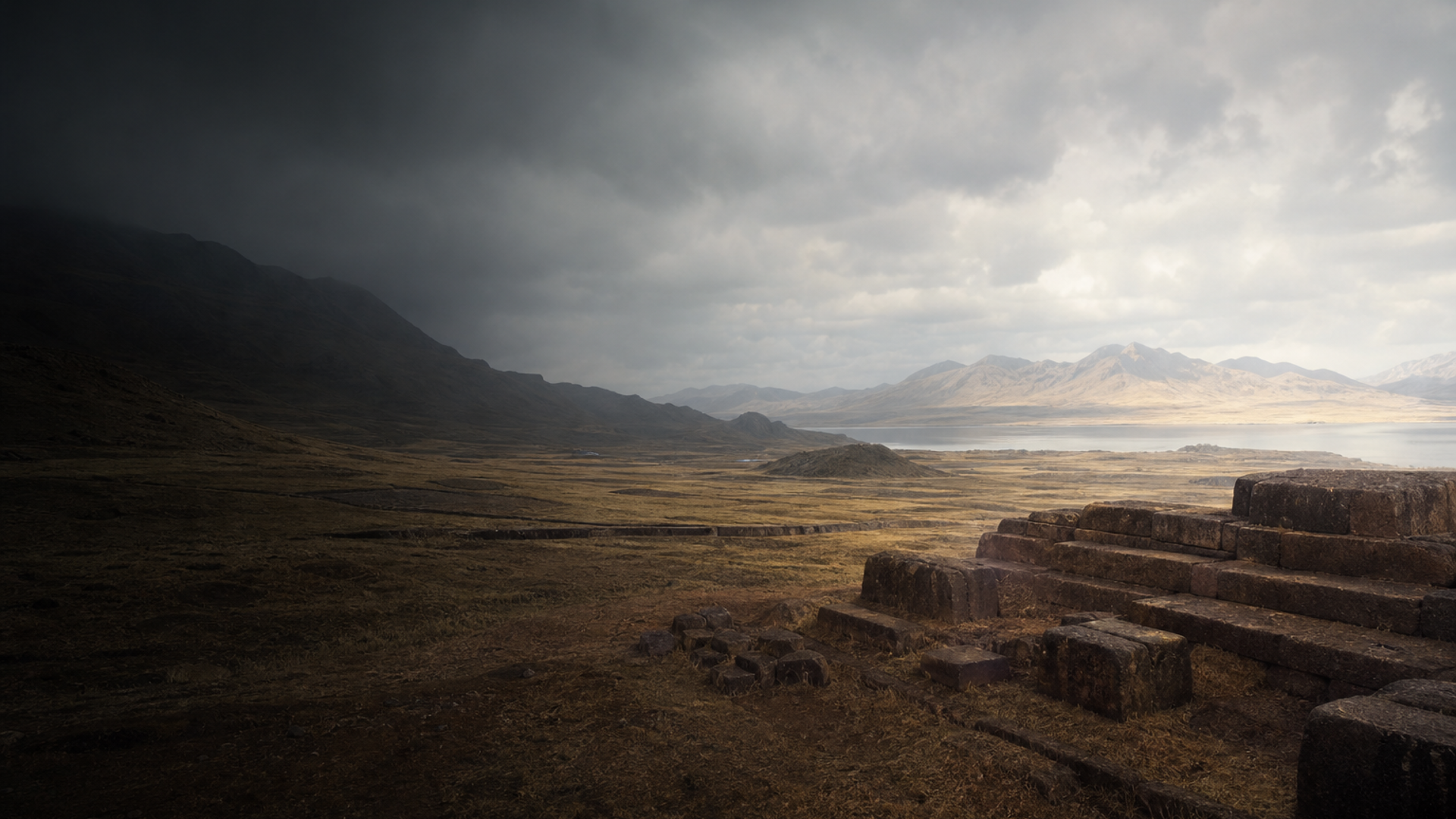
Tiwanaku Echoes (650–1200 CE)

Download PDF creates a visual, rasterized copy. Use Print for selectable text and better assistive-technology support.

Bericht wird vorbereitet

Verfügbare Informationen und Referenzen werden geladen

Verbindung mit dem archäologischen Quellenbestand...

Alte Quellen werden zusammengestellt

Zum Hauptinhalt springen
Tiwanaku Echoes (650–1200 CE)
Zivilisations-Spotlight

Tiwanaku Echoes (650–1200 CE)

Highland state on Lake Titicaca whose stones and genomes hint at Andean continuity

650 CE - 1200 CE
Tiwanaku, Lake Titicaca basin, La Paz, Bolivia
Scrollen zum Start
Kapitel I

Die Geschichte

Die Tiwanaku Echoes (650–1200 CE)-Kultur verstehen

Archaeological remains from Tiwanaku (La Paz, Bolivia) paired with four ancient genomes reveal predominant Y-haplogroup Q and mtDNA B2/C1c. Limited samples suggest regional Andean ancestry but conclusions remain preliminary.

Time Period

650–1200 CE (Middle Horizon & later)

Region

Tiwanaku, Lake Titicaca basin, La Paz, Bolivia

Common Y-DNA

Q (3 of 4 samples)

Common mtDNA

B2 (3), C1c (1)

Kapitel II

Zeitleiste

Zentrale Momente in der Geschichte dieser Kultur

650 CE

Tiwanaku expansion into Middle Horizon

Archaeological evidence marks intensified monument building and regional influence around 650 CE as Tiwanaku becomes a major Middle Horizon center.

Kapitel III

Origins & Emergence

Tiwanaku rises from the wind-swept altiplano like a fossilized city of stones. Centered on the southern basin of Lake Titicaca near present-day La Paz, Bolivia, the monumental core at Tiwanaku — including Kalasasaya, the Akapana pyramid, and the enigmatic Puma Punku complex — crystallized social and ritual life during the Middle Horizon (roughly 600–1000 CE). Archaeological data indicates major building campaigns and expansive influence across the southern Andes by the 7th–10th centuries CE.

Material culture — standardized ceramics, iconographic motifs, and distinctive architectural forms — points to a regional polity that mobilized labor and ideology across highland and nearby lowland corridors. Grave goods, platform mounds, and evidence for craft specialization suggest complex social organization with ritual elites.

However, the dynamic timeline of Tiwanaku's rise and transformation remains debated. Radiocarbon dates place key phases between the 7th and 11th centuries CE, but later reoccupation and regional variation complicate a single narrative. Limited genetic sampling from the site offers tantalizing hints of continuity with Andean populations, yet the small number of sequenced individuals requires caution before inferring broad migratory or demographic events.

  • Major sites: Kalasasaya, Akapana, Puma Punku (Tiwanaku core)
  • Key period: Middle Horizon expansion, ~600–1000 CE
  • Monumental architecture and shared iconography across the basin
Kapitel IV

Daily Life & Society

Stone plazas and sun-baked streets framed lives of farmers, artisans, priests, and rulers. The altiplano’s harsh highland environment shaped subsistence: raised fields (suka kollus) and camelid herding mitigated cold, while quinoa and native tubers featured in diet. Archaeobotanical and zooarchaeological remains from Tiwanaku contexts indicate mixed agriculture and pastoralism adapted to elevation.

Craft production appears highly organized — finely made polychrome ceramics, carved stone stelae, and metalworking fragments reflect specialist workshops, possibly under elite patronage. Ritual scenes carved into stelae and pottery imply cosmologies that structured public performance and state ceremony; plazas and stepped platforms hosted gatherings that reinforced social hierarchies.

Burial practices vary across the site, from high-status interments near ceremonial centers to more modest graves, reflecting differential access to wealth and ritual. Isotopic studies (where available) suggest variations in diet and mobility, but sample sizes are often small. The genomes from four individuals capture snapshots of people who lived within this material world, yet they cannot fully represent the social complexity and diversity of Tiwanaku society.

  • Mixed farming, raised fields, and camelid herding sustained communities
  • Specialized crafts and ritual architecture indicate centralized organization
Kapitel V

Genetic Profile

Four published genomes from Tiwanaku contexts in La Paz provide a cautious molecular window into the population. Three males carried Y-chromosome haplogroup Q, a lineage widespread among Indigenous peoples of the Americas; the maternal lineages are dominated by mtDNA B2 (three individuals) with one instance of C1c. These markers are consistent with predominant Native American ancestry typical of Andean populations.

Archaeogenetic patterns align with an Andean highland profile, but several caveats apply. With only four samples, statistical power is limited: population substructure, sex-biased migration, and temporal changes across the 650–1200 CE span cannot be robustly resolved. The prevalence of haplogroup Q among males here mirrors broader continental distributions, yet subclade resolution and autosomal affinities that might reveal finer-scale connections to modern Aymara, Quechua, or neighboring groups remain uncertain unless further samples are analyzed.

Where autosomal data exist from regional studies, they often indicate long-term genetic continuity in the highlands with signals of local gene flow rather than large-scale replacement during the Middle Horizon. For Tiwanaku specifically, these four genomes tentatively support continuity with Andean lineages, but more extensive sampling from multiple burial contexts and time slices is required to test hypotheses about migration, elite mobility, or demographic shifts.

  • Y-DNA dominated by haplogroup Q (3 of 4)
  • mtDNA primarily B2 (3) and one C1c — consistent with Native American maternal lineages
Kapitel VI

Legacy & Modern Connections

The stones of Tiwanaku continue to shape Andean identity. Modern Aymara and other highland communities inherit cultural landscapes once organized by Tiwanaku institutions; linguistic, ritual, and agricultural practices in the Lake Titicaca basin show threads that archaeology and genetics both illuminate.

Genetic continuity hinted at by the limited Tiwanaku sample echoes broader patterns of regional persistence across the highlands, suggesting that many modern Andean populations may carry ancestral components rooted in pre-Columbian societies like Tiwanaku. Yet this connection must be framed as provisional: only expanded ancient DNA sampling and comparative analysis with present-day genomes can quantify continuity, admixture, or population turnover. Museums and researchers thus present an evolving story where stones, pottery, and genomes together narrate a long human presence on the altiplano.

  • Cultural and genetic threads link Tiwanaku to modern highland peoples
  • Expanded ancient DNA sampling needed to confirm long-term continuity
KI-gestützt

KI-Assistent

Stellen Sie Fragen zur Tiwanaku Echoes (650–1200 CE)-Kultur

KI-Assistent von DNAGENICS

Funktion freischalten
Stellen Sie Fragen zur Kultur Tiwanaku Echoes (650–1200 CE). Unser KI-Assistent kann genetische Befunde, historischen Kontext, archäologische Belege und moderne Verbindungen erläutern.
Beispiel einer KI-Analyse

Die Tiwanaku Echoes (650–1200 CE)-Kultur ist ein faszinierendes Kapitel der Menschheitsgeschichte...

Genetische Analysen zeigen Übereinstimmungen mit früheren Populationen und Hinweise auf besondere Anpassungen und kulturelle Innovationen. Alte DNA-Proben liefern Einblicke in Migrationsmuster, soziale Strukturen und genetische Verbindungen zwischen Populationen.

Dies ist eine Vorschau der KI-Analyse. Schalten Sie den vollständigen KI-Assistenten frei, um detaillierte Einblicke zu erkunden:

  • Genetische Zusammensetzung und genetische Ähnlichkeit
  • Migrationsmuster und Ursprünge
  • Alltag und kulturelle Praktiken
  • Genetischer Bezug zu heutigen Populationen

Weitere antike Kulturen erkunden

Geschichten von Zivilisationen aus der antiken Welt entdecken

Use code for 30% off • Expires Nov 08