Velika Gruda Voices

Download PDF creates a visual, rasterized copy. Use Print for selectable text and better assistive-technology support.

Bericht wird vorbereitet

Verfügbare Informationen und Referenzen werden geladen

Verbindung mit dem archäologischen Quellenbestand...

Alte Quellen werden zusammengestellt

Zum Hauptinhalt springen
Velika Gruda Voices
Zivilisations-Spotlight

Velika Gruda Voices

Bronze Age Montenegro maternal lineages echo through Adriatic hills

1450 CE - 1000 BCE
Velika Gruda, Montenegro (Adriatic hinterland)
Scrollen zum Start
Kapitel I

Die Geschichte

Die Velika Gruda Voices-Kultur verstehen

Montenegro_MLBA (1450–1000 BCE) reflects Middle–Late Bronze Age communities around Velika Gruda. Archaeology and 16 ancient genomes show dominant maternal haplogroups H and U. Evidence is compelling but incomplete; Y-chromosome data are limited, so conclusions remain provisional.

Time Period

1450–1000 BCE

Region

Velika Gruda, Montenegro (Adriatic hinterland)

Common Y-DNA

Not clearly determined (limited Y-DNA data)

Common mtDNA

H (6), U (5), K2a (1), J (1), W+ (1)

Kapitel II

Zeitleiste

Zentrale Momente in der Geschichte dieser Kultur

1450 BCE

Velika Gruda burials date to Montenegro_MLBA

Archaeological and radiocarbon contexts place the Velika Gruda individuals in the Middle–Late Bronze Age (c.1450–1000 BCE), anchoring genetic samples to regional material culture.

Kapitel III

Origins & Emergence

Rising from the rugged slopes above the Adriatic, the communities sampled at Velika Gruda belonged to the Middle to Late Bronze Age horizon of Montenegro (dating here between 1450 and 1000 BCE). Archaeological data indicate settlement continuity in the Bay of Kotor hinterland and a material culture marked by local ceramic traditions, metalwork, and burial practices that link the site to wider Balkan Bronze Age networks.

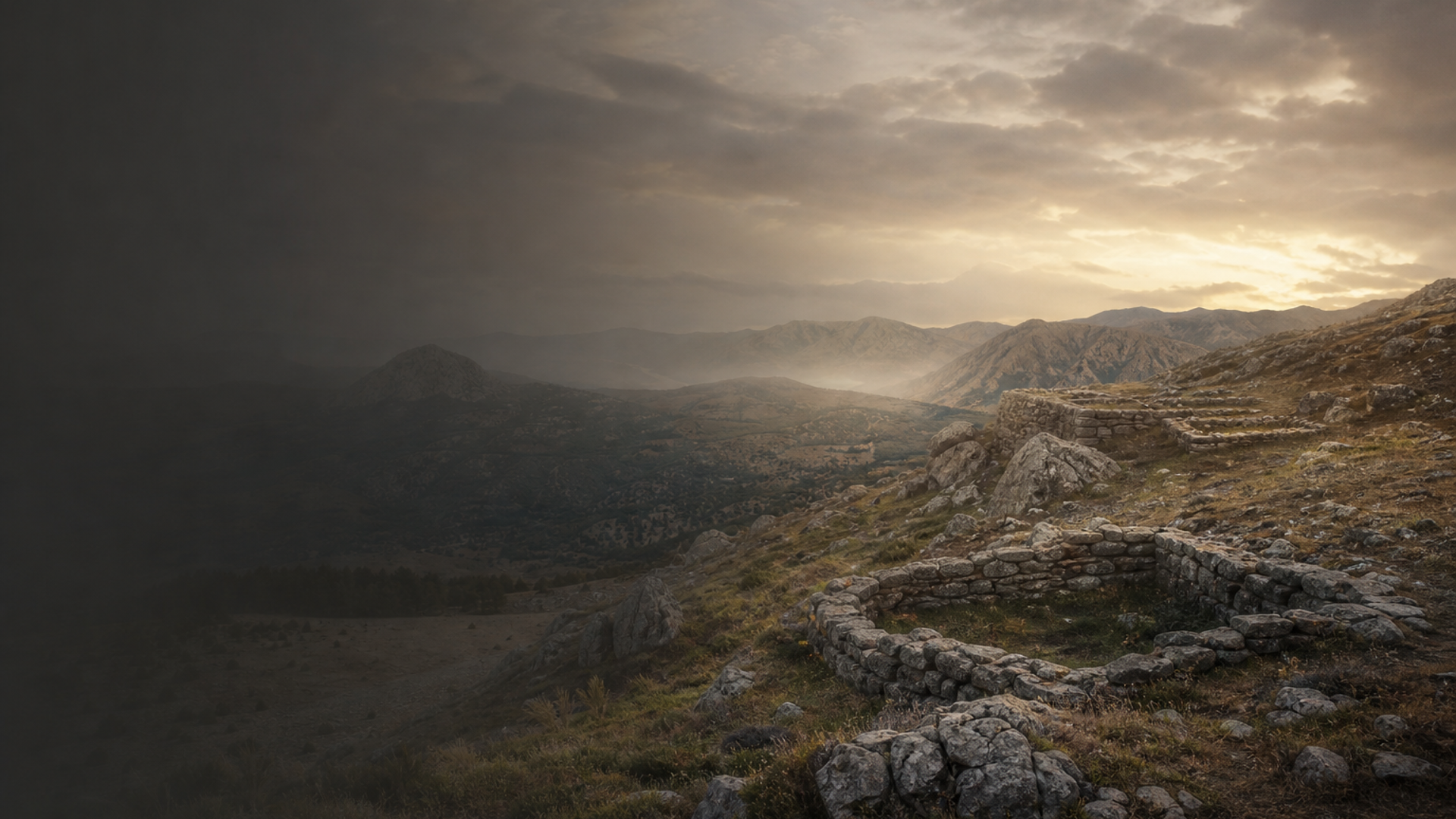
The cinematic sweep of this landscape—sheep-folds, terraces and coastal trade routes—frames a story of local lifeways meeting long-distance contacts. Limited evidence suggests exchanges of raw materials and ideas along the Adriatic littoral and into inland valleys, but the precise vectors of interaction remain only partially visible in the current record.

From a genetic perspective, these communities fall into the later Bronze Age tapestry of the eastern Adriatic: a mixture shaped by earlier Neolithic farmers and subsequent mobility across the Balkans. Archaeological stratigraphy at Velika Gruda anchors the human remains to clear funerary contexts, allowing direct ties between objects of daily life and the people who bore mitochondrial lineages now observed in ancient DNA. As always, the narrative is provisional—additional excavations and genomes are needed to resolve finer-scale origins and movements.

  • Context: Middle–Late Bronze Age Montenegro (1450–1000 BCE)
  • Site: Velika Gruda—burials tied to local ceramic and metal assemblages
  • Regional connections inferred but specific routes remain uncertain
Kapitel IV

Daily Life & Society

Life in Bronze Age Montenegro unfolded in a mosaic of upland hamlets and coastal exchange points. Archaeological remains from Velika Gruda suggest communities engaged in mixed farming—grain cultivation, herding of sheep and cattle—and craft production that included bronze working and pottery. Ceramic styles and tool forms reflect both local innovation and interactions with neighboring groups across the Dinaric Alps and Adriatic seaboard.

Burial practices recovered at Velika Gruda provide glimpses of social identity: inhumations with grave goods that vary in quality and type imply differences in status or role, though sample sizes limit strong social reconstructions. Objects alongside the dead—metal pins, pottery vessels, and occasional ornaments—speak to daily technologies, aesthetic choices, and ritual behaviors.

Seasonal rhythms would have structured labor and mobility: seasonal pastures in highlands, agricultural cycles in terraced plots, and participation in regional exchange networks that brought raw metals and finished goods. Archaeological data indicate a society adaptive to rugged terrain, maintaining local traditions while participating in wider Bronze Age transformations.

  • Mixed economy: farming, herding, and local craft production
  • Burials at Velika Gruda show variable grave goods suggesting social differentiation
Kapitel V

Genetic Profile

Sixteen genomes from Montenegro_MLBA (Velika Gruda) provide a maternal portrait of these Bronze Age people. mtDNA haplogroups are dominated by H (6 individuals) and U (5), with single occurrences of K2a, J, and W+; two individuals lack reported maternal calls or remain unassigned in the dataset. These haplogroups are common across prehistoric Europe—H and U, in particular, are frequent among Neolithic farmer-descended and later Bronze Age populations—so their presence aligns Montenegro_MLBA with broad continental maternal patterns.

Y-chromosome data are not clearly represented in the provided summary, and therefore paternal affinities remain unresolved for this cohort; any interpretation of male-mediated migrations or kinship must remain tentative. Where broader Balkan Bronze Age studies exist, patterns often show continuity of Neolithic-derived maternal lineages together with influxes of steppe-associated ancestry on the male side. The Montenegro_MLBA mtDNA distribution is consistent with that regional trend, but direct evidence for steppe-related admixture or specific paternal haplogroups at Velika Gruda cannot be established from the current sample summary.

With 16 samples, conclusions are stronger than from very small series but still limited: population substructure, kin networks within the cemetery, and fine-scale migration events require larger sample sizes and genome-wide analyses to resolve. Archaeogenetics here provides a powerful bridge to the archaeological record, illuminating maternal lineages while pointing to gaps—especially in Y-DNA—where future sampling can sharpen the picture.

  • mtDNA dominated by H and U (H:6, U:5; K2a, J, W+ each present once)
  • Y-DNA unclear in current dataset—paternal patterns remain unresolved
Kapitel VI

Legacy & Modern Connections

The mitochondrial signatures from Velika Gruda join a long continuum that links Bronze Age Adriatic communities to later European populations. Haplogroups H and U persist into the historic and modern gene pools of the Balkans, so the maternal threads observed here likely contributed—along with many later movements—to the genetic tapestry of the region.

However, continuity should not be assumed without nuance: centuries of migration, admixture, and demographic change have reworked local ancestries. Archaeogenetic data from Montenegro_MLBA are an essential piece of the puzzle but represent a snapshot from one site and one era. When woven with archaeology—burials, material culture, and landscape use—they offer a cinematic glimpse of people rooted in place yet connected across the Bronze Age world. Ongoing sampling and comparison to modern genomic datasets will clarify which elements persisted, which were transformed, and how Velika Gruda’s inhabitants fit into the deeper story of Montenegrin ancestry.

  • Maternal haplogroups H and U link Bronze Age individuals to broader European lineages
  • Modern continuity is plausible but complicated by later migrations and limited sampling
KI-gestützt

KI-Assistent

Stellen Sie Fragen zur Velika Gruda Voices-Kultur

KI-Assistent von DNAGENICS

Funktion freischalten
Stellen Sie Fragen zur Kultur Velika Gruda Voices. Unser KI-Assistent kann genetische Befunde, historischen Kontext, archäologische Belege und moderne Verbindungen erläutern.
Beispiel einer KI-Analyse

Die Velika Gruda Voices-Kultur ist ein faszinierendes Kapitel der Menschheitsgeschichte...

Genetische Analysen zeigen Übereinstimmungen mit früheren Populationen und Hinweise auf besondere Anpassungen und kulturelle Innovationen. Alte DNA-Proben liefern Einblicke in Migrationsmuster, soziale Strukturen und genetische Verbindungen zwischen Populationen.

Dies ist eine Vorschau der KI-Analyse. Schalten Sie den vollständigen KI-Assistenten frei, um detaillierte Einblicke zu erkunden:
  • Genetische Zusammensetzung und genetische Ähnlichkeit
  • Migrationsmuster und Ursprünge
  • Alltag und kulturelle Praktiken
  • Genetischer Bezug zu heutigen Populationen

Weitere antike Kulturen erkunden

Geschichten von Zivilisationen aus der antiken Welt entdecken

Use code for 30% off • Expires Nov 08





