Voices of Early Bronze Armenia

Download PDF creates a visual, rasterized copy. Use Print for selectable text and better assistive-technology support.

Bericht wird vorbereitet

Verfügbare Informationen und Referenzen werden geladen

Verbindung mit dem archäologischen Quellenbestand...

Alte Quellen werden zusammengestellt

Zum Hauptinhalt springen
Voices of Early Bronze Armenia
Zivilisations-Spotlight

Voices of Early Bronze Armenia

Archaeological and genetic glimpses from Kalavan, Talin and Karnut (3350–2354 BCE)

3350 CE - 2354 BCE
Armenian Highlands (Armenia)
Scrollen zum Start
Kapitel I

Die Geschichte

Die Voices of Early Bronze Armenia-Kultur verstehen

Armenia_EBA: five Early Bronze Age individuals from Kalavan, Talin and Karnut (3350–2354 BCE). Archaeological contexts and preliminary DNA point to a mixed local and regional ancestry. Small sample size makes conclusions tentative; findings illuminate maternal diversity and a single R Y-lineage.

Time Period

3350–2354 BCE

Region

Armenian Highlands (Armenia)

Common Y-DNA

R (1 sample, limited)

Common mtDNA

U (2), X2f (1), H (1), U7b (1)

Kapitel II

Zeitleiste

Zentrale Momente in der Geschichte dieser Kultur

2500 BCE

Flourishing Early Bronze communities

By c. 2500 BCE, settlements and cemeteries in the Armenian highlands, including Talin and Karnut, show social complexity and regional exchange networks.

Kapitel III

Origins & Emergence

The Early Bronze Age in the Armenian highlands (c. 3350–2354 BCE) unfolds across upland settlements and cemeteries such as Kalavan, Talin (including the Talin cemetery) and the Karnut Archaeological Complex. Archaeological data indicates growing social complexity: clustered settlements, specialized craft production, and increasingly elaborate burial rites. Metallurgy and long-distance exchange are visible in material assemblages, signaling the region's role as a conduit between Anatolia, the Caucasus, and the Iranian plateau.

Genetic evidence from five sampled individuals offers a preliminary glimpse into the people who inhabited this landscape. Limited evidence suggests a mixture of deeply local maternal lineages (notably haplogroup U) alongside haplogroups found elsewhere in West Asia and Europe. A single recorded Y-DNA lineage classified broadly as R appears in the dataset, but subclade resolution and representativeness remain uncertain. Archaeological contexts combined with these nascent genetic signals paint a picture of locally rooted communities with connections across neighboring regions. Because the sample count is small, interpretations about migration, population replacement, or continuity must remain cautious and provisional.

  • Sites: Kalavan, Talin (and Talin cemetery), Karnut Archaeological Complex
  • Dates: c. 3350–2354 BCE (Early Bronze Age Armenia)
  • Interpretation: local communities with regional connections; genetic data preliminary
Kapitel IV

Daily Life & Society

Archaeological layers in the Armenian highlands reveal a world of terraced fields, stone-built houses, and workshops where copper and bronze were shaped into utilitarian and prestige objects. Ceramic styles and burial goods from Talin and Karnut suggest craft specialization and social differentiation: some graves are simple, others accompanied by ornaments or tools. The Talin cemetery, in particular, provides a vertical cross-section of community life and ritual practice, where mortuary choices likely encoded status, age and community identity.

Seasonal rhythms of mountain agriculture — herding in higher pastures, cultivation of cereals in valleys — would have structured labor and social calendars. Exchange networks carried raw materials and finished objects over rugged terrain: metal ores, pottery styles, and perhaps ideas flowed along these routes. Archaeological evidence indicates resilient communities adapting to a changing climate and intensified interregional contacts; genetic data, when integrated, begins to show how families and lineages moved through this cultural landscape.

  • Economy: agriculture, herding, metallurgy and craft specialization
  • Mortuary evidence: Talin cemetery shows social variation and ritual practice
Kapitel V

Genetic Profile

The genetic dataset for Armenia_EBA comprises five individuals from Kalavan, Talin and Karnut. Sample size is small (<10), so findings are preliminary and best treated as suggestive. Maternal lineages are diverse: two individuals carry haplogroup U (a lineage common in prehistoric Europe and the Caucasus), while others present X2f, H and U7b. Haplogroup H is widespread across Eurasia in later prehistory, X2f is rarer but attested in West Eurasian contexts, and U7b often appears in Near Eastern and South Caucasus ancient genomes — together these maternal signals point to a mix of local highland and broader West Asian affinities.

On the paternal side, one male sample falls within broad haplogroup R. Without finer subclade resolution (R1a vs R1b distinctions), interpretation is limited; R-lineages are widespread across Bronze Age Eurasia and can reflect diverse ancestral contributions. Genomic ancestry components likely include elements related to indigenous Caucasus hunter-gatherer-derived ancestry and incoming Neolithic or Steppe-related influences, but confirming proportions requires larger, genome-wide datasets. In sum: mtDNA diversity suggests multiple maternal origins or long-standing local diversity; the single observed Y-lineage is informative but insufficient to infer paternal patterns across the community.

  • Sample count: 5 — conclusions are provisional
  • mtDNA: U (2), X2f (1), H (1), U7b (1); suggests local and regional maternal diversity
Kapitel VI

Legacy & Modern Connections

The Armenian Highlands remain a palimpsest of human stories. Archaeology and genetics together suggest continuity of settlement and recurrent interaction with neighboring regions. Limited evidence indicates some maternal lineages found in these Early Bronze Age individuals (notably U and H) persist in the broader West Eurasian gene pool, but direct one-to-one continuity with modern Armenians cannot be assumed: millennia of migrations, cultural transformations and population mixing have reshaped ancestry signals.

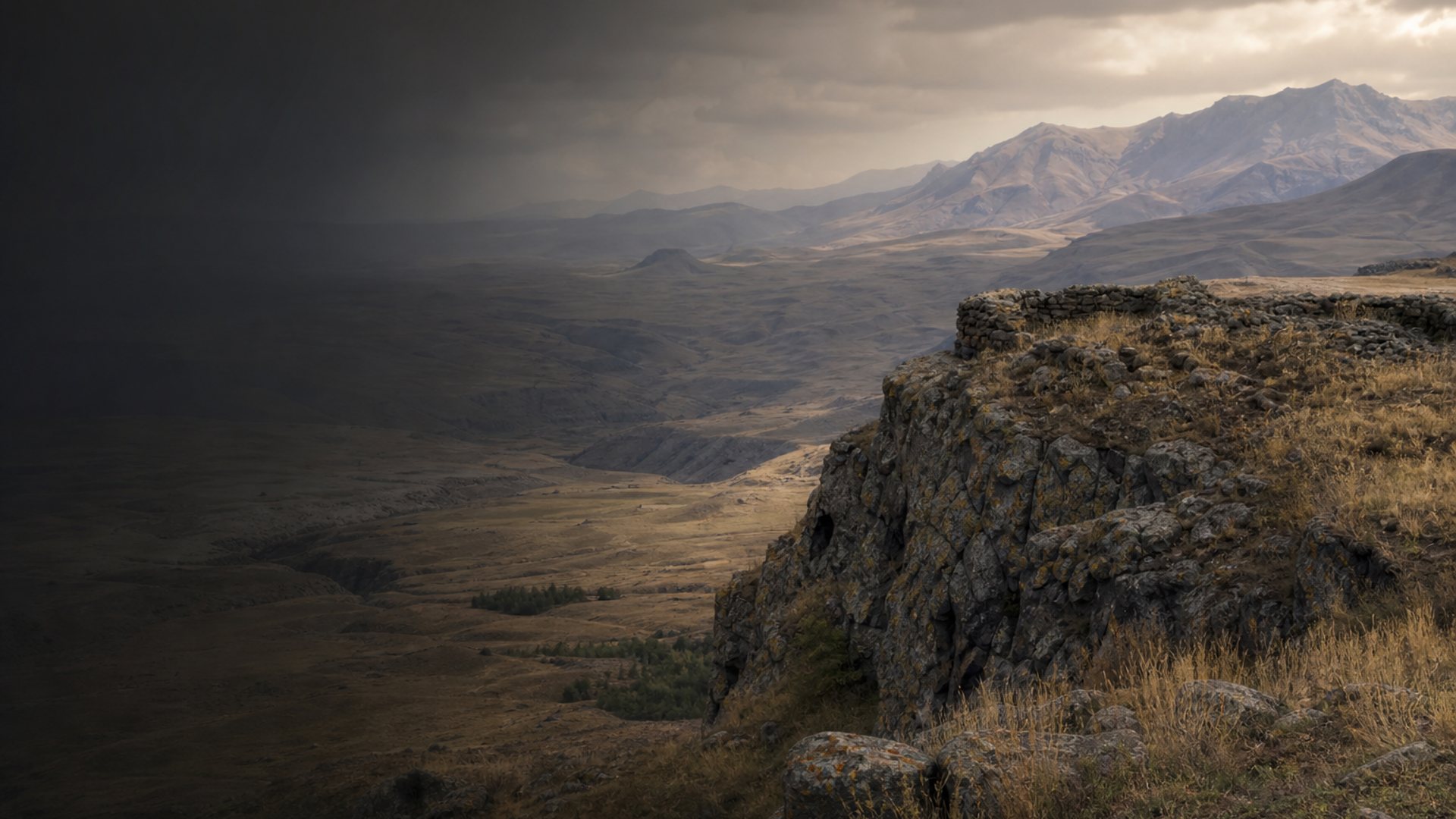
What this small dataset does provide is a foundation for dialogue between material culture and ancestry: it anchors genetic lineages to named places — Kalavan, Talin and Karnut — and to human lives in a rugged landscape of mountains, pastures and trade routes. Future, larger-scale ancient DNA sampling and finer Y-chromosome resolution will clarify how these Early Bronze Age communities contributed to the deep genetic mosaic of the Caucasus and beyond.

  • Small dataset hints at links to later West Eurasian maternal lineages
  • Direct continuity to modern populations remains complex and requires more data
KI-gestützt

KI-Assistent

Stellen Sie Fragen zur Voices of Early Bronze Armenia-Kultur

KI-Assistent von DNAGENICS

Funktion freischalten
Stellen Sie Fragen zur Kultur Voices of Early Bronze Armenia. Unser KI-Assistent kann genetische Befunde, historischen Kontext, archäologische Belege und moderne Verbindungen erläutern.
Beispiel einer KI-Analyse

Die Voices of Early Bronze Armenia-Kultur ist ein faszinierendes Kapitel der Menschheitsgeschichte...

Genetische Analysen zeigen Übereinstimmungen mit früheren Populationen und Hinweise auf besondere Anpassungen und kulturelle Innovationen. Alte DNA-Proben liefern Einblicke in Migrationsmuster, soziale Strukturen und genetische Verbindungen zwischen Populationen.

Dies ist eine Vorschau der KI-Analyse. Schalten Sie den vollständigen KI-Assistenten frei, um detaillierte Einblicke zu erkunden:

  • Genetische Zusammensetzung und genetische Ähnlichkeit
  • Migrationsmuster und Ursprünge
  • Alltag und kulturelle Praktiken
  • Genetischer Bezug zu heutigen Populationen

Weitere antike Kulturen erkunden

Geschichten von Zivilisationen aus der antiken Welt entdecken

Use code for 35% off • Expires Nov 09




