Echoes of Bulgaria's Early Iron Age

Download PDF creates a visual, rasterized copy. Use Print for selectable text and better assistive-technology support.

Bericht wird vorbereitet

Verfügbare Informationen und Referenzen werden geladen

Verbindung mit dem archäologischen Quellenbestand...

Alte Quellen werden zusammengestellt

Zum Hauptinhalt springen
Echoes of Bulgaria's Early Iron Age
Zivilisations-Spotlight

Echoes of Bulgaria's Early Iron Age

Human stories at Rhodope foothills revealed through pottery, graves and ancient DNA.

1100 CE - 500 BCE
Bulgaria (Eastern Rhodopes, Haskovo, Kardzhali)
Scrollen zum Start
Kapitel I

Die Geschichte

Die Echoes of Bulgaria's Early Iron Age-Kultur verstehen

Archaeological and genetic evidence from 16 Early Iron Age individuals (1100–500 BCE) in southern Bulgaria (Kapitan Andreevo, Stambolovo, Diamandovo, Svilengrad) suggest a local population shaped by Balkan farmer ancestry, lingering hunter‑gatherer lineages, and incoming influences—interpreted cautiously due to geographic limits.

Time Period

1100–500 BCE

Region

Bulgaria (Eastern Rhodopes, Haskovo, Kardzhali)

Common Y-DNA

Not reported / limited data in this set

Common mtDNA

H (6), U (3), K (2), H+ (1), J1c (1)

Kapitel II

Zeitleiste

Zentrale Momente in der Geschichte dieser Kultur

1100 BCE

Early Iron Age horizon appears locally

Settlement reorganization and changing burial practices mark the region around Kapitan Andreevo and the eastern Rhodopes.

Kapitel III

Origins & Emergence

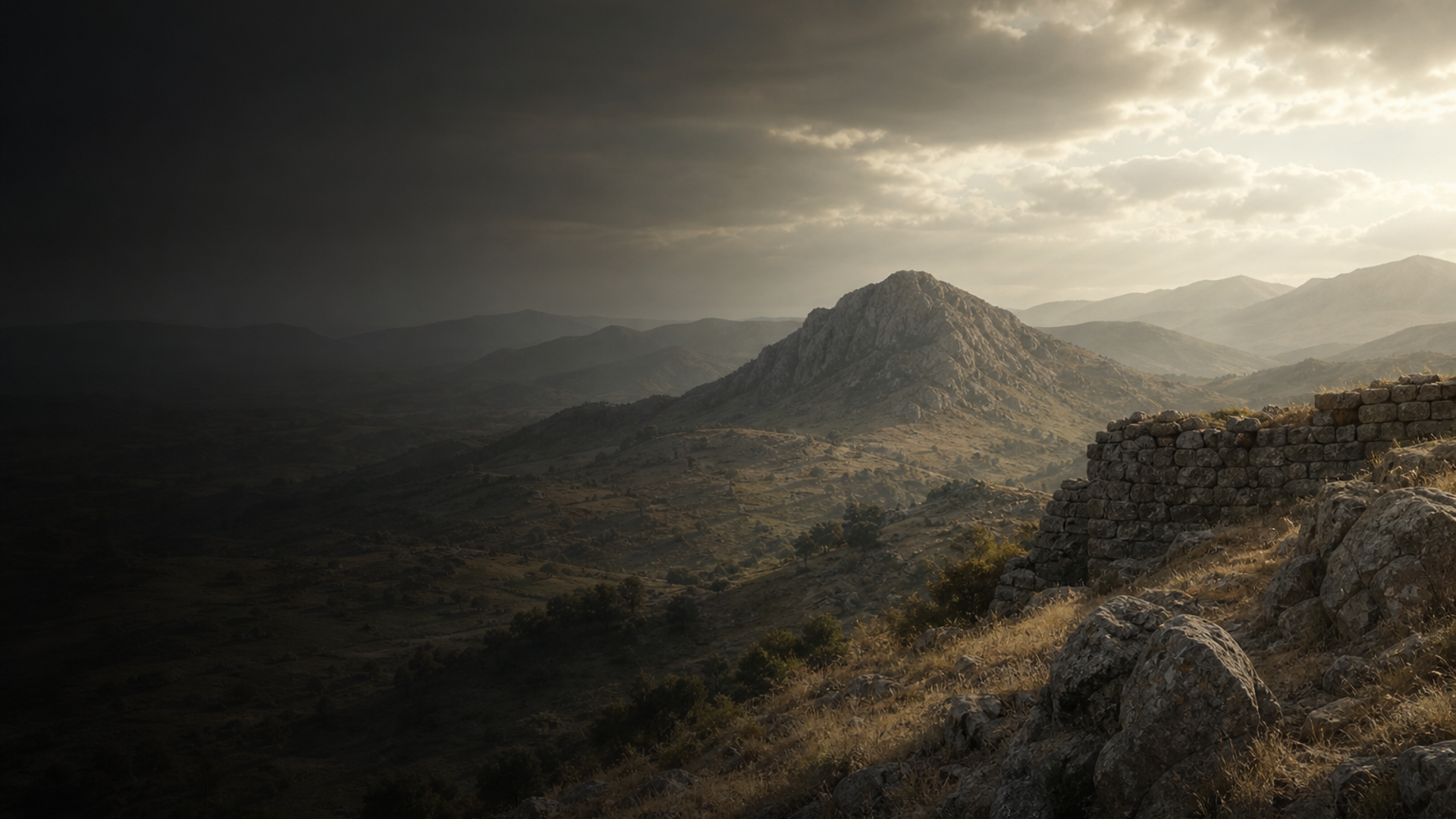
The Early Iron Age horizon in southern Bulgaria unfolds across a landscape of low mountains and river corridors where older Bronze Age communities gave way to new social configurations between roughly 1100 and 500 BCE. Archaeological data indicates settlement reorganization and changing funerary practices at sites such as Kapitan Andreevo (South), Stambolovo (Eastern Rhodopes), Diamandovo (Kardzhali) and Svilengrad (Haskovo). Material culture — pottery styles, metalwork and burial architecture — shows both local continuity with Late Bronze Age traditions and new elements that reflect wider contacts across the Balkans.

Limited evidence suggests interaction with neighboring Thracian groups to the east and with communities along the Aegean and Danubian corridors. This period is cinematic: fortified positions, vibrant artisanry and shifting trade networks that moved metals, crafted goods and ideas. Genetically, Early Iron Age communities in the Balkans are best viewed as palimpsests—layers of Neolithic farmer ancestry, Mesolithic hunter‑gatherer remnants, and mobility from steppe‑derived groups—although the precise balance varies by site and individual. Archaeological context and ancient DNA together provide a multidimensional portrait, but coverage remains regionally focused and interpretive caution is required.

  • Local continuity from Late Bronze Age traditions with new cultural influences
  • Sites: Kapitan Andreevo, Stambolovo, Diamandovo, Svilengrad
  • Evidence for regional interaction across the Balkans and Aegean fringes
Kapitel IV

Daily Life & Society

Daily life in the Early Iron Age Balkans played out in rugged valleys and cultivated terraces. Archaeological remains — house plans, pottery shards, metal tools and burial assemblages — sketch a world of mixed subsistence: cereal agriculture and stock herding supplemented by hunting, foraging and local craft production. Iron and bronze objects appear alongside organic technologies, signaling both continuity and technological change.

Burial contexts from the region suggest social differentiation: richly furnished graves contrast with more modest interments, implying varied access to metal goods and perhaps emergent hierarchies. Craft specialization, visible in fine portable objects and evidence for metalworking debris at some sites, points to workshop activity and exchanges of prestige items over distance. Ceramic styles and ornamentation display local aesthetics even as they incorporate motifs from neighboring cultural spheres.

Archaeological data indicates that mobility—seasonal movement, exogamous marriage networks and long‑distance exchange—was a routine part of life. Material culture conveys a people rooted in place but connected to wider corridors of movement; ancient DNA adds a second layer, revealing biological connections that mirror these archaeological links.

  • Mixed economy: agriculture, herding, hunting and craft production
  • Burial variability suggests social differentiation and long‑distance exchange
Kapitel V

Genetic Profile

Sixteen individuals from southern Bulgaria (1100–500 BCE) provide a preliminary genetic window into Early Iron Age populations of the region. Among these, 13 yielded assignable mitochondrial haplogroups: H (6), U (3), K (2), H+ (1) and J1c (1). The predominance of haplogroup H among maternal lineages is consistent with broad Eurasian European continuity from the Neolithic onward; K and J1c are often associated with Neolithic farmer expansions, while U lineages can reflect older hunter‑gatherer ancestry persisting in the gene pool.

Y‑chromosome data for this dataset are not reported or are limited, so paternal lineage patterns remain unresolved here. Nonetheless, broader ancient DNA studies across the Balkans show that Early Iron Age populations frequently carry mixed ancestries: Anatolian‑Neolithic farmer heritage, Western hunter‑gatherer legacy, and varying proportions of steppe‑related input associated with Bronze Age migrations. Archaeological evidence of cultural change in Kapitan Andreevo, Stambolovo, Diamandovo and Svilengrad is therefore plausibly echoed by a genetic tapestry of continuity plus incoming elements.

Interpretation should be cautious: geographic sampling is focused in southern Bulgaria and the sample size, while larger than many initial studies, remains limited for capturing fine‑scale structure. Further Y‑DNA results and broader regional sampling are needed to clarify male‑line dynamics, migration routes and social practices affecting gene flow such as marriage patterns and mobility.

  • Maternal haplogroups indicate predominance of European lineages (H), with Neolithic (K, J1c) and hunter‑gatherer (U) signals
  • Y‑DNA not well represented in this set; autosomal patterns likely reflect farmer‑hunter‑gatherer‑steppe admixture
Kapitel VI

Legacy & Modern Connections

The human stories recovered from the Rhodopes leave a complex legacy. Genetic threads seen in these Early Iron Age individuals—Neolithic farmer markers, surviving hunter‑gatherer lineages and traces of later mobility—are components in the broader ancestry of modern Southeastern Europe. Archaeological continuity in settlement locations and craft traditions underscores long‑term occupation of the landscape.

However, continuity is partial and layered: centuries of migration, cultural turnover and population movement after 500 BCE mean that direct one‑to‑one links between these ancient individuals and any single modern group are not straightforward. Ancient DNA helps quantify ancestral contributions and demonstrates that many modern Bulgarians carry mixtures of the same deep ancestries identified in the Early Iron Age, but patterns of local continuity vary by region. In short, these remains are both ancestors and actors in a long tapestry of human change—threads that connect past and present without reducing either to a simple story.

  • Components of Early Iron Age ancestry persist in modern Balkan gene pools but in complex mixtures
  • Archaeological and genetic data together reveal long‑term occupation and repeated interactions
KI-gestützt

KI-Assistent

Stellen Sie Fragen zur Echoes of Bulgaria's Early Iron Age-Kultur

KI-Assistent von DNAGENICS

Funktion freischalten
Stellen Sie Fragen zur Kultur Echoes of Bulgaria's Early Iron Age. Unser KI-Assistent kann genetische Befunde, historischen Kontext, archäologische Belege und moderne Verbindungen erläutern.
Beispiel einer KI-Analyse

Die Echoes of Bulgaria's Early Iron Age-Kultur ist ein faszinierendes Kapitel der Menschheitsgeschichte...

Genetische Analysen zeigen Übereinstimmungen mit früheren Populationen und Hinweise auf besondere Anpassungen und kulturelle Innovationen. Alte DNA-Proben liefern Einblicke in Migrationsmuster, soziale Strukturen und genetische Verbindungen zwischen Populationen.

Dies ist eine Vorschau der KI-Analyse. Schalten Sie den vollständigen KI-Assistenten frei, um detaillierte Einblicke zu erkunden:

  • Genetische Zusammensetzung und genetische Ähnlichkeit
  • Migrationsmuster und Ursprünge
  • Alltag und kulturelle Praktiken
  • Genetischer Bezug zu heutigen Populationen

Weitere antike Kulturen erkunden

Geschichten von Zivilisationen aus der antiken Welt entdecken

Use code for 35% off • Expires Nov 09




