Echoes of Byzantine Anatolia

Download PDF creates a visual, rasterized copy. Use Print for selectable text and better assistive-technology support.

Bericht wird vorbereitet

Verfügbare Informationen und Referenzen werden geladen

Verbindung mit dem archäologischen Quellenbestand...

Alte Quellen werden zusammengestellt

Zum Hauptinhalt springen
Echoes of Byzantine Anatolia
Zivilisations-Spotlight

Echoes of Byzantine Anatolia

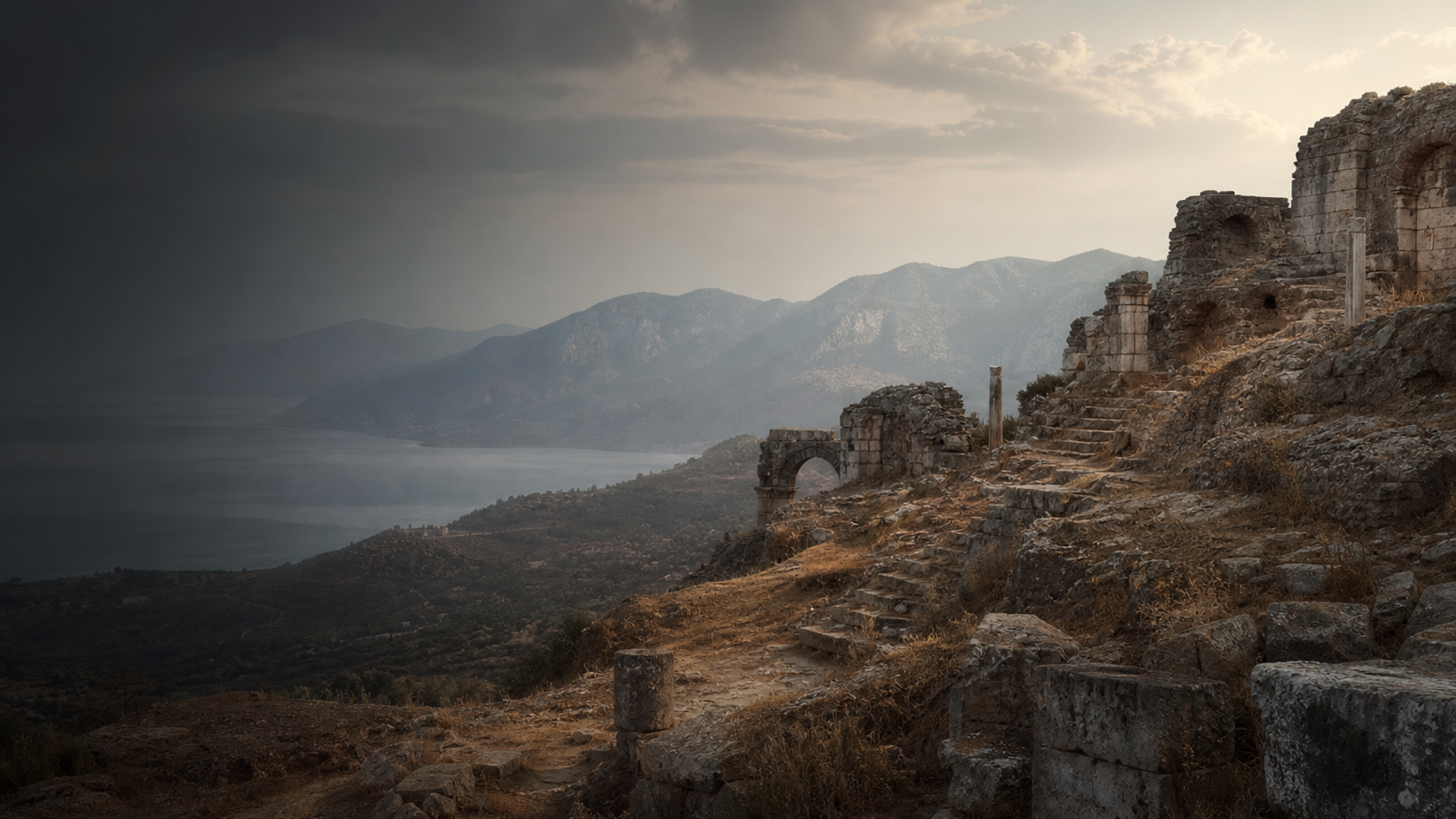
Human stories unearthed from churches, basilicas and cemeteries across Aegean and Marmara Turkey

262 CE - 1400 CE
Turkey (Aegean & Marmara regions)
Scrollen zum Start
Kapitel I

Die Geschichte

Die Echoes of Byzantine Anatolia-Kultur verstehen

Archaeological contexts from Stratonikeia, Lagina, Iznik and Ilıpınar (262–1400 CE) reveal a multi-layered Byzantine Anatolia. DNA from 14 individuals offers preliminary mitochondrial signals (H, U, X, J) that echo local continuity and regional connectivity across Late Antiquity and the medieval period.

Time Period

262–1400 CE (Byzantine era)

Region

Turkey (Aegean & Marmara regions)

Common Y-DNA

Undetermined / insufficient Y-DNA data

Common mtDNA

H (3), U (3), X (2), J (1), H5f (1)

Kapitel II

Zeitleiste

Zentrale Momente in der Geschichte dieser Kultur

330 CE

Constantine refounds Constantinople

Emperor Constantine elevates Byzantium to imperial capital (Constantinople), reshaping trade and ecclesiastical networks that affected Anatolia for centuries.

Kapitel III

Origins & Emergence

The individuals sampled from Stratonikeia and Lagina (Muğla), the west church at Stratonikeia, the Basilica at Iznik (Marmara) and the Ilıpınar cemetery (Orhangazi, Bursa) span a long arc of local history: 262 CE through to 1400 CE. Archaeological contexts — church floors, basilica burial zones and associated funerary deposits — anchor these remains within Byzantine religious and civic landscapes. Stratonikeia and Lagina, located in the Carian-Aegean hinterland, preserve Late Antique to medieval occupation layers; Iznik (ancient Nicaea) is a documented urban and ecclesiastical center from Late Antiquity onward; Ilıpınar sits in the Marmara plains that saw population shifts in the early medieval centuries.

Archaeological data indicates continuity of Christian funerary practice in many contexts, with reuse of older monumental spaces in the medieval period. Limited evidence suggests both local continuity and periodic influxes of people tied to trade, military movement, and administrative reorganization under successive Byzantine authorities. The material record — building phases, grave goods, and stratigraphy — points to a region where local Anatolian traditions blended with Mediterranean and Balkan influences.

Given the modest sample size (14 individuals) and uneven preservation, conclusions about broader population origins must remain provisional. Still, these remains illuminate how communities were embedded in the shifting political, economic and religious networks of Byzantine Anatolia.

  • Samples derive from Stratonikeia, Lagina, Iznik and Ilıpınar
  • Contexts: churches, basilica burials, cemetery deposits
  • Evidence suggests local continuity with regional connections
Kapitel IV

Daily Life & Society

Stone, mortar and bone reconstruct everyday rhythms: basilicas and parish churches were not only liturgical centers but also community anchors where births, baptisms, deaths and memory converged. At Stratonikeia and Lagina, urban quarters and sanctuary precincts give evidence for craft production, market activity, and pilgrimage economies that linked Aegean ports with interior Anatolia. In Iznik, archaeological strata reveal repair and reuse of civic architecture, pointing to episodes of prosperity and strain as trade routes and imperial priorities shifted.

Burial practice — orientation, grave construction, and occasional grave goods — reflects Christian funerary norms tempered by local tradition. Osteological markers show workloads consistent with mixed agricultural, artisanal and transport economies; stable isotope data (where available) can help distinguish local diet patterns from those of newcomers. Archaeological layers suggest periodic demographic change: episodes of population influx associated with military logistics or refugee movements, and quieter phases of rural continuity.

Architectural traces, inscriptions and everyday finds form a cinematic mosaic of life in Byzantine Anatolia: bustling market days, liturgical processions through basilica aisles, and the regular cadence of rural labor. Yet the archaeological record is patchy; local nuances vary by site and period, and many social practices leave ephemeral traces.

  • Churches and basilicas acted as civic and sacred hubs
  • Material culture shows trade, craft, and agricultural livelihoods
Kapitel V

Genetic Profile

Fourteen individuals were sampled across Aegean and Marmara sites dated between 262 and 1400 CE. Mitochondrial DNA (mtDNA) haplogroups are reported for a subset: H (3), U (3), X (2), J (1), and H5f (1). These lineages are broadly common in Europe and western Eurasia and can reflect long-term regional continuity in Anatolia as well as gene-flow from Mediterranean and Balkan networks. Importantly, the mtDNA counts represent at most a subset of the 14 individuals (10 reported mtDNA calls), so population-level inferences must be cautious.

No consistent Y-DNA signature is reported in the provided dataset; either Y-chromosome data were not recovered at scale or results are too heterogeneous to summarize. This absence means we cannot characterize paternal line continuity or incoming male-mediated gene flow from specific regions.

Genetic signals seen here are compatible with an Anatolian population that retained local maternal lineages while participating in wider Mediterranean and Balkan genetic networks during the Byzantine period. However, with only 14 samples and limited Y-DNA resolution, any claims about migrations, replacement, or fine-scale ancestry structure remain preliminary. Additional sampling, deeper genomic coverage, and integration with isotopic and archaeological evidence are essential to resolve whether observed haplogroups reflect local continuity, elite mobility, or episodic immigration.

  • mtDNA observed: H (3), U (3), X (2), J (1), H5f (1) — observed in subset
  • Y-DNA not reported / insufficient to characterize paternal ancestry
Kapitel VI

Legacy & Modern Connections

The genetic and archaeological portrait of Byzantine Anatolia is one of layered continuity and connectivity. Mitochondrial lineages such as H and U are common in modern populations across Anatolia, the Balkans and the Mediterranean; their presence in Byzantine contexts supports a thread of maternal continuity from Late Antiquity into the medieval era. Archaeologically, sites like Iznik and Stratonikeia remain visible palimpsests — ancient stones reused, inscriptions layered over earlier dedications — reminding us that modern Turkey sits on a deeply entangled human past.

Because the dataset is modest, connections to present-day populations must be framed cautiously: shared haplogroups indicate genetic ties at broad geographic scales but do not equate to direct, exclusive descent. Future broader sampling and whole-genome studies will refine how these Byzantine communities contributed to the genetic tapestry of modern Anatolia.

  • mtDNA continuity hints at maternal links to modern Anatolian populations
  • Small sample size means conclusions about broad modern connections are preliminary
KI-gestützt

KI-Assistent

Stellen Sie Fragen zur Echoes of Byzantine Anatolia-Kultur

KI-Assistent von DNAGENICS

Funktion freischalten
Stellen Sie Fragen zur Kultur Echoes of Byzantine Anatolia. Unser KI-Assistent kann genetische Befunde, historischen Kontext, archäologische Belege und moderne Verbindungen erläutern.
Beispiel einer KI-Analyse

Die Echoes of Byzantine Anatolia-Kultur ist ein faszinierendes Kapitel der Menschheitsgeschichte...

Genetische Analysen zeigen Übereinstimmungen mit früheren Populationen und Hinweise auf besondere Anpassungen und kulturelle Innovationen. Alte DNA-Proben liefern Einblicke in Migrationsmuster, soziale Strukturen und genetische Verbindungen zwischen Populationen.

Dies ist eine Vorschau der KI-Analyse. Schalten Sie den vollständigen KI-Assistenten frei, um detaillierte Einblicke zu erkunden:

  • Genetische Zusammensetzung und genetische Ähnlichkeit
  • Migrationsmuster und Ursprünge
  • Alltag und kulturelle Praktiken
  • Genetischer Bezug zu heutigen Populationen

Weitere antike Kulturen erkunden

Geschichten von Zivilisationen aus der antiken Welt entdecken

Use code for 30% off • Expires Nov 08




