Norwich: Medieval Jewish Lives Unearthed

Download PDF creates a visual, rasterized copy. Use Print for selectable text and better assistive-technology support.

Zum Hauptinhalt springen
Zivilisations-Spotlight

Norwich: Medieval Jewish Lives Unearthed

Six individuals from a Chapelfield well reveal a complex medieval community, seen through bones and DNA.

1045 CE - 1261 CE
Norwich, England (Chapelfield well shaft)

Die Geschichte

Archaeological and genetic evidence from six individuals (1045–1261 CE) recovered from a well shaft at Chapelfield, Norwich, offers a preliminary, evocative glimpse of an English medieval Jewish community. Limited sample size means conclusions remain tentative.

Time Period

1045–1261 CE

Region

Norwich, England (Chapelfield well shaft)

Common Y-DNA

J, E, T (each represented)

Common mtDNA

H (incl. H3w), J, U

Zeitleiste

1045 CE

Earliest dated individual

The oldest radiocarbon/stratigraphic date in the Norwich well assemblage falls around 1045 CE; interpretation is provisional.

1144 CE

William of Norwich reported

Documentary account (1144) of William of Norwich later fueled accusations against Jews; archaeological link to the well assemblage is uncertain.

1190 CE

Widespread anti-Jewish violence

Anti-Jewish attacks affected several English towns around 1190 CE, altering community stability; local impact in Norwich is attested in records.

1290 CE

Edict of Expulsion

The 1290 royal edict expelled Jews from England, ending official Jewish residence until readmission centuries later.

Origins & Emergence

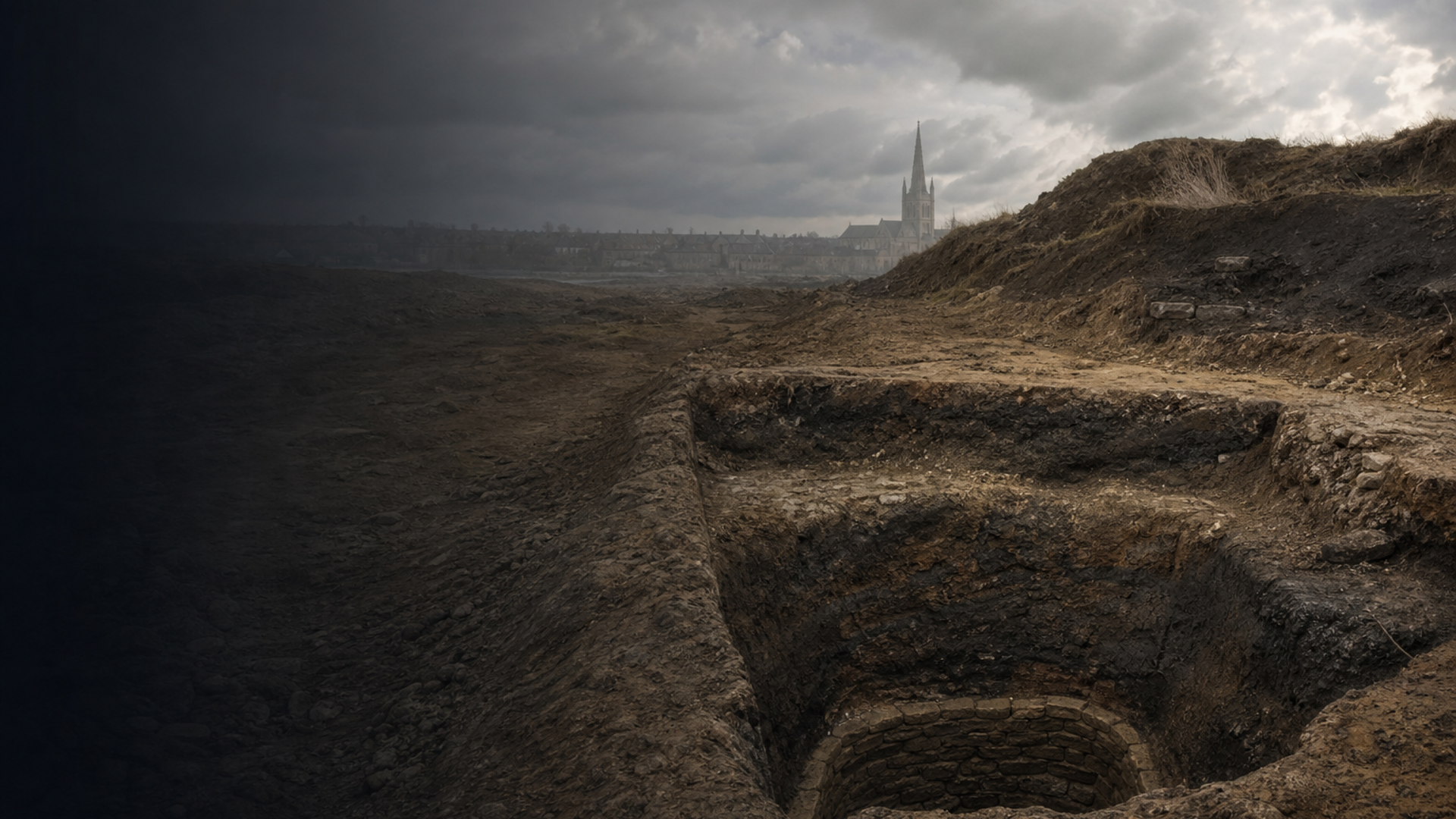
The Norwich assemblage—six individuals recovered from a well shaft beneath what is now Chapelfield Shopping Centre—dates between 1045 and 1261 CE. Archaeological data indicates these remains were deposited in a dense urban environment, where documentary records also attest to a medieval Jewish presence in Norwich from the 12th century onward. A small number of dated burials and stratigraphic relationships suggest intermittent use of the well as a secondary deposit during the High Middle Ages.

Limited evidence suggests that some individuals may predate the most intensive documented phase of Jewish settlement in England (post-1066), while others fall squarely within the period when Jewish communities were more visible within English towns. Material remains from Norwich and comparable towns (coins, charters, and stray artefacts) provide context for mercantile and domestic life, though this particular assemblage lacks distinct ritual markers that would alone identify religious practice.

Genetic markers from the male line (Y-DNA haplogroups J, E, and T) are commonly associated with populations from the Near East and Mediterranean; their presence here is consistent with historical models of Jewish migration and mobility into Anglo-Norman England. At the same time, mitochondrial lineages dominated by H and including U indicate maternal ancestry often found in local European populations. Because the sample count is small (n = 6), these patterns are suggestive rather than definitive, and should be treated as hypotheses to test with larger datasets.

  • Six individuals from a Norwich well shaft, dated 1045–1261 CE
  • Urban deposition; documentary references to Jewish presence in 12th–13th c. Norwich
  • Y-DNA hints at Near Eastern ties; mtDNA shows European maternal signals

Daily Life & Society

Archaeological landscapes of medieval Norwich describe a bustling port and market town where merchants, artisans, and clerics intersected. Documentary sources for medieval English Jewish communities record roles in moneylending, trade, and household services—occupations that left uneven material signatures in the urban record. The well shaft context suggests accidental or secondary deposition rather than formal burial practice; wells and pits in medieval towns were often used as refuse, emergency burial, or deliberate concealment during crisis.

Cinematic images emerge from the fragments: narrow lanes, stone houses, market stalls, and the constant movement of goods and people. Archaeobotanical and artefactual evidence from Norwich more broadly indicates diet based on cereals, legumes, fish, and imported luxury goods for those connected to trade networks. Yet caution is essential: the well assemblage itself offers limited direct evidence of belief, ritual, or specific occupations. Bone preservation can hint at health stresses and diet, but disentangling cultural identity from urban taphonomy requires integrating documentary records, larger cemetery samples, and further DNA sampling.

Given the small sample size, any narrative of daily life drawn from these six individuals must remain provisional. Archaeology provides texture—the urban noise and material detail—while genetics offers lines of ancestry; together they create a layered portrait that invites, but does not yet confirm, specific life histories.

  • Urban Norwich setting with market and trade networks
  • Well shaft likely represents secondary deposition; ritual interpretation is limited

Genetic Profile

The genetic data from the Norwich well comprises six sampled individuals. Y-chromosome haplogroups observed include J (1), E (1), and T (1); mitochondrial haplogroups include H (3, one specified as H3w), J (1), and U (1). These patterns are consistent with a mixed signal: paternal lines that are more frequent in the Near East/Mediterranean, and maternal lines common in western Europe.

Haplogroup J on the Y-chromosome is frequently observed in populations with Levantine ancestry and appears at elevated frequencies in many Jewish communities historically. Haplogroups E and T also have broad Mediterranean distributions and can be found among Jewish and non-Jewish populations across Europe, North Africa, and the Near East. On the maternal side, haplogroup H is common in Europe; the presence of H3w, a rarer subclade, and U suggests maternal inputs that could reflect local European women or long-standing regional admixture.

Crucially, genetic markers do not map one-to-one onto religious or cultural identity. The sample count is low (n = 6), so population-level inferences are preliminary. Archaeogenetic interpretations must therefore remain cautious: these data are compatible with a medieval Jewish community with connections to broader Mediterranean and European gene pools, but larger comparative datasets—both ancient and modern—are required to resolve patterns of continuity, admixture, and migration more robustly. Limited evidence suggests mobility and integration rather than isolation.

  • Y-DNA J, E, T suggest Mediterranean/Levantine paternal ancestry
  • mtDNA H, J, U indicates substantial European maternal contribution; sample size is small

Legacy & Modern Connections

These Norwich individuals lived during a turbulent century for England’s Jewish communities, preceding the 1290 expulsion. Their genetic signatures offer a fragile but evocative bridge between documentary history and lived experience. For modern populations, the data hint at ancestral threads connecting medieval English Jews to broader Mediterranean and European gene pools, reflecting centuries of mobility, trade, and local integration.

Because only six genomes are available, any claims about continuity to modern Jewish or local populations must be tentative. Yet anthropological and genetic synthesis shows how even small assemblages can illuminate patterns: male-line markers point toward diasporic connections, while maternal lineages underscore local admixture. Future sampling across English towns and comparison with larger ancient and modern reference panels could reveal whether Norwich was typical or exceptional. For museum audiences, these remains humanize a community that archaeological and historical forces later dispersed—an intimate, provisional view of identity at the crossroads of faith, commerce, and place.

  • Pre-expulsion window into English Jewish diversity and mobility
  • Potential links to broader Mediterranean and European ancestral pools; conclusions tentative

KI-Assistent

KI-Assistent von DNAGENICS

Funktion freischalten
Stellen Sie Fragen zur Kultur Norwich: Medieval Jewish Lives Unearthed. Unser KI-Assistent kann genetische Befunde, historischen Kontext, archäologische Belege und moderne Verbindungen erläutern.
Beispiel einer KI-Analyse

Die Norwich: Medieval Jewish Lives Unearthed-Kultur ist ein faszinierendes Kapitel der Menschheitsgeschichte...

Genetische Analysen zeigen Übereinstimmungen mit früheren Populationen und Hinweise auf besondere Anpassungen und kulturelle Innovationen. Alte DNA-Proben liefern Einblicke in Migrationsmuster, soziale Strukturen und genetische Verbindungen zwischen Populationen.

Dies ist eine Vorschau der KI-Analyse. Schalten Sie den vollständigen KI-Assistenten frei, um detaillierte Einblicke zu erkunden:

  • Genetische Zusammensetzung und genetische Ähnlichkeit
  • Migrationsmuster und Ursprünge
  • Alltag und kulturelle Praktiken
  • Genetischer Bezug zu heutigen Populationen
Use code for 25% off • Expires Nov 14




