Srubnaya of the Samara Steppes

Download PDF creates a visual, rasterized copy. Use Print for selectable text and better assistive-technology support.

Zum Hauptinhalt springen
Zivilisations-Spotlight

Srubnaya of the Samara Steppes

Bronze Age timber-grave communities along the Volga, seen through archaeology and DNA

2050 CE - 1200 BCE
Samara Oblast, Volga River Valley (Russia)

Die Geschichte

The Russia_Srubnaya dataset (15 samples, 2050–1200 BCE) links timber-grave Srubnaya sites in Samara Oblast to steppe lifeways and mixed maternal ancestries; genetic signals—primarily Y haplogroup R and diverse mtDNA—illuminate population dynamics with appropriate caution.

Time Period

2050–1200 BCE

Region

Samara Oblast, Volga River Valley (Russia)

Common Y-DNA

R (7 of 15 samples)

Common mtDNA

U (5), H3g (2), T (2), I (1), J (1)

Zeitleiste

2500 BCE

Timber-grave funerary traditions solidify

Timber-frame burial architecture becomes widespread in the middle Volga, laying material foundations later associated with Srubnaya cultural practices.

Origins & Emergence

Across the windswept Samara Steppes, timber-framed graves and hearth-centered settlements speak of a people adapting Bronze Age technologies to a riverine landscape. Archaeological data from Rozhdestveno I, Novosel'ki, Barinovka I, Spiridonovka II and IV, and Uvarovka I (all in Samara Oblast along the Volga and Samara rivers) show the characteristic Srubnaya ‘‘timber-frame’’ burial architecture dated in this dataset between 2050 and 1200 BCE. Material culture—bronze tools, socketed axes, and pottery with both local and steppe stylistic traits—suggests continuity with earlier steppe groups while also reflecting local innovation.

Genetically, the 15 samples analysed provide a window into population dynamics on the middle Volga. Limited but consistent signals link these communities to broader steppe ancestries while maternal haplogroups indicate a degree of diversity that may reflect admixture with neighboring farming and forest-steppe groups. Archaeological context indicates mobility and regional exchange along river corridors; DNA adds weight to the idea of demographic movement but does not by itself resolve social mechanisms. Uncertainty remains: 15 individuals form a modest dataset, and archaeological complexity cautions against sweeping generalizations. Nevertheless, the combined lines of evidence evoke Srubnaya as a dynamic Bronze Age horizon shaped by rivers, herds, and long-distance connections.

  • Sites: Rozhdestveno I, Novosel'ki, Barinovka I, Spiridonovka II & IV, Uvarovka I
  • Dates: 2050–1200 BCE; characteristic timber-frame burials
  • Material links to broader steppe traditions and local innovation

Daily Life & Society

The Srubnaya horizon on the Samara plain unfolded in a landscape of riverine meadows, seasonal pastures, and riparian woodlands. Archaeological remains—animal bone assemblages dominated by cattle and sheep/goat, bronze implements, domestic pottery and grain impressions—suggest mixed pastoralism with opportunistic agriculture. Timber-framed graves (the eponymous "srub" or beam constructions) often include grave goods: weapons, simple ornaments, and occasional livestock offerings, hinting at social status differences and the importance of pastoral wealth.

Settlement traces are often ephemeral, reflecting mobile or semi-sedentary lifeways. The Volga and Samara rivers were natural highways: people, animals, and ideas moved along these corridors. Craft production included bronze-working and bone carving; raw materials such as copper may have traveled long distances. Burial variability—single inhumations, collective features, and differing grave goods—suggests heterogenous social organization rather than uniform hierarchy. Limited evidence suggests both patrilineal and wider kin-based networks, but demographic inferences remain tentative.

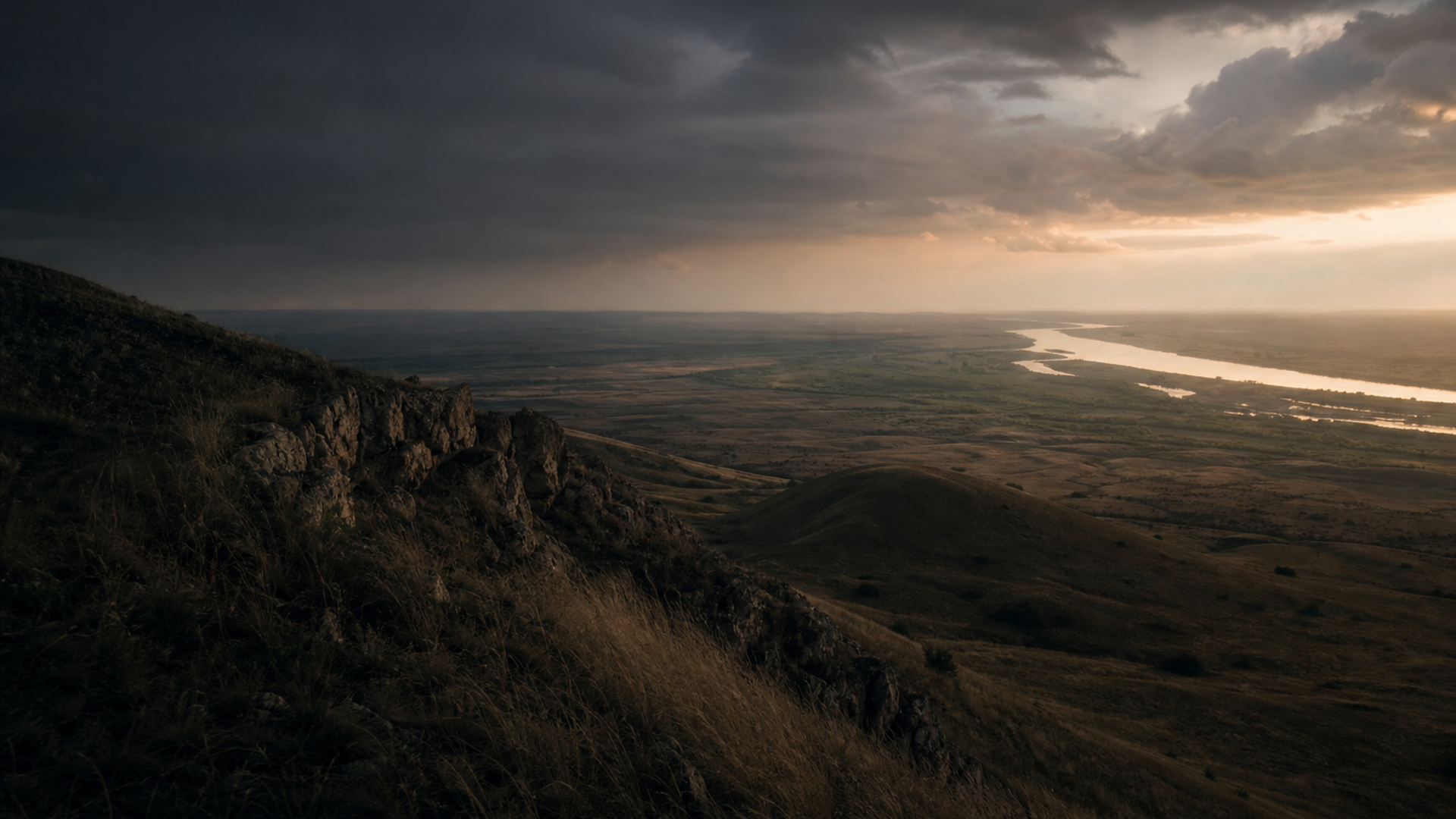
Cinematic image: dawn mist over the Volga, herders leading flocks past timber graves—an economy balanced between mobility and rooted landscape knowledge.

  • Economy: mixed pastoralism (cattle, sheep/goats) with some agriculture
  • Burials: timber-frame graves with variable grave goods, indicating social differentiation

Genetic Profile

This Russia_Srubnaya dataset comprises 15 ancient individuals from multiple sites in the Samara River valley. Y-chromosome lineages are dominated by haplogroup R (7 of 15), a marker commonly associated with steppe male-mediated ancestry in Bronze Age Eurasia. Mitochondrial diversity is notable: five individuals carry haplogroup U (a suite often linked to long-standing European hunter-gatherer and steppe maternal lineages), two carry H3g, two carry T, and singletons include I and J. These maternal lineages point to a mixture of deep European hunter-gatherer-derived and Neolithic farmer-associated maternal ancestries.

Combined, the uniparental data are consistent with a population shaped by steppe male-associated ancestry and diverse maternal sources—plausibly the product of local admixture between incoming steppe groups and neighboring forest-steppe or farming communities. Genome-wide analyses (where available) often amplify this picture: Srubnaya-related individuals can show high proportions of steppe pastoralist ancestry but with varying farmer/forager contributions. Important caveats: with only 15 samples, patterns may not capture the full regional diversity; the presence of R lineages does not specify R1a vs R1b without deeper resolution; and mtDNA haplogroups alone cannot reconstruct complex admixture events.

In short: genetic data corroborate archaeological signals of steppe-connected communities with multi-source maternal ancestry—an image of mobility punctuated by local blending.

  • Y-DNA: predominance of haplogroup R (7/15) suggesting steppe-associated male ancestry
  • mtDNA: diverse maternal haplogroups (U, H3g, T, I, J) indicating admixture with local groups

Legacy & Modern Connections

Srubnaya communities on the middle Volga contributed threads to the tapestry of Bronze Age Eurasia. Archaeologically they mark a continuation and regional transformation of timber-grave traditions; genetically they help trace the persistence and spread of steppe-associated ancestries across later periods. Modern populations in parts of Eastern Europe and western Russia carry echoes of these Bronze Age ancestries, but continuity is complex: millennia of migrations, assimilation, and cultural change blur direct lines.

Caution is essential. With 15 samples, the genetic portrait is informative but not definitive; regional sampling gaps and later demographic events mean that linking Srubnaya people directly to specific modern groups requires nuanced, genome-wide comparisons. Nevertheless, the combined archaeological and genetic evidence paints a vivid scene: river routes stitching communities together, male-mediated steppe signals converging with diverse maternal inputs, and a living legacy embedded in the genetic and cultural geography of the Eurasian steppe.
  • Srubnaya contributed to Bronze Age steppe population dynamics and cultural networks
  • Modern genetic links exist but are indirect and mediated by later population movements

KI-Assistent

KI-Assistent von DNAGENICS

Funktion freischalten
Stellen Sie Fragen zur Kultur Srubnaya of the Samara Steppes. Unser KI-Assistent kann genetische Befunde, historischen Kontext, archäologische Belege und moderne Verbindungen erläutern.

Beispiel einer KI-Analyse

Die Srubnaya of the Samara Steppes-Kultur ist ein faszinierendes Kapitel der Menschheitsgeschichte...

Genetische Analysen zeigen Übereinstimmungen mit früheren Populationen und Hinweise auf besondere Anpassungen und kulturelle Innovationen. Alte DNA-Proben liefern Einblicke in Migrationsmuster, soziale Strukturen und genetische Verbindungen zwischen Populationen.

Dies ist eine Vorschau der KI-Analyse. Schalten Sie den vollständigen KI-Assistenten frei, um detaillierte Einblicke zu erkunden:

  • Genetische Zusammensetzung und genetische Ähnlichkeit
  • Migrationsmuster und Ursprünge
  • Alltag und kulturelle Praktiken
  • Genetischer Bezug zu heutigen Populationen
Use code for 30% off • Expires Nov 15




