Valencian Bronze Age Echoes

Download PDF creates a visual, rasterized copy. Use Print for selectable text and better assistive-technology support.

Zum Hauptinhalt springen
Zivilisations-Spotlight

Valencian Bronze Age Echoes

Six ancient genomes from Alicante illuminate a coastal Bronze Age world — cautiously.

3300 CE - 1504 BCE
Southeast Iberia (Alicante, Spain)

Die Geschichte

Ancient DNA from six Bronze Age individuals (3300–1504 BCE) from Alicante, Spain, links material culture of southeast Iberia to diverse maternal lineages and a single R Y-line. Limited sample size makes conclusions preliminary; archaeological context points to dynamic Bronze Age mobility.

Time Period

3300–1504 BCE

Region

Southeast Iberia (Alicante, Spain)

Common Y-DNA

R (1 of 6)

Common mtDNA

U (2), K (1), H3 (1), I (1), V (1)

Zeitleiste

2200 BCE

Bronze Age Intensification in Southeast Iberia

Regional archaeological evidence points to increased metallurgy, fortified settlements, and wider exchange networks around 2200 BCE, setting the stage for cultural developments sampled by these genomes.

Origins & Emergence

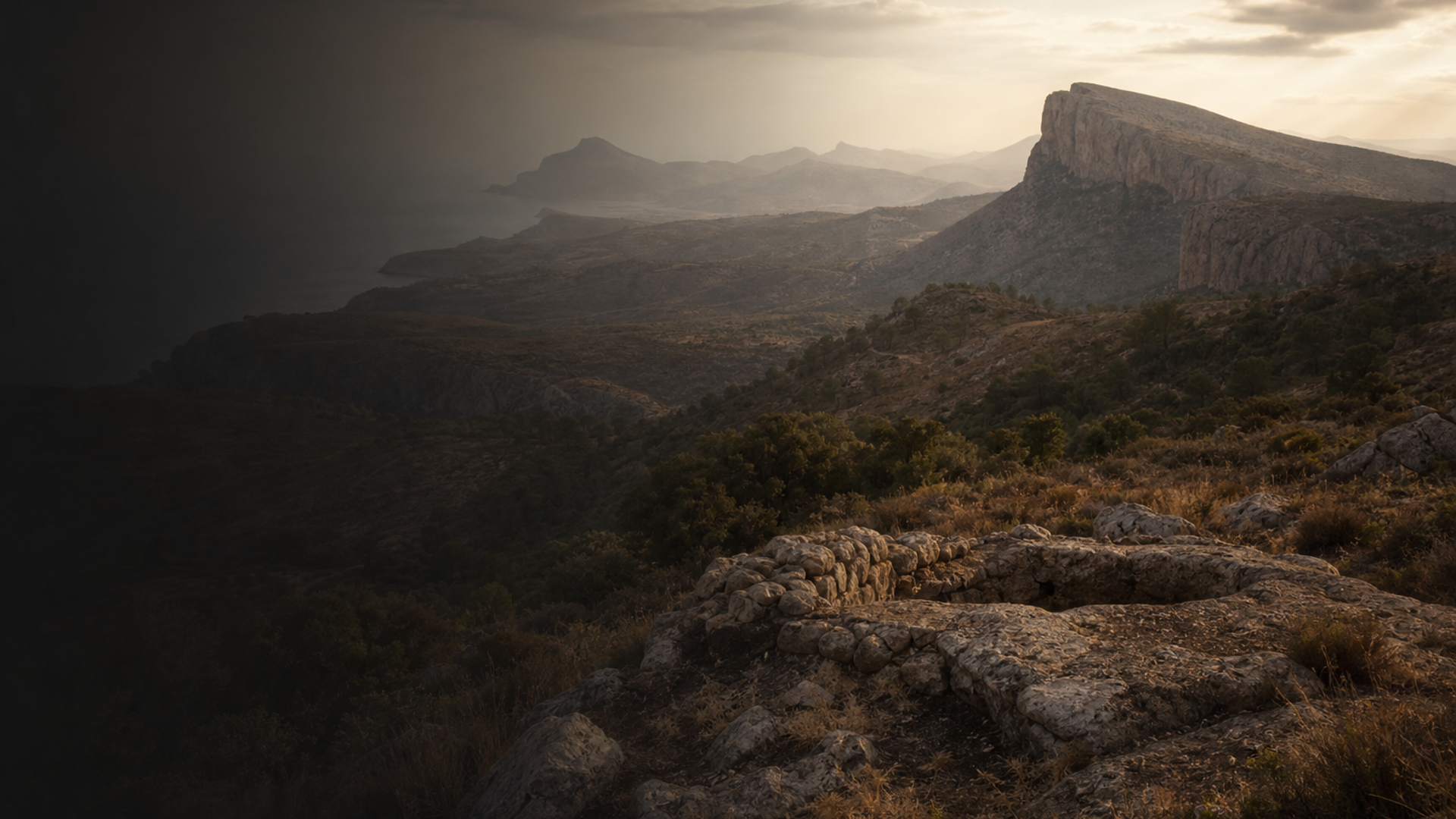
The human story recorded in the bones from Alicante unfolds across a long Bronze Age coastline. Archaeological data indicates these six individuals span a temporal arc from the late Chalcolithic into the later Bronze Age (c. 3300–1504 BCE). Samples derive from excavated contexts at La Horna (Aspe) and two Villena locales — Peñón de la Zorra and Puntal de los Carniceros — places where limestone ridges and cultivated valleys meet.

Cinematic vistas of salt wind and terraced fields obscure a more complex formation process: southeast Iberia in this era was a mosaic of local Neolithic descendants, troughs of innovation in metallurgy, and incoming networks of exchange. Limited evidence suggests that population interactions — maritime and overland — intensified during the Middle–Late Bronze Age, shaping a cultural horizon often grouped under the Bronze Age Southeast Iberia tradition. Because this dataset contains only six genomes, interpretations of broader demographic origins remain provisional.

Material culture at nearby sites shows technological shifts in metalwork and settlement patterns; genetic data from these individuals offers a new, grainy lens on who participated in those changes.

  • Samples dated c. 3300–1504 BCE from Alicante province
  • Sites: La Horna (Aspe), Peñón de la Zorra, Puntal de los Carniceros (Villena)
  • Small sample size means regional origins remain tentative

Daily Life & Society

Archaeological contexts in southeast Iberia reveal communities balancing farming, herding, and burgeoning metallurgical craft. Settlement traces around Villena and Aspe suggest defended hilltop occupations and lowland fields — landscapes shaped by seasonal work and long-distance exchange routes. Pottery styles, bronze artifacts, and structured deposits indicate households engaged with wider Bronze Age networks along the Mediterranean coast.

Grain storage, animal husbandry, and small-scale craft workshops would have structured daily rhythms. Social differentiation is visible in burial offerings and settlement architecture in the broader region; however, linking specific social roles to these six individuals is not possible without more contextual data. Osteological indicators in regional assemblages hint at varied workloads and diet, consistent with mixed farming economies and access to marine and terrestrial resources.

In short, the human scene was one of practical ingenuity — fields, forges, and coastal trade punctuated by seasonal ritual and communal memory — but direct ties between these behaviors and the sequenced individuals remain cautious and inferential.

  • Economy: mixed farming, herding, and local metallurgy
  • Settlements include hilltops and lowland farming zones

Genetic Profile

The genetic snapshot from these six Valencian Bronze Age individuals is compact but suggestive. Maternal lineages show diversity: two individuals carry haplogroup U, and one each carry K, H3, I, and V. These mtDNA types are broadly distributed across prehistoric Europe and the western Mediterranean; some (notably U and H subclades) reflect deep European maternal ancestry that persisted through the Neolithic and into the Bronze Age. The single detected Y-chromosome signal is assigned to haplogroup R (one individual).

A lone R Y-haplogroup is compatible with the presence of Steppe-related male-derived ancestry documented elsewhere in Bronze Age Iberia, but with only one male Y call among six samples, any inference about widespread male-mediated migration into this micro-region would be premature. Likewise, the mtDNA variety points to maternal heterogeneity — possibly local continuity combined with incoming lineages — but mitochondrial markers alone cannot resolve the scale or direction of mobility.

Genome-wide analyses (if available for these samples) would be required to test admixture proportions and affinities to contemporaneous groups such as El Argar or coastal Bronze Age communities. Given the sample count (n=6), conclusions must remain framed as preliminary and hypothesis-generating.

  • mtDNA: U (2), K, H3, I, V — indicates maternal diversity
  • Y-DNA: single R haplogroup — suggests possible Steppe-related input but is tentative

Legacy & Modern Connections

Fragments of genetic continuity from Bronze Age southeast Iberia echo into the present, but the story is subtle. Several mitochondrial lineages observed among these six individuals (for example H-subclades and U types) remain common in modern Iberian populations, hinting at partial maternal continuity across millennia. The isolated R Y-line suggests connections to wider Bronze Age patterns of ancestry movement across Europe, yet with so few male lines recovered here, any claim about lasting paternal replacement would be speculative.

Archaeogenetic studies increasingly show that regional cultural change does not always equal wholesale population turnover. In Alicante and broader southeast Iberia, the archaeological record of metallurgical innovation and social reorganization may have layered upon existing local populations, with intermittent influxes of people and ideas. These six genomes therefore act as poignant, if fragmentary, witnesses: they illuminate a human landscape of persistence and connectivity, and they underline how much remains to be discovered with larger DNA samples and tighter archaeological context.

  • Some maternal haplogroups seen here persist in modern Iberia
  • Small dataset highlights need for more genomes to trace paternal and autosomal continuity

KI-Assistent

KI-Assistent von DNAGENICS

Funktion freischalten
Stellen Sie Fragen zur Kultur Valencian Bronze Age Echoes. Unser KI-Assistent kann genetische Befunde, historischen Kontext, archäologische Belege und moderne Verbindungen erläutern.
Beispiel einer KI-Analyse

Die Valencian Bronze Age Echoes-Kultur ist ein faszinierendes Kapitel der Menschheitsgeschichte...

Genetische Analysen zeigen Übereinstimmungen mit früheren Populationen und Hinweise auf besondere Anpassungen und kulturelle Innovationen. Alte DNA-Proben liefern Einblicke in Migrationsmuster, soziale Strukturen und genetische Verbindungen zwischen Populationen.

Dies ist eine Vorschau der KI-Analyse. Schalten Sie den vollständigen KI-Assistenten frei, um detaillierte Einblicke zu erkunden:

  • Genetische Zusammensetzung und genetische Ähnlichkeit
  • Migrationsmuster und Ursprünge
  • Alltag und kulturelle Praktiken
  • Genetischer Bezug zu heutigen Populationen
Use code for 30% off • Expires Nov 14