انتقل إلى المحتوى الرئيسي
ملفات الحمض النووي

Iberian Late Bronze Echoes

Six voices from tomb and cave link archaeology and DNA across 1800–813 BCE

1800 CE - 813 BCE
Spain — Valencian Community, Asturias, Álava

القصة

Archaeological remains from Valencian tombs, an Asturias cave, and Álava hill deposits (1800–813 BCE) reveal maternal continuity (H1j dominant) and sparse paternal diversity (P, R). Limited samples mean conclusions are preliminary but suggest Western Iberian Bronze Age connections.

Time Period

1800–813 BCE (Late Bronze Age)

Region

Spain — Valencian Community, Asturias, Álava

Common Y-DNA

P (1), R (1) — very limited

Common mtDNA

H1j (3), K (1), J (1), H (1)

الخط الزمني

1800 BCE

Earliest sampled individuals

The chronology begins ~1800 BCE with burials attributed to Late Bronze Age traditions in eastern Iberia.

1200 BCE

Late Bronze Age flux

Regional exchange and funerary variation increase across Iberia; tumuli and cave interments coexist.

813 BCE

Latest sampled individual

The most recent dated individual falls near 813 BCE, approaching the Iron Age transition.

Origins & Emergence

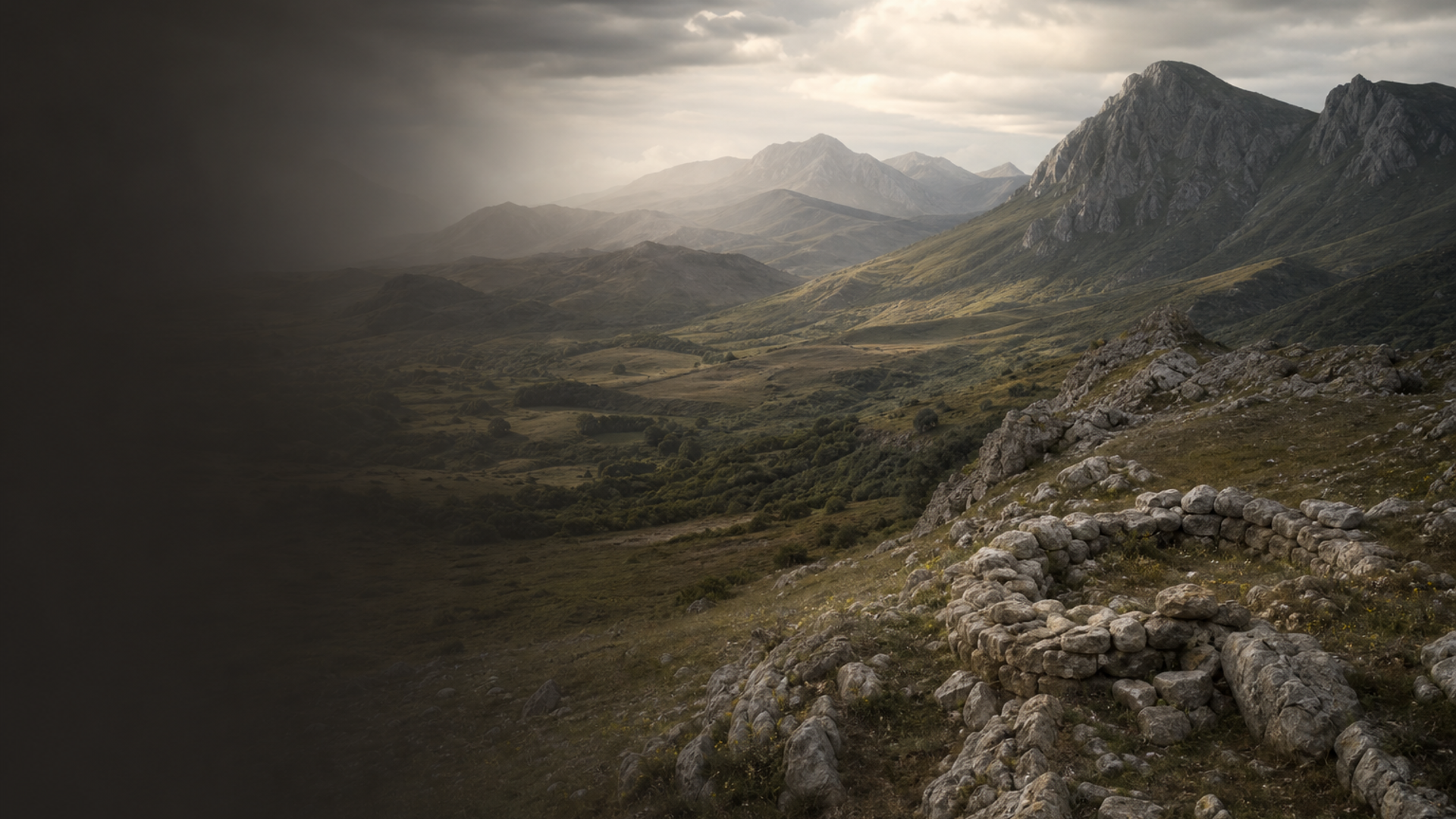
Across eastern and northern Iberia a muted chorus of Late Bronze Age life emerges from stone and bone. Archaeological contexts include monumental burials such as Túmulo Mortorum near Cabanes (Castellón) and cave interments like El Espinoso in Asturias, together with funerary deposits at El Sotillo near Laguardia (Álava). These sites span roughly 1800–813 BCE, a long arc during which regional communities deepened local traditions while exchanging material culture across the peninsula.

Material remains—grave goods, tumulus architecture, and cave deposition—indicate ritualized death practices and a landscape shaped by mobility and connection: coastal plains, interior river valleys, and upland routes. Limited radiocarbon data and stratigraphic sequences place these individuals within broader Late Bronze Age transformations in Iberia, a period of increasing social differentiation and long-distance interaction. Archaeological data indicates continuity with earlier Bronze Age funerary forms alongside innovations in burial display.

Because the sample set is small, interpretations of population movements or sudden demographic change remain tentative. What the material record and DNA together can suggest is a picture of communities rooted in western Iberian traditions but touched by wider Bronze Age networks — a mosaic rather than a single migratory wave.

  • Samples come from Túmulo Mortorum (Cabanes), El Espinoso cave, and El Sotillo (Laguardia)
  • Dates span ~1800–813 BCE, within the Iberian Late Bronze Age
  • Archaeology indicates local funerary traditions with signs of external contact

Daily Life & Society

Fragments of pottery, worked metal, and burial architecture paint an evocative scene of everyday life and social display. In coastal Castellón, tumulus burials suggest families or lineages invested resources in visible monuments, while cave interments in Asturias reflect different ritual choices where natural cavities framed memory and ancestry. El Sotillo burials in Álava occupy a landscape of vine terraces and hillocks that would later be dotted with fortified sites.

Economically, these communities likely combined agriculture, pastoralism, and specialized crafts. Metalworking and exchange of prestige items point to networks reaching across Iberia and toward the western Mediterranean. Social life would have been organized around kin groups and seasonal cycles; grave goods imply social differentiation but not rigid urban hierarchies. Ethnographic analogy and archaeological context together suggest households negotiating identity through burial practice, object exchange, and landscape placement.

Because organic and settlement evidence from these specific sites is limited, reconstructions of diet, household size, and craft specialization rely on regional parallels. Archaeological data indicates a world where daily survival, ritual performance, and long-distance ties were interwoven.

  • Tumulus and cave burials show diverse funerary choices within the same cultural horizon
  • Material culture implies mixed farming, pastoralism, and artisanal exchange

Genetic Profile

DNA recovered from six individuals provides a preliminary genetic snapshot of Late Bronze Age Iberia in eastern and northern Spain. Mitochondrial DNA is dominated by H1j (three individuals), with additional lineages K, J, and H. H1 sublineages are commonly found across western Europe and often interpreted as signals of maternal continuity since the Neolithic and postglacial expansions; in this dataset the prevalence of H1j suggests local maternal persistence in these communities.

Male-line markers are sparse: two Y-chromosome assignments appear as P (one individual) and R (one individual). Y-P is a broad upstream clade that can indicate lineages related to later R and Q branches, while R-labelled results point to paternal diversity consistent with broader European Bronze Age patterns. However, with only two Y profiles and six total samples, these signals are fragile: they may reflect chance sampling rather than population-wide structure.

Genomic comparisons with larger Iberian ancient-DNA datasets could clarify affinities (for example, ties to Atlantic Iberian groups or Mediterranean contacts), but such inferences must await more samples. Limited evidence suggests continuity on the maternal side and mixed paternal inputs, highlighting the value—and limits—of small-sample ancient DNA studies.

  • mtDNA dominated by H1j (3/6), indicating possible maternal continuity
  • Y-DNA diversity limited: P (1) and R (1); small sample size makes conclusions tentative

Legacy & Modern Connections

These individuals are threads in a long Iberian tapestry. The maternal signal (H1j and related H subtypes) links them to a deep western European mitochondrial heritage seen in later populations. Archaeologically, tumuli and cave deposits inform regional traditions that persisted into the Iron Age and shaped local identity.

Genetic ties are suggestive rather than definitive: with only six samples, connections to modern populations or claims about large-scale migrations would be premature. Nonetheless, combining DNA with burial context allows us to picture ancestors whose bodies, objects, and genomes moved across a complex Late Bronze Age landscape — a human bridge between ancient regional worlds and later Iberian populations.

  • Maternal lineages connect to broader western European mtDNA patterns
  • Small sample count (<10) means modern connections remain provisional

مساعد الذكاء الاصطناعي

مساعد الذكاء الاصطناعي من DNA Genics

فتح هذه الميزة
اطرح أسئلة عن ثقافة Iberian Late Bronze Echoes. يمكن للمساعد شرح النتائج الجينية والسياق التاريخي والأدلة الأثرية والصلات بالعصر الحديث.
مثال على تحليل بالذكاء الاصطناعي

لمحة عن ثقافة Iberian Late Bronze Echoes

تساعد عينات الحمض النووي القديم الباحثين على دراسة أنماط الهجرة والعلاقات الجينية بين المجموعات السكانية القديمة.

هذه معاينة للتحليل. يتيح المساعد الكامل استكشاف الموضوعات التالية:

  • التركيب الجيني والأصول
  • أنماط الهجرة والأصول
  • الحياة اليومية والممارسات الثقافية
  • الإرث الجيني المعاصر