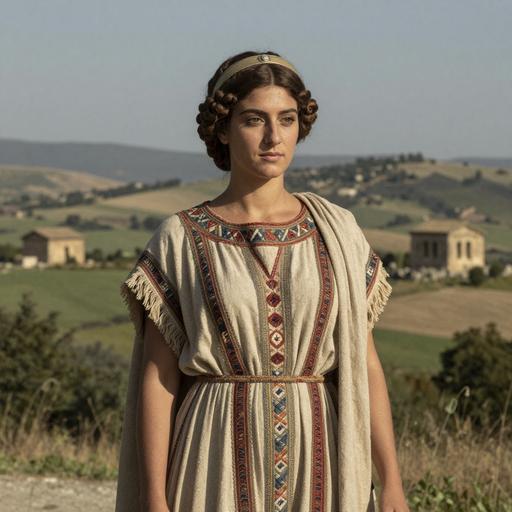
The Etruscan culture, particularly as it was manifested in Tarquinia, represents a fascinating and enigmatic chapter in ancient history. This civilization flourished in what is now central Italy, mainly in the regions of Tuscany, Umbria, and Lazio, before the rise of the Roman Empire. Tarquinia, known to the Etruscans as Tarchna, was one of the most powerful and influential city-states of the Etruscan League, a confederation of twelve cities. It played a pivotal role in the cultural and political life of the Etruscans.
Geography and Urban Design
Tarquinia was strategically positioned on a plateau overlooking the Tyrrhenian Sea, which facilitated trade and communication with other Mediterranean cultures. The city was not only a hub of commerce but also a cultural center, surrounded by fertile lands that supported agriculture and provided resources necessary for its growth.
The urban design of Tarquinia, like other Etruscan cities, likely featured a well-planned layout. The city was known for its impressive walls, made of large blocks of stone, which exemplified Etruscan engineering skills. Public buildings and temples were constructed in an axial alignment, often decorated with elaborate terracotta sculptures and painted elements.
Art and Architecture
Tarquinia is most famed today for its necropolises, which are among the most significant and illuminating remnants of Etruscan culture. The best-known is the Monterozzi Necropolis, where hundreds of tombs have been discovered. These tombs are celebrated for their frescoes, which portray lively scenes of everyday life, banquets, dances, and various ceremonies, providing unique insights into Etruscan society. The vibrant colors and dynamic depictions reflect a society that valued art, music, and the aesthetics of life.
Etruscan architecture in Tarquinia and other cities included the use of the Tuscan column, which would later influence Roman and Renaissance architecture. Their temples, while following Greek models in some respects, were unique with their wooden structures, terra-cotta decorations, and the placement of figures on the rooftop, such as the renowned Apollo of Veii.
Society and Culture
The Etruscans of Tarquinia had a complex society with a distinct culture that was both influenced by and influential on the neighboring cultures, such as the Greeks and Romans. They had their own language, which, although not fully understood today, shows elements borrowed from a variety of sources, underscoring their expansive trade networks.
The social structure of Tarquinia, like other Etruscan cities, was hierarchical. Nobility held considerable power, and society was divided between the aristocracy and the common people, known as the \iluvio." Women in Etruscan society, as depicted in tomb paintings, appeared to enjoy comparatively more freedom and higher status than their Greek or Roman counterparts. They participated in banquets and public life, as shown by the frequent depictions of women alongside men, engaged in festive and ceremonial activities.
Religion and Mythology
Religious practices were a cornerstone of Etruscan culture. The Etruscans were polytheistic, worshipping a pantheon of gods similar to those of the Greeks and Romans, but with their own distinct variations and nuances. Tinia, Uni, and Menrva were among the chief deities worshipped. Divination played a significant role in Etruscan religion; priests, known as haruspices, interpreted the will of the gods through the reading of animal entrails, particularly the liver, or through interpreting lightning and other natural phenomena.
Economy and Trade
The economy of Tarquinia was robust, sustained by agriculture, mining of minerals, and trade. The region was rich in iron, tin, and copper, which were critical for the production of bronze, and these resources enabled the Etruscans to craft metal goods that were highly prized in trade. Tarquinia, with its coastal location, engaged extensively in maritime trade, interacting with the Phoenicians, Greeks, and other cultures across the Mediterranean.
Influence and Legacy
The influence of the Etruscan culture, particularly from cities like Tarquinia, on Rome was profound. Numerous aspects of Roman culture, from religious practices, priesthoods, and architecture to symbols of power such as the fasces, have their origins in Etruscan civilization. Despite their eventual assimilation into the Roman Republic in the late 4th century BCE, the Etruscans left a lasting legacy that helped shape the development of Western civilization.
In conclusion, the Etruscan culture of Tarquinia stands out as a vibrant and dynamic civilization, one that is celebrated for its remarkable achievements in art, religion, and architecture. Although much about the Etruscans remains shrouded in mystery due to the lack of extensive written records, the archaeological traces they left behind provide a tantalizing glimpse into their sophisticated society."