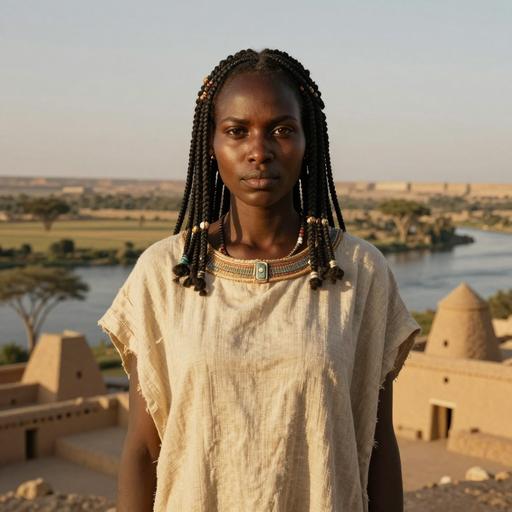
The Kadruka Culture, a significant archaeological culture of prehistoric Nubia, flourished during the Pre-Dynastic period, approximately between 4000 BCE and 3000 BCE. It is principally recognized through findings in the region known today as Sudan, particularly around the area of modern-day Dongola. This culture was a vital part of the broader A-Group culture of Nubia, contemporaneous to and interacting with early Egyptian cultures, like the Badarian and Naqada cultures.
Geographic and Environmental Context
The Kadruka Culture developed in the fertile floodplains of the Nile in Upper Nubia, a region that provided a rich environment for human settlement due to its annual inundation. This region bridged African and Mediterranean worlds, making it a critical conduit for cultural and material exchanges. The seasonal flooding of the Nile allowed for agriculture, which was the backbone of the Kadruka economy, enabling the cultivation of emmer wheat, barley, and various vegetables and fruits.
Social and Political Organization
The Kadruka society appears to have been organized into small, village-based communities. Social structures indicate varying degrees of complexity, possibly reflecting hierarchies based around kinship or clan affiliations. Burials suggest social stratification, with certain individuals afforded more elaborate grave goods, hinting at a society with defined roles and social ranks.
Material Culture
The material culture of the Kadruka people is primarily discerned through pottery, tools, and grave goods. Their pottery is distinctive, characterized by undecorated, utilitarian forms often made from Nile silt, with some items showing a mastery of form and function. Tools crafted from stone, bone, and copper suggest technological adeptness. Copper objects indicate early metallurgical activities, likely influenced by contact with neighboring regions.
Burial Practices
The Kadruka Culture is particularly noted for its burial sites, which offer a wealth of information about their beliefs and societal structures. Cemeteries such as those at Kadruka itself have yielded dozens of burial sites, often arranged in a well-organized manner. These graves vary in their wealth, with some individuals buried with elaborate grave goods including jewelry, pottery, stone implements, and in rare instances, copper items. The orientation and careful positioning of bodies in burial pits reflect complex rituals and an early form of ancestral worship or a belief in an afterlife.
Art and Symbolism
Art in the Kadruka Culture is modest, yet it holds symbolic importance. Artifacts such as decorated pottery, stone beads, and simple figurines illustrate the importance of both functional and decorative art. The motifs often include geometric designs, possibly reflecting broader symbolic meanings or societal structures. Such artifacts provide insight into the aesthetic and ideological dimensions of the Kadruka Culture.
Economy and Trade
Economically, the Kadruka relied heavily on agriculture, supplemented by hunting, fishing, and animal husbandry. Evidence points to the raising of cattle, goats, and sheep, which played a critical role in their subsistence and social systems. The strategic location of Nubia as a corridor between Africa and Egypt facilitated trade, and the Kadruka people participated in exchange networks, trading items such as gold, ivory, and precious stones, which have been found at archaeological sites.
Cultural Interactions
The Kadruka people interacted significantly with neighboring cultures, particularly those in early Egypt. This interaction is evident from the exchange of goods and cultural practices, some of which influenced and, conversely, were influenced by Egyptian developments. These contacts were not only commercial but also led to cultural and technological exchanges, seen in similar pottery styles and burial practices.
Decline and Legacy
The eventual decline of the Kadruka Culture, around 3000 BCE, is attributed to shifts in climatic conditions affecting the Nile's flooding patterns, as well as increasing complexity and centralization in nearby Egyptian polities, which may have absorbed or overshadowed the Kadruka. However, the legacy of the Kadruka Culture is pivotal in understanding the development of complex societies in Nubia and their role in the broader Nile Valley civilization narrative. Their innovations, particularly in agriculture and metallurgy, laid foundational aspects of Nubian culture, preluding the rise of the Kerma Culture and later Nubian kingdoms.
In conclusion, the Kadruka Culture represents a seminal phase in Nubian prehistory, characterized by significant developments in social organization, economy, and interaction with neighboring regions, which collectively contributed to the cultural richness of Nubia in Antiquity.