Menu
Store
Blog
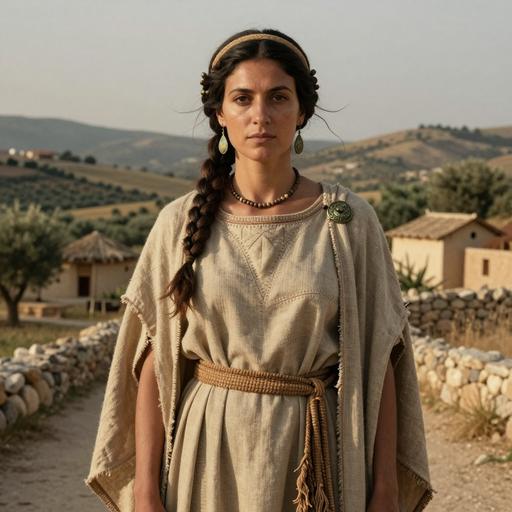
Portrait reconstruction of MYG003
Ancient Individual

A woman buried in Greece in the Bronze Age era

MYG003
1596 BCE - 1438 BCE
Female
Late Bronze Age Mygdalia
Greece
Scroll to begin
Chapter I

Identity

The biological and cultural markers that define this ancient individual

Sample ID

MYG003

Date Range

1596 BCE - 1438 BCE

Biological Sex

Female

mtDNA Haplogroup

Not available

Cultural Period

Late Bronze Age Mygdalia

Chapter II

Place

Where this individual was discovered

Country Greece
Locality Mygdalia (Achaea, Patras region)
Coordinates 38.1869, 21.7765
Chapter III

Time

When this individual lived in the broader context of human history

MYG003 1596 BCE - 1438 BCE
Chapter IV

Story

The narrative of this ancient life

The Late Bronze Age Mygdalia, part of the broader Mycenaean civilization, reflects an intriguing and pivotal era in ancient Greek history. This period, roughly spanning from 1600 to 1100 BCE, is characterized by significant cultural, architectural, and socio-political developments that laid the groundwork for classical Greek culture.

Geographic and Environmental Context

Mygdalia, situated in the Peloponnese region, specifically in the northern area of modern Greece, was an important Mycenaean site strategically located near key trade routes and fertile lands. This location allowed it to flourish as a center of agriculture, trade, and defense. The region's climate, marked by hot, dry summers and mild, wet winters, influenced the agricultural practices and settlement patterns of its inhabitants.

Social and Political Structure

The Mycenaean society was highly stratified, with a king or \wanax" at the top, followed by a noble class of warriors and priests. Mygdalia, like other Mycenaean settlements, was organized around a palatial complex that served as both an administrative and cultural hub. The palaces were not only residences for the elite but also centers for economic distribution and religious activities.

Beneath the ruling class was a large populace of farmers, laborers, and artisans. The Mycenaeans practiced a form of redistributive economy where goods produced by the lower classes were collected and allocated by the palatial administrators. This system was supported by a network of scribes who used Linear B script, one of the earliest forms of written Greek, indicating the importance of record-keeping and bureaucracy in Mycenaean society.

Economy and Trade

Mygdalia's economy was robust, heavily relying on agriculture, livestock, and trade. The fertile lands surrounding the settlement supported the cultivation of grains, olives, and grapes, while the rearing of sheep and goats provided wool and dairy products. The region's natural resources were complemented by sophisticated craftsmanship in ceramics, textiles, and metallurgy.

Trade was vital to Late Bronze Age Mygdalia, with connections extending across the Aegean and into Egypt, Anatolia, and the Near East. Mycenaeans were known for their seafaring prowess, and Mygdalia, being close to the coast, likely participated in this maritime network. Artifacts such as pottery, weapons, and jewelry found at the site evidence these trade relationships and the cultural exchanges that accompanied them.

Religion and Beliefs

Religion played a central role in Mygdalia, with evidence suggesting the worship of both local deities and those shared with the broader Mycenaean world. The society practiced a polytheistic religion, venerating gods and goddesses associated with nature, fertility, and war. Religious ceremonies and offerings were common, and archaeology from similar sites suggests the existence of sanctuaries or shrines within the palatial complex.

Architecture and Art

The architecture of Mygdalia was impressive, reflecting the broader Mycenaean style. The palatial complex was typically fortified with massive walls constructed using the cyclopean technique—large limestone boulders fit together without mortar. Within these walls, buildings were adorned with frescoes, depicting scenes of daily life, religious rituals, and martial prowess.

Art in Mygdalia included detailed pottery, intricately carved jewelry, and weaponry adorned with warlike and religious motifs. This artistic expression was not only functional but symbolic, reflecting the societal values and worldview of the Mycenaean people.

Decline and Legacy

The decline of Mygdalia, like much of the Mycenaean civilization, is attributed to a combination of factors including natural disasters, internal strife, and external pressures such as invasions by the so-called Sea Peoples. By the late 12th century BCE, Mycenaean society had collapsed, leading to a period of reduced cultural activity known as the Greek Dark Ages.

However, the legacy of the Late Bronze Age Mygdalia and Mycenaean civilization endured, influencing the development of Greek language, mythology, and political systems. The stories of Homer, alongside archaeological discoveries, continue to shed light on this fascinating era, highlighting the sophistication and complexity of these ancient people.

In sum, Late Bronze Age Mygdalia was a vibrant and dynamic community, contributing significantly to the cultural tapestry of the ancient Aegean and forming an essential link in the history of Greece."

Chapter V

Context

Other ancient individuals connected to this sample

Sources

References

Scientific publications and genetic data

Scientific Publication

Ancient DNA reveals admixture history and endogamy in the prehistoric Aegean

Authors Skourtanioti E, Ringbauer H, Gnecchi Ruscone GA
Abstract

The Neolithic and Bronze Ages were highly transformative periods for the genetic history of Europe but for the Aegean-a region fundamental to Europe's prehistory-the biological dimensions of cultural transitions have been elucidated only to a limited extent so far. We have analysed newly generated genome-wide data from 102 ancient individuals from Crete, the Greek mainland and the Aegean Islands, spanning from the Neolithic to the Iron Age. We found that the early farmers from Crete shared the same ancestry as other contemporaneous Neolithic Aegeans. In contrast, the end of the Neolithic period and the following Early Bronze Age were marked by 'eastern' gene flow, which was predominantly of Anatolian origin in Crete. Confirming previous findings for additional Central/Eastern European ancestry in the Greek mainland by the Middle Bronze Age, we additionally show that such genetic signatures appeared in Crete gradually from the seventeenth to twelfth centuries BC, a period when the influence of the mainland over the island intensified. Biological and cultural connectedness within the Aegean is also supported by the finding of consanguineous endogamy practiced at high frequencies, unprecedented in the global ancient DNA record. Our results highlight the potential of archaeogenomic approaches in the Aegean for unravelling the interplay of genetic admixture, marital and other cultural practices.

Use code for 40% off Expires Mar 01