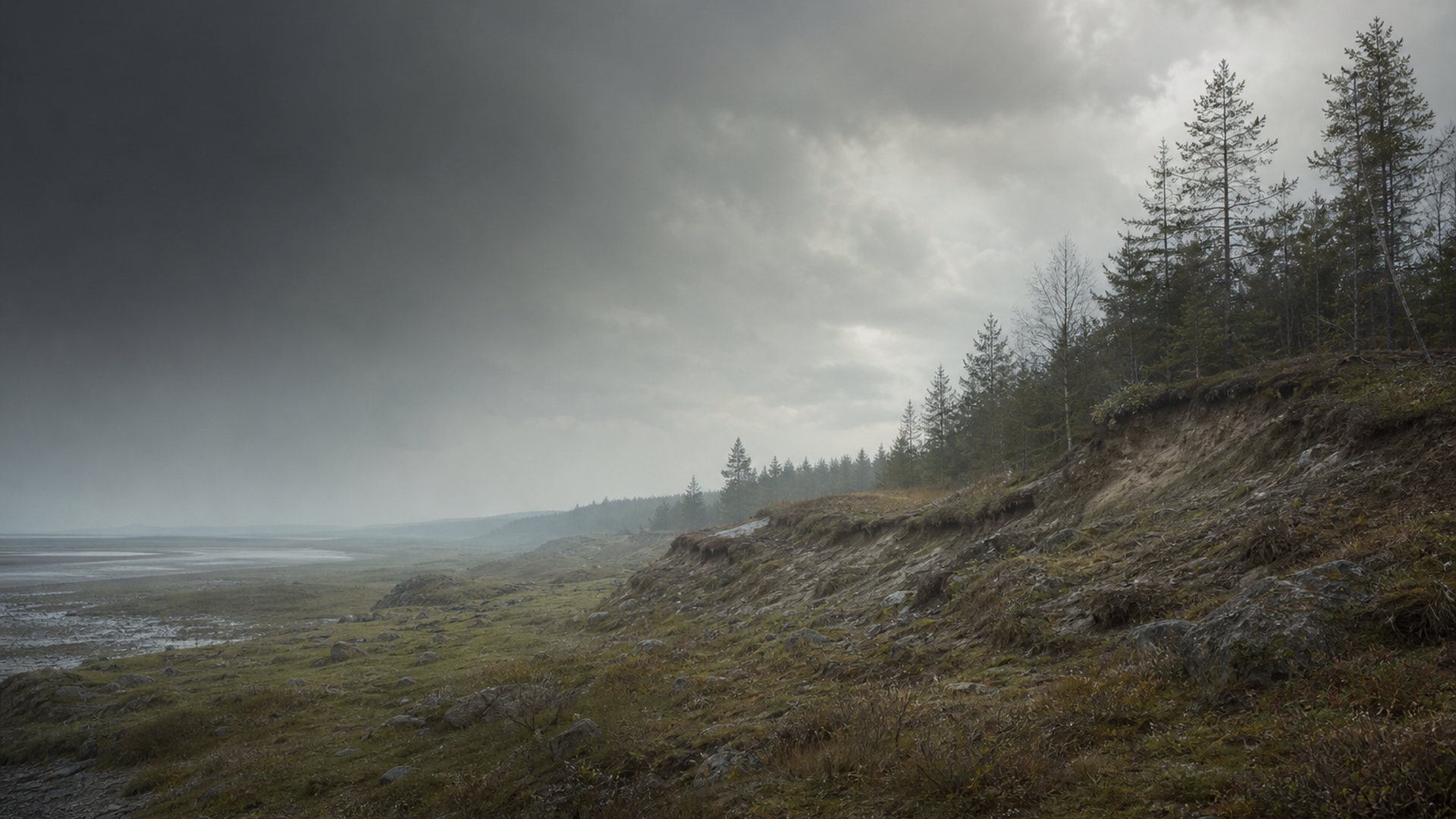
Along the sheltered lakes and peatlands of the Vologda landscape, the people we group as Russia_Minino_Mesolithic left traces between roughly 9140 and 5555 BCE. Archaeological data indicates funerary deposits and habitation debris at two adjacent localities commonly referred to as Minino-1 and Minino-2 (Minino Village, Vologda District). These places occupy a cinematic liminal zone — the meeting of boreal forest and water — where Mesolithic lifeways unfolded in early postglacial Russia.
Material culture recovered from the Minino sites (stone tools, worked bone, and personal ornaments reported in excavation notes) suggests mobile hunter-gatherer groups exploiting rich freshwater and forest resources. Stratigraphy and radiocarbon dates bracket a long span of use, but preservation and sampling are uneven; limited evidence suggests episodic occupation and a cemetery function for parts of the sites. The Minino assemblage fits within the broader Minino Culture horizon recognized in northwestern Russia, yet local variability is clear: ecological setting, burial choices, and artifact styles demonstrate regional adaptation rather than a single uniform tradition.
Genetic sampling from human remains at Minino now provides a new axis for understanding emergence: DNA reveals maternal lineages dominated by haplogroup U and paternal markers including R and P-related lineages, hinting at connections to wider postglacial Eurasian hunter-gatherer networks. These genetic signals, when combined with stratigraphic and artifact evidence, help reconstruct how postglacial communities formed, moved, and maintained regional identities in the sub-arctic fringe. Still, many conclusions remain provisional pending broader sampling and further contextual study.