Aller au contenu principal
Profil culturel

Minino Mesolithic Shores

Mesolithic graves on the Vologda lakeshores where stones, bone and DNA whisper of ancient lives

9140 CE - 5555 BCE
Vologda Oblast, Russia (Minino Village)

Le récit

Archaeological and ancient-DNA evidence from Minino-1 and Minino-2 (Vologda Oblast, Russia; 9140–5555 BCE) reveals a hunter-gatherer community with mtDNA dominated by U lineages and Y-lineages including R and P. Limited sample sizes suggest intriguing links to broader Eurasian hunter-gatherer networks.

Time Period

c. 9140–5555 BCE

Region

Vologda Oblast, Russia (Minino Village)

Common Y-DNA

R, R1a, P1, P, M (counts: R=3,R1a=1,P1=1,P=1,M=1)

Common mtDNA

U (incl. U4, U4a) — 6 of 12 samples

Chronologie

9140 BCE

Earliest dated Minino deposit

Radiocarbon evidence places initial human activity at Minino sites near 9140 BCE, marking early postglacial occupation in Vologda landscapes.

5555 BCE

Latest dated interments

The most recent radiocarbon dates from Minino fall near 5555 BCE, indicating long-term use of the sites through the Mesolithic.

Origins & Emergence

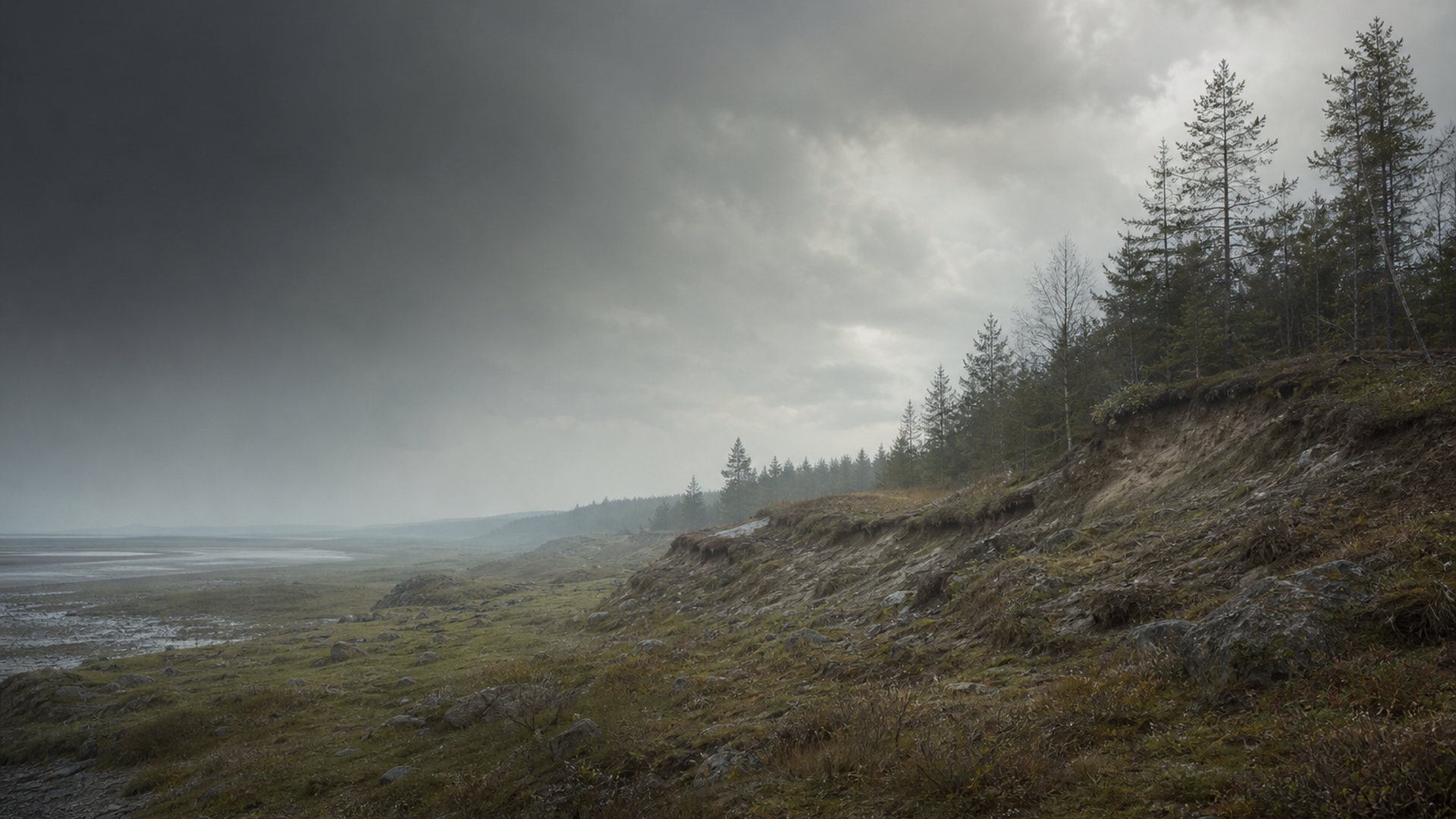
Along the sheltered lakes and peatlands of the Vologda landscape, the people we group as Russia_Minino_Mesolithic left traces between roughly 9140 and 5555 BCE. Archaeological data indicates funerary deposits and habitation debris at two adjacent localities commonly referred to as Minino-1 and Minino-2 (Minino Village, Vologda District). These places occupy a cinematic liminal zone — the meeting of boreal forest and water — where Mesolithic lifeways unfolded in early postglacial Russia.

Material culture recovered from the Minino sites (stone tools, worked bone, and personal ornaments reported in excavation notes) suggests mobile hunter-gatherer groups exploiting rich freshwater and forest resources. Stratigraphy and radiocarbon dates bracket a long span of use, but preservation and sampling are uneven; limited evidence suggests episodic occupation and a cemetery function for parts of the sites. The Minino assemblage fits within the broader Minino Culture horizon recognized in northwestern Russia, yet local variability is clear: ecological setting, burial choices, and artifact styles demonstrate regional adaptation rather than a single uniform tradition.

Genetic sampling from human remains at Minino now provides a new axis for understanding emergence: DNA reveals maternal lineages dominated by haplogroup U and paternal markers including R and P-related lineages, hinting at connections to wider postglacial Eurasian hunter-gatherer networks. These genetic signals, when combined with stratigraphic and artifact evidence, help reconstruct how postglacial communities formed, moved, and maintained regional identities in the sub-arctic fringe. Still, many conclusions remain provisional pending broader sampling and further contextual study.

  • Sites: Minino-1 and Minino-2, Minino Village, Vologda District
  • Dates: c. 9140–5555 BCE (radiocarbon range)
  • Function: occupation and cemetery evidence; regional Minino Culture affiliation

Daily Life & Society

The people of Minino lived in a world of shifting shorelines, birch forest, and rich inland waters. Archaeological data indicates reliance on fishing, waterfowl, and forest game, with tools of stone and bone adapted for netting, spearing, and processing hides and fish. Ornaments and worked bone objects recovered from graves suggest personal display and social signaling were part of funerary practice, and that craft traditions were integrated into daily life.

Burial evidence — where present — implies structured treatment of the dead. Bodies appear to have been interred with selected items rather than exhaustive grave inventories, a pattern common among Mesolithic communities across northern Eurasia. Age and sex distributions from the cemetery contexts suggest multi-generational use, though preservation biases and the modest number of sampled individuals caution against over-interpretation. Seasonal mobility likely organized subsistence and social calendars: families or kin groups may have aggregated at lakeshores in richer seasons and dispersed into forest zones at other times.

Archaeological data indicates flexible social networks rather than tightly bounded, hierarchical communities. Personal adornment and the reuse of certain locales point to long-term attachments to landscape features — a memoryscape of fishing stations, burial grounds, and ritual places that anchored identity through generations.

  • Economy: fishing, waterfowl, forest game; stone and bone tools
  • Social patterns: funerary treatment and personal ornaments indicate social signaling

Genetic Profile

Ancient DNA from 12 individuals recovered at Minino-1 and Minino-2 offers a rare genetic window into northwestern Russian Mesolithic populations. Maternal lineages are dominated by haplogroup U (6 of 12), with U4 and U4a represented — a pattern consistent with many Mesolithic hunter-gatherers across northern and eastern Europe. U-lineages are commonly associated with long-term postglacial forager populations and often appear in contexts described as Eastern Hunter-Gatherers (EHG) or related groups.

Paternal markers in the Minino series include members of haplogroup R (three individuals), one R1a, and representatives assigned to P1 and basal P lineages; there is also one individual labeled M in the Y-DNA summary. The presence of R and P-related Y-haplogroups aligns with broader patterns of Paleolithic–Mesolithic Eurasian diversity, where R and P clades contribute to the ancestry of later European and Asian populations. R1a at this early date is notable but should be treated cautiously: single occurrences in small samples do not by themselves imply widespread R1a dominance.

Genetically, Minino individuals display affinities consistent with northern Eurasian hunter-gatherer ancestry components, but the sample size (n=12) remains modest for population-level claims. Limited evidence suggests continuity with neighboring hunter-gatherer groups and genetic input that later contributed to the formation of Bronze Age and historic populations, yet the precise dynamics of gene flow, local continuity, and external contacts require expanded sampling and higher-resolution analyses. Where sample counts are low or haplogroup representation is singular, conclusions are preliminary.

  • mtDNA dominated by U (incl. U4/U4a) — typical of Mesolithic hunter-gatherers
  • Y-DNA includes R, R1a, P1/P — suggests connections to broader Eurasian paternal lineages

Legacy & Modern Connections

The Minino sites form part of the deep historical substratum of northwestern Russia. Genetic markers found at Minino — maternal U lineages and paternal R/P variants — appear in later populations across northern Eurasia, suggesting strands of continuity amid episodes of migration and cultural change. Archaeological continuity in landscape use, combined with genetic signals, implies that elements of Mesolithic lifeways contributed to local demographic and cultural foundations.

However, linking Minino directly to any single modern group would be an overreach. Genetic continuity is complex: later population movements, Neolithic and Bronze Age transformations, and recent historical processes all reshaped ancestry in the region. Still, Minino remains an evocative reference point — a place where bone, stone and DNA together illuminate the longue durée of human life by the lakeshores. As ancient DNA sampling increases in northwestern Russia, the tentative connections suggested by Minino will be tested and refined.

  • Genetic threads from Minino feed into broader northern Eurasian ancestries
  • Direct links to modern populations are tentative until larger datasets are available

Assistant IA

Assistant IA par DNAGENICS

Débloquer cette fonction
Posez des questions sur la culture Minino Mesolithic Shores. L'assistant IA peut expliquer les résultats génétiques, le contexte historique, les preuves archéologiques et les liens génétiques avec les populations actuelles, dans les limites de l'interprétation.
Exemple d'analyse IA

La culture Minino Mesolithic Shores représente un chapitre fascinant de l'histoire humaine…

L'analyse génétique met en évidence des similarités avec des populations antérieures et des signes d'adaptations propres. Les échantillons d'ADN ancien éclairent les schémas migratoires et les liens entre populations, avec des limites qui dépendent de l'étude et du contexte archéologique.

Il s'agit d'un aperçu de l'analyse IA. Accédez à l'assistant complet pour explorer :

  • Composition et similarité génétique
  • Schémas migratoires et origines
  • Vie quotidienne et pratiques culturelles
  • Contexte génétique actuel